Friday, January 27, 2012

The Ordinary Mysteries of Life

Spoiler alert: If you have not watched The Descendents, and are planning to do so, this blog post gives the game away. And this post will make much more sense if you have seen that movie.

Alain de Botton believes that secular museums get it wrong when they exhibit religious art. For the people who created these works, and the audiences they had in mind, these were more than works of art. By arranging their exhibits purely in terms of their place in the history of the art, the museums lose the opportunity to communicate the real meaning of these works
Christianity, by contrast, never leaves us in any doubt about what art is for: it is a medium to teach us how to live, what to love and what to be afraid of. Such art is extremely simple at the level of its purpose, however complex and subtle it is at the level of its execution. Christian art amounts to a range of geniuses saying such incredibly basic but extremely vital things as: "Look at that picture of Mary if you want to remember what tenderness is like"; "Look at that painting of the cross if you want a lesson in courage"; "Look at that Last Supper to train yourself not to be a coward and a liar".
When I first saw it, I thought the recent movie The Descendents is a fine example of such art, which shows us how to live. It is a classic morality play. The main character is Matt King, an everyman hero, a man who learns after his wife's death that she had been betraying him, and struggles to protect his children and bring them back together into a family. We watch him being challenged repeatedly, and see him respond with modest grace. There are many other characters, but King is in every single scene, and the story is about him and how he restores peace to his life. I felt for him throughout the movie, and wanted him to find happiness.

However, is he a good man? Would Alain consider his behavior a good model for others? King's wife might have disagreed; after all, she cheated on him and was planning to ask him for a divorce. His father in law doesn't seem to hold him in any high regard. At least one of his friends blames him for his wife's straying. When he learns that his wife was sleeping with another man, his response is to seek out that man, to give him a chance to see her one last time before her death. Who does that? A gentle man, or a weak one?

He is instinctively conservative. Born into great wealth, he chose to do nothing with it, and lives on what he earns as a lawyer. He did not buy his wife the boat she craved, but there is no sign that he intends to use his money at all, whether for great purposes or trivial. He is the sole trustee of a vast family estate on Hawaii, and has to decide what to do with it before the trust expires in seven years. The laws against perpetuities are intended to protect the living from the whims of the dead: property which has been inherited in trust should be employed as the living wish to use it. However, there is no sign that he feels burdened: all he wants is for that land to remain as it is, another thing which he does not wish to use or change.

He was unable to handle the two women in his life. He took refuge in his work to avoid his wife, and sent his daughter away to an institute for troubled girls. When his wife dies, and he learns that she had been planning to leave him, he seems to spend very little time wondering why. The movie ends with him and his two daughters on a couch, watching a documentary on TV.

So, is The Descendents the story of a fine, modest man who responds with charity and generosity to the pain he has to suffer? Or is it the tale of an emotionally cramped, over-cautious man, whose self-isolation brings disaster on himself and his family, and who seems to have learnt nothing from the experience? Dear Reader, you will not be surprised to know that I believe the answer to my question is "both, and neither". Even if it is the latter, we have to empathize. This man is suffering. He may not be an actively good man, but he means no harm, and is certainly not an actively bad one. If he has a fault, it is that he is passive. Certainly I appreciate the pleasures of a quiet life. Without a clue to his motivations, his behavior is hopelessly ambiguous. A good man, and a weak one, can be hard to tell apart: the movie makes that point very well.

The director has achieved this effect artfully, by what he has left out. There are no clues which can help us resolve the uncertainty about his character. There are no flashbacks. The main character does not confide his thoughts to a diary; he does not have an extended conversation with a friend of family member; he does not confess to a priest. There are no soliloquies: there is only one episode where the director allows King to address the audience directly. We observe his behavior, and infer his character, as we do with most of the people we know in the real world. This is what I like best about this movie: the director uses the resources of the cinema to show us everything, and yet leave us wondering who it was we were watching all along. In the end, King remains a mystery. The director is not writing an abstract treatise on how to live. He is showing us the ordinary miseries of a particular man's life, and won't let us draw any lessons from it.

Alain de Botton may be correct when he says that the original intent of Christian art was propaganda: to shows how to live a Christian life. He may also be correct that this art served to console and guide the viewer, and that it could still serve that purpose for some of us. I doubt we need reassurance and help any less than those who lived five hundred years ago. However, I wonder if their art is what we can draw any consolation from that art , if we no longer believe what those who created those works believed. They lived in a hierarchical, ordered world with God everywhere, where man's duty was ordained by the place assigned to him by heaven.

Many of us live in a world without any signs to guide us. When Alain De Botton asks us to look to the great masters for lessons in how to live, he is reducing the possible range of reactions we can have to that art: he assumes that there is only one possible response. When we look at St Catherine, we are required to view it as a lesson in how to face death fearlessly, but why should we see it as that? And if we do, can we not seek out other teachers from whom we can learn the same lesson?

Consider the story of Petronius. When the "arbiter of elegance" at the court of Nero fell under Imperial suspicion, he committed suicide.
He did not fling away his life with precipitate haste, but having made an incision in his veins and then, according to his humor, bound them up, he again opened them, while he conversed with his friends, but not in a serious strain or on topics that might win for him the glory of courage. And he listened to them as they repeated, not thoughts on the immortality of the soul or on the theories of philosophers, but light poetry and playful verses. To some of his slaves he gave liberal presents, a flogging to others. He dined and indulged himself in sleep, that death, though forced on him, might have a natural appearance.
To him, his death was as inconsequential as his life was frivolous. He was fearless in death, but his manner of dying was as different as possible from that of the Christian martyrs. Which is better at helping us find meaning in life and courage in the face of death? For some of us secular modernists, both are too alien to be of any use at all. We are no longer able to seek lessons from art because, for us, art is another ambiguous element of an already illegible world.

Tuesday, January 24, 2012

How do you know you have a brain?

RJ Lipton posts at Godel's Lost Letter about the use of slime molds for computation. They are
no more than a bag of amoebae encased in a thin slime sheath, yet they manage to have various behaviors that are equal to those of animals who possess muscles and nerves with ganglia — that is, simple brains.
Scientists have been using slime molds to model various situations, and have been able to demonstrate that they come up with interesting "answers"
One of the driving forces behind the new computational interest in slime molds is a seminal experiment performed by Atsushi Tero of Hokkaido University. He grew the mold Physarum polycephalum on a standard dish, but placed both attractors and obstacles on the dish. The attractors were food—oat flakes if you must know—and the obstacles were bright light. The mold is attracted to food—who is not?—but is camera shy and tries to avoid bright light. Tero for fun arranged the attractors and obstacles to model the major centers in the Greater Tokyo Area. The mold initially filled the whole dish, but over time evolved into a network that connected the centers in a way that closely approximated the actual Tokyo rail system.
No single cell is "aware" of anything except its immediate environment, and yet the creature quickly converges on a particular configuration. Of course, life is full of such phenomena. A single-celled embryo in a reasonably hospitable environment quickly arrives at a "solution": a functioning adult. An adult body which manages to continue to function through all the insults life throws at it.

Or our brains. Like every other part of our bodies, it is descended from the original embryo. At no point is any neuron aware of anything more than its immediate surroundings, and yet the whole organ is capable of rich behavior. Even more impressive is how robust it (and the human body in general) is. The various parts of our bodies vary significantly from one person to another, and yet they are able to work together, to the point where people can have their viscera on the wrong side of the body, and never come to know it.

Bradley Voytek over at Oscillatory Thoughts blogged a fantastic, mind-blowing post about the incredible resilience of the human brain: "Why we don't need a brain". Most of the rest of this post simply plagiarizes what he has written.

He describes a case reported by Professor John Lorber, and includes the CT scan published with the study.
There's a young student at this university... who has an IQ of 126, has gained a first-class honors degree in mathematics, and is socially completely normal. And yet the boy has virtually no brain.
To be more exact
To put this in perspective, at its largest parts, this boy's brain was still only half the size of a normal brain. Total volume appears to be well below that.
Voytek rejects Lorber's theory that this indicates enormous redundancy in the human brain. The question he asks is simple: given what we know about the terrible consequences suffered by victims of stroke, how could this boy be so normal in all important respects?

He then describes another case ( "How much brain is really necessary" ) published by Distelmaier: a young girl born with hydrocephalus that caused a severely underdeveloped brain. Surgeons treated the hydrocephalus with a shunt to remove fluid, and the result was that, at 20 months, her cerebral and cerebellar hemispheres had managed to do quite a bit of catching up and, as he puts it:
At 34 months the authors performed a followup neurodevelopmental examination of the girl. Although she had some developmental delay (particularly motor problems), she appeared to be socially and cognitively well off, especially considering where she started!
He ends with a paper by Desmurget, Bonnetblanc, and Duffau ( "Contrasting acute and slow-growing lesions: a new door to brain plasticity" )
Desmurget and pals were basically trying to reconcile some strange clinical observations: if a patient has a stroke to an "eloquent" part of the brain (basically neurosurgeon-speak for language or motor cortex), there are clear behavioral deficits. That is, damage to eloquent cortex causes speech problems or paralysis/hemiparesis.
Paradoxically, however, patients with low-grade gliomas (a type of brain cancer), could undergo surgical removal of large parts of brain tissue in the eloquent cortex without any noticeable behavioral consequences.
The reason appears to be that a stroke is practically instantaneous. A glioma grows over the years, and can become enormous. In the meantime, however, the brain adapts, other parts of the brain take over from the damaged areas, and when the surgeons come along and excise the growth, the consequences for the person are relatively minor. You can recover from enormous damage to your brain, provided it happens slowly enough.

I obviously find this simply wonderful. How, as some brain tissue dies off, other parts take over and ensure that the organism is able to function. This is a kind of computational problem, similar to that of the slime molds, and I guess the organ solves it by using feedback from the external world to train itself. I assume something similar happens during the "critical period" for vision.

This is all computation of a kind. However, this is obviously very different from how our computers work today, though the Internet, and other more robust networks of computers do show similar capabilities. Fascinating, but I don't know enough about the subject. Time to get a copy of Lewis Wolpert?

Saturday, January 21, 2012

Role Playing

I recently came across this blog post by Eli Dourado, in which he quotes the book Finite and Infinite Games by James Carse. I will quote the whole passage, because it is necessary to read it all, to understand the point it is making.
Seriousness is always related to roles, or abstractions. We are likely to be more serious with police officers when we find them uniformed and performing their mandated roles than when we find them in the process of changing into their uniforms. Seriousness always has to do with an established script, an ordering of affairs completed somewhere outside the range of our influence. We are playful when we engage others at the level of choice, when there is no telling in advance where our relationship with them will come out—when, in fact, no one has an outcome to be imposed on the relationship, apart from the decision to continue it.

To be playful is not to be trivial or frivolous, or to act as though nothing of consequence will happen. On the contrary, when we are playful with each other we relate as free persons, and the relationship is open to surprise; everything that happens is of consequence. It is, in fact, seriousness that closes itself to consequence, for seriousness is a dread of the unpredictable outcome of open possibility. To be serious is to press for a specified conclusion. To be playful is to allow for possibility whatever the cost to oneself.
I thought of this passage the next day, as I was being inspected by security before I entered the office building: that sense of playing a role according to an unwritten script was suddenly very palpable. Isn't this the point of all ritual, whether in a courtroom or a church? To exclude the possibility of surprise?

Friday, January 20, 2012

The story SOPA

The big story in recent days has been the Stop Online Piracy Act (SOPA) and the Protect IP Act (PIPA), and how various important sites on the Internet have shut down to protest these bills. I'm strongly opposed to these bills, but I've not been following the story very closely because I find it implausible that such radical legislation will pass, when so many powerful corporations are arrayed against it.

Of the little I've read, three pieces have made an impression. None of these are particularly original, but two of them are well expressed, and thought provoking. The third is not.

Over at The Leisure of the Theory Class, Eran Shmaya writes
But what about protection of “intellectual property” ? Clearly this is not a necessary condition for a civil society. It’s also not a necessary condition for production of knowledge and culture. We had Plato and Archimedes and Cicero and Shakespeare and Newton before it occurred to anybody that Bob has to get Alice’s permission to reproduce a code that Alice wrote.
This seems correct to me. As the Economists would say, knowledge is non-rivalous, even if it is (with the help of the law!) excludable. Jefferson put it much more elegantly when he wrote to McPherson.
He who receives an idea from me, receives instruction himself without lessening mine; as he who lights his taper at mine, receives light without darkening me.
We want to reward people who create new knowledge and art, and to encourage them in their work. We create this artificial form of property so that those who use their work repay them some part of the value they receive.

And Eran is right when he writes that
I realize some people lose their job because of online piracy. Also, Some people lost their jobs following the introduction of ATMs. But we view ATMs as positive development since it made a certain service way cheaper. My guess is that the same is true about intellectual piracy — it makes distribution of culture and knowledge cheaper and therefore makes also the production of culture and knowledge cheaper. True, some companies, particularly the established ones, are damaged by intellectual theft. Other companies, particularly startups, benefit.
Intellectual property, like other forms of property, is a form of protection offered by society because its benefits outweigh the costs. All forms of property are artifical, of course. If the same piece of land could be used by any number of people, each in their own way without any causing any inconvenience to others who wish to use the same piece of land, we wouldn't allow anyone to own land either.

Eli Dourado blogs
There are a positive number of murders each year. If we put more resources into investigating and prosecuting murders, there would be fewer murders. Nevertheless, it is not at all clear that we are spending too little on murder. The optimal number of murders is positive, not zero. The best policy with respect to murder is to try to maximize the net benefits of the policy, not to minimize murders.
OK, with you so far.
Suppose a new technology were introduced that made it easy to get away with murder (e.g., David Friedman’s plan for Murder Incorporated). This technology makes it extremely costly, though, say, not impossible, to stop murders from occurring. What happens to the optimal amount of murder enforcement? The amount that must be spent to deter each murder has gone up, so the price of deterrence has gone up. Consequently, society should aim to deter fewer murders. Under some extreme circumstances, we might even be better off if murder were legalized (and if people were advised to just be more polite to each other).

Similarly, whatever your prior belief about copyright enforcement, the Internet has made it easier to get away with copyright infringement. The amount that must be spent to deter each instance of copyright infringement has increased. Consequently, society should aim to deter fewer instances of copyright infringement, not more instances as SOPA supporters advocate.
This seems logical to me, and the extension to copyright law follows immediately. It is much more costly to enforce copyright law in the age of the Internet, which means that we should try less, not more.

However, the commentators on his blog had a good point to make: this is true only if the benefits of deterring murder (or copyright violation) are constant. If the costs go up, and the benefits go up too, it is no longer clear what we should do.

As Zac Gochenour wrote in the comments
Put another way, to use your murder example, the cost of a small amount of murders is relatively low as long as people can more or less go about their lives normally without living in constant fear of murder. In the extreme, if murder became cheap and rampant, the survival of the species might literally depend on ending murder, in which case we might dedicate a lot of resources to stop it. Just think of the “DC Sniper” from a few years back: people were afraid to even leave the house, so the social cost of murder had risen drastically (so it made more sense to stop it).
But then
Enough devil’s advocacy. I would respond thusly: copyright infringement is getting cheaper (information wants to be free) at the same time that the benefits of a larger public domain are getting greater (see Benkler’s “The Wealth of Networks”) and it seems clear that if not now, then soon, the net benefit of even a token amount of copyright protection will be negative. So not only has the cost of enforcement gone up (meaning we should invest less in enforcement as you describe) but the benefit of enforcement has actually declined sharply as well.
Greg Mankiw's blog post struck me for different reasons. He is the most distinguished (or at least the most famous) of these three writers. His post is also the most badly thought out, and poorly argued.
The anti-SOPA crowd argues that this is a matter of basic liberty. But it's not. In a free society, you don't have the freedom to steal your neighbor's property. And that should include intellectual property. Moreover, it is the function of the state to enforce those rights. We don't leave it up to civil litigation to protect property rights (although that is part of the solution). We give the state substantial powers to stop theft. Just as owners of tangible personal property have good cause to call for a police force and a system of criminal courts, owners of intellectual property have good cause to ask the state to stop those who would infringe on their rights.
For this level of analysis, you don't need a Harvard Economics professor who used to chair the Council of Economic Advisors. Your garden variety drunken uncle can do as well.

I wonder if the next paragraph from his post explains why he holds this view better than any Economic theory of public goods could
This is an important economic issue for the United States. We are large producers of intellectual property: movies, novels, software, video games, TV shows, and even economics textbooks.
Emphasis added. He ends his piece by firing a salvo of platitides at the reader
Believers in free enterprise, property rights, and economic liberty should be among the most vocal advocates of laws to stop intellectual piracy.
I have no reason to quote him here, except that I found his piece startling crude and pointless, and it seems I am not the only one to feel this way. Over on Twitter, it seems both Matt Yglesias and Modelled Behavior agree.

Tuesday, January 17, 2012

Money

Pretentious title notwithstanding, John Medaille has written a very nice article about David Graeber's new book Debt: the first 5000 years.

I loved this story he tells
On his 21st birthday, the nature writer Francis Thompson was presented by his father with a bill for all the expenses of his upbringing including the costs of his birth and delivery. Francis paid the bill, but he never spoke to his father again.
As Medaille writes
There is no doubt that the father was correct to point out to his son the obligation that he had, but in quantifying that obligation, he converted it into a debt, for that is the difference between an obligation and a debt: an obligation becomes a debt when you can put a number on it. “I owe you one” is an obligation; “I owe somebody $10″ is a debt. Obligations bind people together even after they have been “paid.” But debts bind us only for as long as the debt exists. The relationship dies on payment of the debt. We might say that obligations bind us together, while debts drive us apart. By quantifying the obligation, Thompson’s father offered him the opportunity to dissolve it, to discharge it, and in doing so to end their relationship; his son took the offer and was no longer his son.
The story he summarizes is truly extraordinary: from the gift economies of the ancient world through the Shekels of Mesopotamia, through Rome and Medieval England, to today's money.

The whole story of how England stopped using tally sticks was completely new to me.
Tally sticks circulated in England for 500 years. It is worth noting that when the Bank of England was founded, in 1694, one quarter of its capital was in the form of tally sticks. But the bankers wished to monopolize the creation of money, and immediately set out on a long campaign to get the tally sticks outlawed. And they got their wish when the Liberal party came to power in 1832. One of their first acts was to fulfill the agenda of the Bank of England. All of the tally sticks were gathered together and burned in a stove in the House of Lords. However, the fire got out of hand and burned down the Houses of Parliament.
Money involves debt. Debt indeed predates money, and it is obvious that some debts will never be paid. He ends his article with a plea for amnesty, what I gather would be something like the "jubilees" of the ancient Hebrews, but he doesn't explain how he would do this.

Medaille may not be aware that this is essentially what many economists have been arguing for. Inflation is exactly that: a way to reduce the real burden of debt, transferring wealth from the creditors to debtors.

It may seem like a fraud, a kind of theft, but if the debts were incurred with a certain expectation of inflation (which seems plausible), then slow growth and unexpectedly low inflation is only a windfall gain for creditors, and higher inflation merely claws some of those gains back.

To me, that is a secondary point. Graeber's book challenges many of the assumptions we carry around with us. A subject like anthropology provides a valuable service when it looks at how we live today, and says to us "it need not be like this, you know. Other societies, at other times and in other places, have done things differently. We can tell you how some of them worked."

Why did I write this post?

Over at the Modeled Behavior blog, Karl Smith has written a lovely little post on causation.

As he puts it
Suppose you had figured out actual causation. How would you know?
I was reminded of a (Five year!) old post of mine, quoting a story I read about causation in Dennett's book "Freedom evolves".

Causation is a subtle concept. Experiments don't prove causation (whatever that is) except in the simplest case. We are far too confident that we know what we are talking about.

Saturday, January 14, 2012

Deresiewicz on Leadership

Two fine bloggers have recently quoted William Deresiewicz's article on leadership: John D Cook and Vivek Haldar. I was deeply moved when I first read this article. I have now read it again, and I still think it is a wonderful little essay, an excellent work of inspirational rhetoric. On its substance, though, my feelings are more mixed.

I still agree with much of what he says.

I agree that many of those who are accepted into elite schools are actually meek conformists, who were selected precisely because they jumped through hoops to please their teachers and seniors.

However, I don't think those who did not get into those schools are any better at independent thinking: maybe they simply lacked self discipline.

I agree when he writes that
excellence isn’t usually what gets you up the greasy pole. What gets you up is a talent for maneuvering. Kissing up to the people above you, kicking down to the people below you.
or that
I find for myself that my first thought is never my best thought. My first thought is always someone else’s; it’s always what I’ve already heard about the subject, always the conventional wisdom. It’s only by concentrating, sticking to the question, being patient, letting all the parts of my mind come into play, that I arrive at an original idea.
This blog post is an example of that. Maybe I will have a third thought soon, and repudiate what I am now writing. After all, the mind cannot foresee its own future.

I agree with him that leadership requires independent thought. I would add that leadership is for those who have grown accustomed to solitude, who won't crumble at the first sign of being isolated. I also agree that this requires long preparation: a battlefield is no place for philosophy. I agree that we discover what we believe by saying it out loud, to friends who we can trust.

However, Deresiewicz never considers some important questions: What is this leadership? Why do we need it? Why are so many large organizations so inhospitable to independent thought?

There can be good reasons why he wouldn't discuss these questions. He is speaking to young officers, many of whom will soon be going off to war. These deflating questions are hardly what they need as they begin their careers.

This passage, though, makes me wonder if he has ever asked these questions even to himself:
We have a crisis of leadership in America because our overwhelming power and wealth, earned under earlier generations of leaders, made us complacent, and for too long we have been training leaders who only know how to keep the routine going. Who can answer questions, but don’t know how to ask them.
It seems to me that Deresiewicz himself is the prisoner of an ideology of leadership, which attributes America's "power and wealth" to leadership. This is pernicious nonsense, which encourages and delusions of grandeur among the powerful.

Leadership is not something you do alone. It is requires other people to allow you to lead. At times of great stress and uncertainty, people who seem to know what to do will attract followers. Independent thinking becomes necessary. When times are good, independent thinking needs to justify itself: the safest thing to do is what has always been done.

Leadership is not only a matter of your traits or behavior. The same behavior may be considered arrogant and obstinate, or decisive and strong-willed, depending on the context. A person may be said to be delusional or visionary, depending on the situation and, above all, on the outcome.

As Joseph Nye notes in this article about charisma, the classic example is Winston Churchill
Followers are more likely to attribute charisma to leaders when they feel a strong need for change, often in the context of a personal, organizational, or social crisis. For example, the British public did not regard Winston Churchill as a charismatic leader in 1939, but, a year later, his vision, confidence, and communication skills gave him charisma, given Britons’ anxiety after the fall of France and the Dunkirk evacuation. And then, in 1945, after the public’s focus had turned from winning the war to constructing a welfare state, Churchill was voted out of office.
He also points out that
Similarly, the business press has described many a CEO as “charismatic” when things are going well, only to withdraw the label when profits fall.
The same man suddenly appears deluded and out of touch. Churchill could have testified that it also works in reverse: during the years before 1939, he was considered obsessive and paranoid for constantly warning of the danger posed by Hitler. Today, we consider him a prophet: that is not what his contemporaries called him.

This is not to say that charisma doesn't exist, or that there are no born leaders. We are attracted by confident people who seem to be in control of the situation. We often lack confidence in our own views, and happily drown our own doubts when faced with the certainties of others.

As Nye writes
Non-verbal signals account for a major part of human communications, and simple experiments have shown that some people communicate non-verbally better than others. For example, a Princeton University study found that when people were shown images of two candidates in unfamiliar elections, they could predict the winners seven times out of ten.
No doubt the leading candidate gains in confidence, and that confidence makes him seem even more dominant, even more assured of victory over his increasingly demoralized opponent, and the voters can probably detect this in their body language, setting up a self-fulfilling expectations of success and failure.

Dan Kahneman describes how he discovered the "illusion of validity" while trying to identify future leaders for the Israeli Army
The stars we saw on the obstacle field were most likely accidental flickers, in which a coincidence of random events — like who was near the wall — largely determined who became a leader. Other events — some of them also random — would determine later success in training and combat.

You may be surprised by our failure: it is natural to expect the same leadership ability to manifest itself in various situations. But the exaggerated expectation of consistency is a common error.
I think Deresiewicz's article is valuable, but not because it shows us how to become leaders. The behaviors he describes may be necessary for leadership, but are certainly not sufficient. Leadership is not necessarily a good thing, and can even be harmful. The worship of leadership can subvert respect for due process and the rights of the little people who come in the way of the visions of great men.

The article is valuable as a reminder of virtues which are worth practicing for their own sake.

Wednesday, January 11, 2012

The Red Queen is dead

When I was in my first year of grad school, I read both Richard Dawkins' The Selfish Gene, and Matt Ridley's The Red Queen. They changed the way I saw the world. Back in high school, I had read Milton Friedman's Free to Choose, and it had had a similar effect on my thinking.

As I've grown older, and learned more, I've come to think of these books as perfect examples of the damage a beautiful model can cause to a young, impressionable mind.

The Red Queen applies crystalline logic to the War of the Sexes: pregnancy and child-rearing are expensive and risky for females, but sex is cheap for males. One man can make every woman in the world pregnant, but a woman can have no more than a dozen or so children in her lifetime. The canonical example is Genghis Khan: by some accounts, practically everyone alive today is descended from him. Given these facts, it makes evolutionary sense for men to be promiscuous, but women should be chaste.

The logic is flawless, but how about the premises?

Genghis Khan lived late in our species history. Go back a few thousand years, and practically all of us were hunter-gatherers living in small bands. Any man in these bands who tried to monopolize the women would in short order find a scorpion waiting in his sleeping bag. He would need the help of other men to get anything at all done. A very "successful" man would probably still have many more children than even the most fecund woman, but it is unlikely that men and women differed greatly in the number of children they had. Women could always band together to put any man in his place.

Greg Downey at the PLoS blog Neuroanthropology has published the first of three blog posts about what he calls the "long, slow, sexual revolution". I was very glad to read this, and not only because of the very NSFW video included with the post, nor simply because it introduced me to the delectable Julia Zimero.

Human reality is complicated, and our picture of it needs to be a little messy, a little contingent, too. I no longer think that any aspect of the real world can be understood without data: Nature is far too subtle for our unaided imagination. Einstein would never have thought of Special Relativity without Michelson and Morley. I don't know enough about this topic, but I am looking forward to breaking the ice which has locked my thinking in place for far too long.

Tuesday, January 10, 2012

Educating the senses

Resuming the art motif, I liked this sentence from an interview with a musician.
"Art is stuff that teaches you to use your senses"
A very good interview. I don't know if I would consider Laurie Anderson's work to be art, but it makes me uncomfortable, and that must be good.

HT: The Browser

Old books

William Deresiewicz's speech on Solitude and Leadership, quoted in Vivek Haldar's blog
"...most books are old. This is not a disadvantage: this is precisely what makes them valuable. They stand against the conventional wisdom of today simply because they’re not from today. Even if they merely reflect the conventional wisdom of their own day, they say something different from what you hear all the time."
TS Eliot, quoted by John D Cook in a post on his great blog
"There never was a time when those that read at all, read so many books by living authors rather than books by dead authors. Therefore there was never a time so completely parochial, so completely shut off from the past."

Saturday, January 07, 2012

Errol Morris

I loved The Fog of War.

Jad Adumrad and Paul Kedrosky tweet about a delightful little film by Errol Morris: the Umbrella Man.

Nigel Warbuton tweets about this little video in which Errol Morris talks about how photographs relate to the real world.


Iran in The Atlantic


A great collection of photos from Iran in the Atlantic, but this one of archer Shiva Mafakheri is stunning.

Picasso: the new Norman Rockwell?

In my previous post, I compared Norman Rockwell unfavorably to Picasso, Matisse, and Pollock. It is possible to see most Rockwell paintings without really noticing them. They are what we still expect a painting to be. However, the works of Picasso, Matisse, and Pollock still take us by some surprise. A painting is never merely "realistic": the artist must choose what to include, and what to exclude, what to emphasize, and what to downplay. In the case of these artists, it is even more clear that this is what they have done. They do not even pretend to be trying to replicate reality as we see it. Thus, they reinvent the art, and make us pay attention.

In this post, Chris Dillow argues that
the dominant cultural form of late capitalism is pastiche - the soulless imitation of past achievements, devoid of conviction
He uses a musical performance in a "music contest" to illustrate this.

There are good commercial reason for this phenomenon. In this tweet, John D. Cook quotes Stanislav Datskovskiy
Employers much prefer that workers be fungible, rather than maximally productive.
A machine for manufacturing musical stars puts performers on notice that there is an endless supply of singers who could replace them, and so keeps them in their places. Recycling old favorites is cheap and safe: the audience knows what to expect, and don't need to apply themselves to decide whether they like what they are listening to. The supply of music to perform is vastly greater than if the performers had to regularly come up with new works to perform: the writers and composers are shown their places.

However, while I adore Dillow's crabby blogging, I fear this post is not up to his usual standards of rigor. He is right when he says that
On the one hand, growth and profitability requires that culture be commodified. For capitalists, it is useless if we merely contemplate past artistic accomplishments. We must instead buy new ones.
He is simply wrong when he says that
On the other hand, though, capitalism is unable or unwilling to innovate, as the benefits of such innovation cannot be reliably captured**.
Capitalism is capacious enough to contain many contradictions. There are markets for reality shows and televised music contests, but there are also markets for original music. Anthologies are published, but so are new works of fiction and poetry, even experimental ones. Entirely new genres emerge, and some move on to become mainstream. This is almost always the work of young people, who become nicely reactionary once they are middle-aged, and the art of their youth has been installed as the new standard from which any deviation is obvious perversion. If, instead of "capitalism", he had written "corporations", or "large corporations", I would have agreed whole-heartedly.

How is this relevant to the discussion of Picasso, Matisse, Pollock, and Rockwell? Just that the distance between Pollock and Rockwell is not a constant, and is growing smaller with time. Several generations have now grown up with Pollock in the cultural background. We can still find people who find such works meaningless and incomprehensible, who won't be satisfied until painting is indistinguishable from photography, but these painters have become canonical: we can look at their work with pleasure, and without (much) shock. The pleasure is welcome, but the absence of shock means that we are probably no longer seeing what those who first encountered them saw. We have grown habituated, and again need someone to show us how to see. Note: I am obviously no professional art critic, and these are hardly original thoughts. There have obviously been many artists, and schools, since Pollock. I think Pop Art is the closest to having gone mainstream. Going "mainstream" isn't a bad thing; it only means that the style has been completely absorbed into the community, its lessons understood; the opposite of this isn't some state of purity, but sterility and failure.

Friday, January 06, 2012

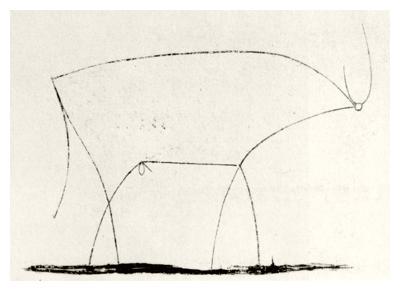
Picasso could draw?

I saw the image on the left in a post on Simen's beautiful blog, and I immediately thought "What a beautiful Pollock", and then "Norman Rockwell could paint like Pollock? Then why didn't he?"


Later, I read this post by Vivek Haldar about Iteration in painting, and I realized that some people would think "Picasso knew how to draw realistically? Then why didn't he?"


What is my point? Other than that I am an elitist intellectual?
Not, of course, that Rockwell should've painted like Pollock. It's that when I look at Rockwell's paintings, I see a technician, someone who could paint, but I wonder why he bothered. What he did, others could do too. Picasso and Matisse had technique, but they then tried to tried to do with the medium what others had not done.
Ironical, because what I have written is hardly original, but these two paintings illustrate this point so beautifully that I felt I had to save this juxtaposition for later. In this blog post.
There is a problem with this point of view, of course, and I'll address that in my next post.

Resume

Google wrecks the Reader, and I realize that I need a new way to extend my memory: a place to stow what I choose to salvage from the Internet every day. Hence, back to the blog. For now.

Monday, May 24, 2010

Jumpology


The first image is of Dali, the second is of Merce Cunningham and Martha Graham. The photographs are by Phillippe Halsman. They are both from this article in the New York Times. (The slide show won't allow me to reuse the images, so hunted them down on the Internet.)


When you ask a person to jump, his attention is mostly directed toward the act of jumping, and the mask falls, so that the real person appears

Space Shuttle: Time Lapse Movie

Thursday, May 20, 2010

Give this man his Nobel

Craig Venter presides over a second Genesis.
Like Shelley’s protagonist, Dr Venter and Dr Smith needed some spare parts from dead bodies to make their creature work. Unlike Victor Frankenstein, though, they needed no extra spark of Promethean lightning to give the creature its living essence. Instead they made that essence, a piece of DNA that carries about 1,000 genes, from off-the-shelf laboratory chemicals. The result is the first creature since the beginning of creatures that has no ancestor.
It seems that the development was long expected, and that synthetic DNA is not new. Craig Venter created the first "functioning" artificial virus as long ago as 2003. That is the heart of this story, and all similar stories: that we now take accelerating change so much for granted. As the image shows, this achievement was possible because productivity in DNA synthesis has been increasing at a pace which looks exactly like Moore's law, but faster.


Most philosophers will not be surprised, but how will most people react to passages like the following? I don't expect any real change in the philosophy of the man in the street: we will live our lives, and these episodes will  never quite sink in:
It demonstrates more forcefully than anything else to date that life’s essence is information. Heretofore that information has been passed from one living thing to another. Now it does not have to be. Non-living matter can be brought to life with no need for lightning, a vital essence or a god. And this new power will allow the large-scale manipulation of living organisms.
As I think back on the developments we have seen in Science and Technology in the recent past, it strikes me that I cannot even begin to imagine what the world, or we humans, will look like in 20 years time. In many ways, we will fall far short of Star Trek (I would be amazed if we managed inter-stellar, or even regular inter-planetary travel) but who knows in how many ways we will exceed that fantasy?

Postscript: More from Sciencedaily.