Tuesday, March 01, 2022

The Logic of Appropriateness

 On 24 February 2022, Russia launched an invasion of Ukraine. 

In this podcast episode of ChinaTalk, Adam Tooze suggests (and I agree) that if Putin had succeeded in a Blitzkrieg conquest of Ukraine, then protests in the West would have been muted. However, the courage exhibited by the Ukrainian President, the stubborn resistance put up by the Ukrainian population, and the slow progress of the Russians who seem to have repeated the mistake of the USA in Iraq, of expecting to be welcomed as liberators rather than invaders, all have won the loud sympathy of voters in the West. The politicians are forced to respond, or look weak and craven. 

Some of the decisions have been very sensible. Germany will be increasing its defense budget, which will help make Europe more independent of the USA. A huge push for renewable energy may result, and oddly enough this may be the one thing which saves us from Global Warming. 

But the Western response is becoming increasingly disproportionate and reckless. It seems they have learned nothing from the experience in Iraq. Young Russian soldiers are disoriented, unprepared, and unwilling to fight. Brave Russians have been protesting the war right near the Kremlin. But the West have gone into  self-righteous anger. The USA has punished the Russian economy with a viciousness previously seen in the case of Iran and Venezuela. The racism on display has been outrageous. French ministers are stating as a fact that they will destroy the Russian economy.

This thread seems to offer at least a vocabulary for what is going on. Essay here. 


Meanwhile the Russian army may be preparing to ratchet up the violence. 

Monday, February 28, 2022

Monday, February 21, 2022

State of Exception

 From "The Party" by Richard McGregor. 

This passage reminded me of Carl Schmitt and "The State of Exception" 


Monday, February 14, 2022

Monument to the unknown deserter

Again from James C Scott's "Two cheers for Anarchism". 
This is harder to digest, given that we are brought up to view desertion with horror (betrayal both of comrades and country) it checks the worst tendencies of the military to abuse and waste human lives, and more importantly, asks the question which needs to be asked "why are we fighting, and why cannot I go home?"   

Sunday, February 13, 2022

Two Cheers for Anarchism

 A excerpt from the book by James C Scott. I am not convinced by this passage, but what he says is certainly true about Market Economies. Homo economicus cannot create a healthy Market. Healthy outcomes require habits of uncalculating trust and trustworthiness. 


Friday, February 11, 2022

Inventing Nations


From “Imagined Communities” by Benedict Anderson. 


Thursday, February 10, 2022

On not existing

In this episode of "Embrace the void", the host rattles off the names of things and asks the guest Jack Symes whether he considers them to be "real" or "not real". Out of a long list (including "colours", "free will", "genders", "races", "morality", "rights", "God or gods", "society", numbers", "fictional characters", "money" and so on), I think the only time the guest responded "not real" was when the host named "love." 

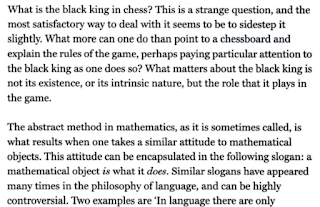
From "Mathematics: a Very Short Introduction" by Gowers

A philosophers' game, of course, but I would have answered "Real" to practically everything.

Does the sky exist? Obelix was wrong to worry about a solid dome over our heads, which could come crashing down at any moment, but the sky certainly can be blue, or overcast, or a "dawn sky" or a "night sky"; the sky can contain birds or storms, or rainbows, though we can never reach the pot of gold at the end of those either.  

Do gods exist? Well they certainly make themselves felt through the actions of those who believe in them. 

Does "India" exist? It certainly didn't exist when Indosaurus roamed the plains. Nor did it always have the same borders which it does today. Nor will it exist in its present form forever. Neither did it always mean the same thing- a "geographical term" (like Europe), a cultural territory (again like "Europe") with ambiguous boundaries, a colony, an imperial dominion, and a Union are all different things. We may even be a nation today- we certainly were not always that. 

Asking whether something is "real" is almost pointless- what is interesting is in just what sense something is real. The "unreal", "illusory" and merely "conventional" make their presence felt through how they bend "reality."

Edit: the worst atrocities follow when these illusions, which can be debated and contested endlessly, infect our minds and turn us into puppets who live and die to protect these illusions, and deny the ordinary pain of the person before them. 

The tradition of all the dead generations weighs like a nightmare on the brain of the living.

No matter. Try again.

 After almost a decade, going to try again to record some of my thoughts.

Monday, April 16, 2012

In defense of Heuristics

When people (or other animals) run to catch a flying ball, how do they ensure that they get to the right place at just the right time?

The computational theory of the mind says that we have a "mental model" of how things fly through the air. We use this to work out the likely trajectory of the ball, and run to where our model says the ball will come to earth. The embodied cognition people point out that this is wrong. We use a heuristic: we run so as to keep the line of sight to the ball at a constant angle to the horizontal and this simple rule ensures that we get to the right spot just at the right time.

Gerd Gigerenzer touches on this topic during this excellent talk I came across via a tweet by Yves Smith. He gives the clearest explanation I've seen of how the two approaches differ in their predictions, and how the computational theory is simply wrong even if our goal is not a realistic description of how people actually manage to catch balls but is, as Friedman might have argued, merely to be able to come up with good predictions of their observable behavior.


Of course, his topic is not embodied cognition, but rationality in general, and how decision making under uncertainty differs from decision making under risk, how heuristics are not "second best", and how complex problems don't need complex solutions. Robustness is more importance than optimization, when you cannot know the optimum. His argument in favor of a simple 1/N heuristic, as compared to Markowitz's portfolio allocation theory, was quite astonishing.

Saturday, April 14, 2012

Dunning Kruger

This post about what the Dunning Kruger effect is, and what it is not, is very good.
So the bias is definitively not that incompetent people think they’re better than competent people. Rather, it’s that incompetent people think they’re much better than they actually are. But they typically still don’t think they’re quite as good as people who, you know, actually are good.

Saturday, March 17, 2012

Your lying heart

As a graduate student, I attended some courses on the art and science of psychotherapy. During one of these lectures, our teacher imparted a morsel of clinical wisdom. This is what he told us: "You will from time to time meet a patient who shares a disturbing tale of multiple mistakes in his previous treatment. He has been seen by several clinicians, and all failed him. The patient can lucidly describe how his therapists misunderstood him, but he has quickly perceived that you are different. You share the same feeling, are convinced that you understand him, and will be able to help." At this point my teacher raised his voice as he said, "Do not even think of taking on this patient! Throw him out of the office! He is most likely a psychopath and you will not be able to help him."
From Daniel Kahneman's "Thinking, Fast and Slow."

Tuesday, March 06, 2012

What words can do justice

From the National Geographic on the Rhino Wars
Game scouts found this black rhino bull wandering Zimbabwe's Savé Valley Conservancy after poachers shot it several times and hacked off both its horns. Veterinarians had to euthanize the animal because its shattered shoulder couldn't support its weight.
Adam Omizek at Modeled Behavior recently blogged
I have argued that consumer pressure for better treatment of animals in agriculture is a good thing, but that pressuring for better treatment of workers might lead to worse outcomes.
He is writing about animals in agriculture, but what he says applies in general. We are the most powerful species ever to roam the planet, and it is amazing how badly we behave.

Monday, March 05, 2012

Moneyball: this is not a review

I recently watched Moneyball.

One of the most moving scenes in the movie is the one where you watch Billy Beane begins to assemble a team from players who have been overlooked by other teams. You can see how much it matters to them when he asks him to play for him.

What does this imply for my post about Meritocracy?

Doesn't it show that free markets reward talent? Doesn't it show that free markets reward those who can see the value in outsiders and put them to work? Doesn't it show that free markets are meritocracies, and isn't that a good thing?
My answers to these questions would be: yes, yes, and a qualified no.

Markets are wonderful. We should try to find the right person for the job, and we should reward people for doing their jobs well. The bourgeois virtues are very real.

My post on Merit was not an argument against using markets.

Since the 1980s, the best cricket players in India have been growing ever richer. However, that they earn a hundred times what their predecessors used to earn doesn't mean that they are a hundred times as good at the game. They have grown richer mainly because Indians now watch television. In some other countries, the benefits have gone to Football players, while in other countries, Basketball players have gained. These beneficiaries may be great athletes, and they "deserve" their incomes in the sense that this is what others willingly pay them in the marketplace. They are like landlords who have seen the value of their properties explode because someone else built a highway or a railway station nearby.

Hockey is supposedly India's "National Game" and the Indian Hockey team is the most successful team in Olympic History. However, they earn a fraction of what Cricketers earn. There are excellent historical and infrastructural reasons for this. However, to say that Cricket is a better team than Hockey, or that Cricketers are better athletes than Hockey players would be silly. That is my first point: however hard we work, and these athletes work very hard indeed, we underestimate the contribution of luck to our wealth.

Merit, in the sense in which we use it here, is also a morally neutral term. In the movie, Billy Beane recruits players whom others won't touch because they are arrogant, or because they take drugs and frequent strip clubs. As he puts it, all he cares about is whether they are cheap and can "get on base". Personally, I have no problems with people who use drugs or go to strip clubs. The point I am trying to make is that if Billy Beane is rewarding merit, both merit and reward are of the narrowest kind: he reognizes technical competence, and rewards it with money.

Billy Beane was doing The Market's work, and that is good. However, The Market giveth, and the Market taketh away.

We underestimate the importance of the environment: we see those who thrive and see that they are intelligent, hard-working, and conscientous, and they often are! We then assume that they would have thrived in all possible worlds. We don't notice that many of those who are left behind are also were hard-working and dilgent. We also forget that we often seem most virtuous (energetic, optimistic, generous) when things are going our way.

This has moral consequences: instead of being grateful, the successful evolve a fine sense of entitlement, while the defeated blame themselves. This is not only a human tragedy, but a mistaken understanding of how the world works.

Note: Prices are a signal. When wages rise, workers should move into that industry. However, the number of spots on the Indian Cricket team is limited to 11 (plus extras). What we see are more players trying to get in, and a few who do make it and earn huge sums. Most of us do not work in such industries. When wages rise, people enter our industry.
However, this does not mitigate the tragedy of declining industries: I doubt former steel plant engineers are any less intelligent or hardworking that programmers, but they cannot easily start over again.

Saturday, March 03, 2012

Predictable

I don't intend to write any more posts about tax for a while. However, Tim Harford makes an interesting point in this article
But few people seem to have recognised that if the entrepreneurial activity in question is avoiding tax through artificial loopholes, it might be a very good idea to generate some uncertainty and give pause for thought.
I don't agree, but an interesting comment nevertheless.

Taxes II

I recently read this article in which Samuel Brittan argues for a tax on land, and quotes Winston Churchill
Roads are made, streets are made, services are improved, electric light turns night into day, water is brought from reservoirs a hundred miles off in the mountains - and all the while the landlord sits still. Every one of those improvements is effected by the labour and cost of other people and the taxpayers. To not one of those improvements does the land monopolist, as a land monopolist, contribute, and yet by every one of them the value of his land is enhanced. He renders no service to the community, he contributes nothing to the general welfare, he contributes nothing to the process from which his own enrichment is derived.
I am no expert on Georgism, but I am intrigued.

Bryan Caplan, however, doesn't like it.
There's just one problem: While the Georgist tax has no effect on the incentive to pump discovered oil, it has a devastating effect on the incentive to discover oil in the first place. Suppose you could find a $1M well by spending $900k on exploration. With a 99% Georgist tax, your expected profits are negative $890k.
I am nor persuaded by Bryan's argument. The company will look at the total profits which it can make by investing in finding and developing the oil field.

First, it will pay a higher tax on the land it owns, but since it will no longer be taxed on the profits it makes from extracting, refining, and distributing the oil which it finds, it is not clear that its total profits will be any less.

Second, it is not the case that the company's profits from oil exploration are higher in the absence of the land tax: what would be paid as land tax would instead be paid to the landlord. The effect of the Georgist tax is to transfer rent from the current owner of the land to the State. Whether this is a good thing or not is debatable, but the tax is not paid by the company which finds the oil nor the one which develops it, and will not affect their incentives. Note that this is Ricardian rent, and not simply money rent, though the two could be the same.

To be clearer about this, consider a company which is thinking of buying some land outright, where it is confident that it will find oil. It will take the land tax into account when deciding whether to buy the land (just as it would take sales tax, etc into account today). The effect of the land tax will be to reduce the price which the company is willing to pay for the land, and so will in effect be paid by the current owner of the land. The landlord will sell to them if what they can pay is more than he could make from the user with the next best use of that land. If the land tax did not exist, the company would pay more, and the landlord would be end up richer. But the person with the second best use of the land would also be willing to pay more, and so the landlord's decision would not be affected by the tax!

Finally, as a couple of the commentators have pointed out, there is a fatal problem with Bryan's argument: the model which he says cannot work in theory already works in practice.
Or do you think that when Western oil companies rock up in Saudi Arabia, that the Saudis don't make them pay every cent for the value of the land/natural resources? The Western oil companies just get to keep the additional profits made by extracting, refining, shipping the stuff.
and (italics added)
I invite you to check out the world of actual oil and mineral exploration, this happens all the time. Very seldom will a party of oil/minerals exploration not have to negotiate with a private/government party who will extract as much rent as they can, and the stuff still gets out of the ground with a profit for the exploration party.

The author mistakes 100% of the rent for being 100% of the value of, in this case, oil. It's not, it's what the exploring party will bid to profitably extract it.
Bryan argues that we should be taxing negative externalities instead. The windfall gains made by the landlord because of the efforts of others is a positive externality which blesses the landlord alone, and this is what the tax is meant to recover.

Ricardian Rent is an amazingly subtle concept. I only understood it properly after I read Tim Harford's The Undercover Economist. I am not an expert on taxation, and it could be that I have got something wrong, but I really doubt it. I think it is much more likely that his ideological preferences caused Bryan to rush to judgement.

Edit: Gulzar's comment below, and his op-ed are well worth reading.

Thursday, March 01, 2012

Unearned Income

Why we are so enamored with the idea of paid work? This is not about political preferences. The Right bangs on about welfare queens, the left proclaims the virtues of the working classes. Does anybody like idle people?

Strangely enough, as this article by Samuel Brittan shows, Hayek seems to have had no problem with them, or those of us who merely aspire to be completely idle some day.
Hayek went out of his way to praise the existence of the person of independent means, who was responsible for much of the innovation of the last few centuries -- whether in high culture, in the launch of good causes such as the anti-slavery campaign or the more mundane development of the art of living including a great variety of hobbies and sports which were afterwards taken up by the mass of the population.
At a time when you cannot open a business magazine without being forced to contemplate over-achieving businessmen who have no life outside of work, and when people actually seek out tips for sleeping less, as if sleep were some great conspiracy by Nature to prevent them from realizing their full potential, this is refreshing stuff.
Indeed Hayek went so far as to say that if there were no other way it would be better to grant an independent income to one householder in a hundred chosen by lots than not to have it at all. In the 40 years and more since his Constitution of Liberty was published, productivity in the developed world has made great strides. Are we not now approaching a position where some non-wage income could be available not to one in a hundred but to all citizens?
As with so many other ideas, I first encountered the Citizen's Basic Income (CBI) in Chris Dillow's blog. Now that Europe is in crisis, it will be argued that a CBI is impossible there, but I don't think that is the case at all. The real obstacle is always going to be the ideology of work.

Wednesday, February 29, 2012

On Merit

In this very wise essay, Michael Young reminds us that the 1958 book in which he coined the word "Meritocracy" was meant to be a warning.
It is good sense to appoint individual people to jobs on their merit. It is the opposite when those who are judged to have merit of a particular kind harden into a new social class without room in it for others.
There are any number of arguments against Meritocracy:
  1. It reassures the powerful and it demoralizes the powerless.
  2. It removes all checks on rent-seeking. As Michael Young notes in his essay
    So assured have the elite become that there is almost no block on the rewards they arrogate to themselves. The old restraints of the business world have been lifted and, as the book also predicted, all manner of new ways for people to feather their own nests have been invented and exploited.
  3. It confuses merit and marketability.
As always, I've learned a lot from Chris Dillow.

There is one other argument which I encountered on Andrew Gelman's blog, but have not seen elsewhere. In a post about an article by James Flynn (of the "Flynn effect"), Gelman says
Flynn also points out that the promotion and celebration of the concept of “meritocracy” is also, by the way, a promotion and celebration of wealth and status–these are the goodies that the people with more merit get.
Thus, because we believe that we reward virtue with wealth and power, not only do the wealthy and powerful gain legitimacy, but wealth and power themselves gain a moral sheen by association with virtue. At the limit, we no longer believe that virtue can be its own reward: it has to be accompanied by the insignia of social acclaim.

Tuesday, February 28, 2012

Taxes

Christina and David Romer's new paper, “The Incentive Effects of Marginal Tax Rates: Evidence from the Interwar Era,” says that the incentive effects of marginal tax rates are
consistently positive, small, and precisely estimated
This really should not be a surprise. Most people would rather be rich than poor, but most people get up and go to work in the morning not because they want to be rich, but because they must or because they love their work. People who love their work will work harder as they get richer.

James Kwak notes that these results are based on the richest of the rich, the top .05% of the population and hence the ones who would find it easiest to slack off if they decided that work isn't worth it; the rest of us would have even less choice
To put this in perspective, an elasticity of 0.19 implies that tax revenues would be maximized with a tax rate of 84 percent.
Should we raise taxes on the wealthy?

The normative aspect of taxation is genuinely difficult. I think most people who oppose higher taxes on the wealthy do so for ethical reasons. They feel it would be unjust to people who have worked hard for their wealth, and have benefited others. I often feel similar scruples, and certainly we shouldn't be taxing people merely because we can.

However, I also agree with Hayek on desert. The world is full of intelligent, hard-working, decent people. For every successful man who we admire for his intelligence and energy there are a dozen who we haven't heard of but who are equally worthy in any meaningful sense. The market rewards you not for what you have done, but for what "it" wants you and others to do more of. Certainly I don't see any good reason why the extremely wealthy should pay tax at a lower rate than those poorer than them.

The doubts which I do have are about government's ability to serve our best interests even if they wish to, though the solution to that would be to avoid overcomplicating government. Whatever your opinion of the "right" rate of tax to apply to the extremely wealthy, these estimates should make you revise that upwards.

Monday, February 27, 2012

A little light Sociology

I follow several blogs about Sociology and Anthropology. Their authors see things differently enough from me so that I have to make an effort to understand what they are saying. I frequently disagree with them, but I also change my mind often. It is an interesting exercise.

I took this image from a post by Lisa Wade over at Sociological Images.


It is difficult for us to see ourselves as others see us, and it is difficult for others to see us as we see ourselves. Lisa writes
Many believe that the U.S. is at the pinnacle of social and political evolution. One of the consequences of this belief is the tendency to define whatever holds in the U.S. as ideal and, insofar as other countries deviate from that, define them as problematic.
I suspect she wrote this only because she assumed that she would be read mostly by Americans. The situation in the cartoon is perfectly symmetrical. All people assume their way of life is "natural". Born into our cultures like fish to water, we cannot usually see ourselves from the outside. We assume that people from other communities are all alike. Because we are not aware of how we have internalized our way of life, we believe that we act freely (and why not?).

Because we cannot imagine ourselves into the situation of others, who have internalized their cultures as completely as we have ours, we assume that they act out of fear. As this post by the Last Psychiatrist shows, the media has a lot to answer for. This should be useful when we read about Iran in the newspapers.

Note: None of this is to say that I am a thorough-going cultural relativist. Yet.

Sunday, February 26, 2012

Archaeology is hard

Even though rice rarely survives in archaeological deposits, all plants absorb tiny amounts of silica from groundwater. The silica fills some of the plant's cells and when the plant decays it leaves microscopic cell-shaped stones, called phytoliths, in the soil. Careful study of phytoliths can reveal not just whether rice was being eaten but also whether it was domesticated.

Yan and MacNeish dug a sixteen-foot trench in Diaotonghuan cave near the Yangzi valley...
From Why the West Rules- for now