Thursday, February 04, 2010

Self destruct

Article, in the New York Times about how Microsoft has been sabotaging itself, by a former vice president at Microsoft.
Classic stories of how corporate bureacracies eat their children, even if "top management" tries to protect them.
For example, early in my tenure, our group of very clever graphics experts invented a way to display text on screen called ClearType. It worked by using the color dots of liquid crystal displays to make type much more readable on the screen. Although we built it to help sell e-books, it gave Microsoft a huge potential advantage for every device with a screen. But it also annoyed other Microsoft groups that felt threatened by our success.

Engineers in the Windows group falsely claimed it made the display go haywire when certain colors were used. The head of Office products said it was fuzzy and gave him headaches. The vice president for pocket devices was blunter: he’d support ClearType and use it, but only if I transferred the program and the programmers to his control. As a result, even though it received much public praise, internal promotion and patents, a decade passed before a fully operational version of ClearType finally made it into Windows.
And
When we were building the tablet PC in 2001, the vice president in charge of Office at the time decided he didn’t like the concept. The tablet required a stylus, and he much preferred keyboards to pens and thought our efforts doomed. To guarantee they were, he refused to modify the popular Office applications to work properly with the tablet. So if you wanted to enter a number into a spreadsheet or correct a word in an e-mail message, you had to write it in a special pop-up box, which then transferred the information to Office. Annoying, clumsy and slow.

Morituri te salutant

An article on the strange past-times of our ancestors.

Gladiator matches were not free for alls. Each gladiator had a certain attack and defence weapon combination, and these were matched between pairs of fighters so none had an unfair advantage. Men of equal, speed, strength and skill were also matched together to ensure a fair fight.

Since no point system existed, fighting was always pursued until a decisive outcome, which could be any of the following alternatives: defeat through death, defeat due to injury preventing further combat, defeat due to exhaustion, a win, with the bestowal of a palm branch or a laurel crown, or a draw, with both opponents being allowed to depart the Arena alive. This was the most unlikely case, since the superiority of one fighter had to be proved to enable the public to reach a verdict.

The final decision of the loser's fate resided within the hands of the games’ organizer. To this end he appealed to the mood of the plebs. Upon the cry of iugula (lance him through), it was expected of the vanquished that he would set an example of the greatness of manhood (exemplum virtutis) and would motionlessly receive the death thrust. The turning down of the thumb signified to the spectators, not that the gladiator should be put to death, but rather that the gladiator was dead.

After the final blow, arena servants carried the combatant on a stretcher into the carcass chamber and gave the twitching body a deathblow. It is not known exactly how this execution was performed. The executor, a costumed arena servant, associated with the Roman god of death “Dis Pater” or the Etruscan counterpart “Charun” carried a deadly hammer accompanying the gladiator on his last journey.

Monday, February 01, 2010

Upholstery and Personality Types

Robert Sapolsky on how the link between personality types and heart disease was discovered.
It was the mid-1950s, and he and Rosenman were having an unexpected problem with their successful cardiology practice: they were spending a fortune reupholstering the chairs in their waiting rooms. There seemed to be no end of chairs that had to be fixed. One day a new upholsterer came in to see to the problem, took one look at the chairs, and discovered the type A-cardiovascular disease link. He announced it semicryptically, with the words: What the hell is wrong with your patients? People don’t wear out chairs this way. The front-most few inches of the seat cushions and the armrests--and only the front-most few inches-- were torn to shreds, as if some very short beavers had spent the night in the office craning their necks to savage the chairs. Obviously these particular waiting rooms were far from peaceful places. The patients habitually sat on the edges of their seats while fidgeting and clawing away.

Saturday, January 30, 2010

Hacking your senses

A nice article in Wired Magazine on how people are hacking their own senses; had shared this on Facebook, but I just spent 30 minutes searching for it. Clearly, should have been on my blog.
During a long brainstorm session, they wondered whether the tongue could actually augment sight for the visually impaired. I tried the prototype; in a white-walled office strewn with spare electronics parts, Wicab neuroscientist Aimee Arnoldussen hung a plastic box the size of a brick around my neck and gave me the mouthpiece. "Some people hold it still, and some keep it moving like a lollipop," she said. "It's up to you."
Arnoldussen handed me a pair of blacked-out glasses with a tiny camera attached to the bridge. The camera was cabled to a laptop that would relay images to the mouthpiece. The look was pretty geeky, but the folks at the lab were used to it.
She turned it on. Nothing happened.
"Those buttons on the box?" she said. "They're like the volume controls for the image. You want to turn it up as high as you're comfortable."
I cranked up the voltage of the electric shocks to my tongue. It didn't feel bad, actually — like licking the leads on a really weak 9-volt battery. Arnoldussen handed me a long white foam cylinder and spun my chair toward a large black rectangle painted on the wall. "Move the foam against the black to see how it feels," she said.
I could see it. Feel it. Whatever — I could tell where the foam was. With Arnold ussen behind me carrying the laptop, I walked around the Wicab offices. I managed to avoid most walls and desks, scanning my head from side to side slowly to give myself a wider field of view, like radar. Thinking back on it, I don't remember the feeling of the electrodes on my tongue at all during my walkabout. What I remember are pictures: high-contrast images of cubicle walls and office doors, as though I'd seen them with my eyes. Tyler's group hasn't done the brain imaging studies to figure out why this is so — they don't know whether my visual cortex was processing the information from my tongue or whether some other region was doing the work.

Friday, January 29, 2010

On Socialism

An article in the Times of London on Tony Blair's appearance before the committee investigating the Iraq war.
Last night declassified documents released by Downing Street revealed that Mr Blair had already indicated Britain’s support for regime change in Iraq six months before the 9/11 attacks.
and
Earlier the former Prime Minister said that many of the arguments used to justify overthrowing Saddam’s regime now applied to Iran. He said that Iran was now a greater risk to Britain than Iraq was at the time that he ordered the invasion in March 2003
A blog post by Chris Dillow on arguments against government intervention in financial markets.
In its early days, one feature of the research into cognitive biases was the emphasis it placed upon the fact that “experts” were as prone to error as laymen. In Kahneman and Tversky’s classic Judgment Under Uncertainty, for example, David M. Eddy showed that doctors commonly misinterpreted diagnostic probabilities, whilst Stuart Oskamp wrote that “professional psychologists are no better interpersonal judges, and sometimes are worse ones, than are untrained individuals"
Governments are large bureaucracies, just like any large corporation. Individuals within Governments face exactly the same pressures to conform and comply which people in companies face. Government ministers are as prone to be delusional as CEOs. However, when governments get things wrong, they do so on a scale which no individual firm can manage. The Iraq war was just one such error of judgement. Another was the US government's role in feeding the housing bubble in the US.
Starting in 1993, Fannie and Freddie have affordable housing goals—30% of Fannie and Freddie’s purchases of loans have to be loans made to borrowers whose income was below the median income in their area. These are interim goals. In 1996, the interim goal becomes firm at 40%. In 1997, the number rose to 42%. In 2001 it rose to 50%. The Bush Administration increased this number to 52% in 2005, 53% in 2006, and 55% in 2007.
The "right" argument against government ownership of the means of production is not that private property is a natural right, but that government ownership results in an unacceptable concentration of power. The market is a means to displine and punish poor management. Markets (especially financial markets) will fail regularly, and will experience cycles of boom and bust, and there is a role for government in mitigating this, but markets are still the least bad means of organizing our economy.

Accidental Laws

One of the challenges for Physics is to explain where the laws of Physics come from. Why these laws and no others? Where do the constants of Physics come from? Feynman wrote in his lectures about the ratio of the repulsion of two electrons due to electricity, and the attraction of the two electrons due to their masses:
where does such a large number come from? It is not accidental, like the ratio of the volume of the Earth to the volume of a flea. We have considered two aspects if the same thing, an electron....Some say that we shall one day find the "universal equation", and in it, one of the roots will be this number.
In the same passage, he considers the possibility that this constant could vary with the age of the Universe.
In this Edge interview, Leonard Susskind suggests an alternative, based on a combination of String Theory and the Anthropic Principle: that there is no deep reason for these constants and the laws of nature. These values and laws vary from one part of the Multi-verse/Mega-verse to another, and we happen to be in a part where these values are such that they can support living creatures like us.
Gradually physicists and cosmologists are coming to see our ten billion light years as an infinitesimal pocket of a stupendous megaverse. At the same time theoretical physicists are proposing theories which demote our ordinary laws of nature to a tiny corner of a gigantic landscape of mathematical possibilities.
Interesting throughout.

Monday, January 25, 2010

Computers and Humans

More on computers, as the greatest Chess master of all writes a wonderful, wonderful book review.

Kasparov on what the computer game has done to how people play.
The heavy use of computer analysis has pushed the game itself in new directions. The machine doesn't care about style or patterns or hundreds of years of established theory. It counts up the values of the chess pieces, analyzes a few billion moves, and counts them up again... It is entirely free of prejudice and doctrine and this has contributed to the development of players who are almost as free of dogma as the machines with which they train. Increasingly, a move isn't good or bad because it looks that way or because it hasn't been done that way before. It's simply good if it works and bad if it doesn't. Although we still require a strong measure of intuition and logic to play well, humans today are starting to play more like computers.
Given how Maths has long been plagued by philosophical arguments of "but what does it mean?", "are numbers real?" and so on, I wonder if something similar will result in Maths as well. Young Mathematicians who have grown up with computers may take a similarly pragmatic view of what their predecessors considered essential matters of style and good practice.

On how easy access to vast databases of games gives young players unprecedented advantages
In the pre-computer era, teenage grandmasters were rarities and almost always destined to play for the world championship. Bobby Fischer's 1958 record of attaining the grandmaster title at fifteen was broken only in 1991. It has been broken twenty times since then, with the current record holder, Ukrainian Sergey Karjakin, having claimed the highest title at the nearly absurd age of twelve in 2002. Now twenty, Karjakin is among the world's best, but like most of his modern wunderkind peers he's no Fischer, who stood out head and shoulders above his peers—and soon enough above the rest of the chess world as well.
Whereas the article by Kenneth Rogoff was on how humans are using computers to cheat in tournaments, and others are responding by using computers to detect those cheats, and the implications of all this for our understanding of what we mean by "intelligence", Kasparov is more interested in how differences between humans and computer can result in gains from trade.
In what Rasskin-Gutman explains as Moravec's Paradox, in chess, as in so many things, what computers are good at is where humans are weak, and vice versa. This gave me an idea for an experiment. What if instead of human versus machine we played as partners? My brainchild saw the light of day in a match in 1998 in León, Spain, and we called it "Advanced Chess." Each player had a PC at hand running the chess software of his choice during the game. The idea was to create the highest level of chess ever played, a synthesis of the best of man and machine.
And this passage is purest Economics:
Having a computer partner also meant never having to worry about making a tactical blunder. The computer could project the consequences of each move we considered, pointing out possible outcomes and countermoves we might otherwise have missed. With that taken care of for us, we could concentrate on strategic planning instead of spending so much time on calculations. Human creativity was even more paramount under these conditions... A month earlier I had defeated the Bulgarian in a match of "regular" rapid chess 4–0. Our advanced chess match ended in a 3–3 draw. My advantage in calculating tactics had been nullified by the machine.
Italics added.
In 2005, the online chess-playing site Playchess.com hosted what it called a "freestyle" chess tournament in which anyone could compete in teams with other players or computers...Lured by the substantial prize money, several groups of strong grandmasters working with several computers at the same time entered the competition. At first, the results seemed predictable. The teams of human plus machine dominated even the strongest computers. The chess machine Hydra, which is a chess-specific supercomputer like Deep Blue, was no match for a strong human player using a relatively weak laptop. Human strategic guidance combined with the tactical acuity of a computer was overwhelming.

The surprise came at the conclusion of the event. The winner was revealed to be not a grandmaster with a state-of-the-art PC but a pair of amateur American chess players using three computers at the same time. Their skill at manipulating and "coaching" their computers to look very deeply into positions effectively counteracted the superior chess understanding of their grandmaster opponents and the greater computational power of other participants. Weak human + machine + better process was superior to a strong computer alone and, more remarkably, superior to a strong human + machine + inferior process.

The "freestyle" result, though startling, fits with my belief that talent is a misused term and a misunderstood concept. The moment I became the youngest world chess champion in history at the age of twenty-two in 1985, I began receiving endless questions about the secret of my success and the nature of my talent.
Again, italics added
Where so many of these investigations fail on a practical level is by not recognizing the importance of the process of learning and playing chess. The ability to work hard for days on end without losing focus is a talent. The ability to keep absorbing new information after many hours of study is a talent. Programming yourself by analyzing your decision-making outcomes and processes can improve results much the way that a smarter chess algorithm will play better than another running on the same computer. We might not be able to change our hardware, but we can definitely upgrade our software.
Even though he has been intrumental in encouraging the use of computers in Chess, I was struck by how he is interested more in using Chess and Chess-playing software as a laboratory to explore human intelligence, rather than as an end in itself. He ends with a plea for programmers to try and mimic the the human, creative, elements of intelligence.
This is our last chess metaphor, then—a metaphor for how we have discarded innovation and creativity in exchange for a steady supply of marketable products. The dreams of creating an artificial intelligence that would engage in an ancient game symbolic of human thought have been abandoned. Instead, every year we have new chess programs, and new versions of old ones, that are all based on the same basic programming concepts for picking a move by searching through millions of possibilities that were developed in the 1960s and 1970s.

Like so much else in our technology-rich and innovation-poor modern world, chess computing has fallen prey to incrementalism and the demands of the market. Brute-force programs play the best chess, so why bother with anything else? Why waste time and money experimenting with new and innovative ideas when we already know what works? Such thinking should horrify anyone worthy of the name of scientist, but it seems, tragically, to be the norm. Our best minds have gone into financial engineering instead of real engineering, with catastrophic results for both sectors.

Saturday, January 23, 2010

Comparing US cities with National Economies

I came across this via the Economist's link exchange.


Friday, January 22, 2010

Dreaming children

Wonderful little post at mindhacks on the dream life of children.
What an absolutely marvellous line.
Preschoolers’ dreams are often static and plain, such as seeing an animal or thinking about eating.

Thursday, January 21, 2010

Deaton on Statistics

William Easterley summarizes Angus Deaton's AEA Presidential Address on comparing economic statistics across countries.
What struck me was this passage about India.
The World Bank’s recent 40 percent upward revision of the global poverty number was based on an absurd procedure that led to the paradox in the quote.
To make a long story short, the World Bank decided to boot richer India out of the group of poorest countries used to determine the poverty line, which made the poverty line higher, which made Indian (and global) poverty higher – all because India was richer. This misguided revision of the poverty line, which accounted for virtually all of the upward revision, was not clear to virtually anyone until this new paper by Deaton.

Two horrifying stories

The first is a book review of "Last Train from Hiroshima" in the New York Times. The book is about those who survived both atomic attacks in Japan. The review is so horrifying that you wonder what the book is like. Scenes which Goya or Picasso could never have imagined.
Mr. Pellegrino follows his survivors as they trudge through wastelands that make “The Road” by Cormac McCarthy read like “Goodnight, Moon.” He describes the so-called “ant-walking alligators” that the survivors saw everywhere, men and women who “were now eyeless and faceless — with their heads transformed into blackened alligator hides displaying red holes, indicating mouths.”
The author continues: “The alligator people did not scream. Their mouths could not form the sounds. The noise they made was worse than screaming. They uttered a continuous murmur — like locusts on a midsummer night. One man, staggering on charred stumps of legs, was carrying a dead baby upside down.”
The second is a post at the Foreign Policy blog about whether CNN's Sanjay Gupta, who is a doctor, did the right thing when he treated patients in a field hospital in Haiti.
A somewhat convoluted CNN.com writeup of the incident reveals that Gupta -- after a team of Beligan doctors and nurses left a field hospital due to security fears -- "monitored patients' vital signs, administered painkillers and continued intravenous drips. He stabilized three new patients in critical condition."
I think he did exactly the right thing, but the photo which accompanies this post! I first saw it 16 years ago, and I remember it, and the story of Kevin Carter who won the Pultizer prize for taking this photograph and then killed himself.

Seeking relief from the sight of masses of people starving to death, he wandered into the open bush. He heard a soft, high-pitched whimpering and saw a tiny girl trying to make her way to the feeding center. As he crouched to photograph her, a vulture landed in view. Careful not to disturb the bird, he positioned himself for the best possible image. He would later say he waited about 20 minutes, hoping the vulture would spread its wings. It did not, and after he took his photographs, he chased the bird away and watched as the little girl resumed her struggle. Afterward he sat under a tree, lit a cigarette, talked to God and cried. "He was depressed afterward," Silva recalls. "He kept saying he wanted to hug his daughter."

Wednesday, January 20, 2010

A work of art

The Economist's Free Exchange Blog

A Tool to Deceive and Slaughter is an artwork by Caleb Larsen, currently for sale on eBay. If it hasn’t sold in the next couple of days — the minimum bid is $2,500 — it will go back on eBay. On the other hand, if it does sell, it will still go back on eBay. That’s what it does, as clearly explained in the legal contract accompanying the work:


Artist has created a work of art titled “A Tool to Deceive and Slaughter (2009)” (“the Artwork”) which consists of a black box that places itself for sale on the auction website “eBay” (the “Auction Venue”) every seven (7) days. The Artwork consists of the combination of the black box or cube, the electronics contained therein, and the concept that such a physical object “sells itself” every week.


...Many artists have tried to remove their art from the commercial aspects of the art world — by making it free, for instance, or by putting on performances, or creating public installations. This one does it by making an artwork which is so commercial that it can’t be collected. You could buy the piece today, and it might be worth $100,000 in a few years’ time. But you wouldn’t own it in a few years time, and you would have personally gained only a tiny fraction of the increase in the piece’s value, if anything at all.

I know this is very different, but it somehow reminded me of this other self-referential toy

Tuesday, January 19, 2010

Computers and Art

Two articles about what computers have been getting up to. What struck me about both is that they describe how computers are moving beyond raw computational problems and are now helping with problems which require "taste". Computers are now better at distinguishing fake paintings from genuine ones, and can mimic the style of chess grandmasters so that humans can no longer tell whether they are playing a human or a computer pretending to be that particular human.

The first is about the use of computers to distinguish fake paintings from authentic ones. The approach is based on the idea of a visual vocabulary which is distinctive to each artist. This vocabulary consists of "words" termed "filters" which can be used to very compactly describe any work by that artist but would be much less efficient at describing a work by another person.
To carry this out computationally, the team obtained very high quality scans of all the Bruegel drawings, both authenticated ones and fakes. They broke the digital images of the authentic ones up into tiny patches, each just a few pixels wide, and then used a machine learning algorithm to identify a small set of those patches that could be used as filters, in imitation of the visual system. The algorithm picks the filters so that the smallest number possible is needed to generate every patch in the Bruegel. These formed the “words” of Bruegel’s own unique visual language.
The team was inspired by how the human visual system has evolved to very efficiently encode the world we find ourselves in; presumably, if we had evolved on another planet, or underwater, our visual system would have use a very different set of filters.
Graham, Rockmore and Hughes applied these ideas to art authentication by imagining an organism that had somehow managed to evolve a visual system while only ever viewing Bruegel drawings. The organism would be able to see Bruegel drawings using very few filters, but when it looked at anything else — including fake Bruegel drawings — it would have to use many more.
The second is an article by Kenneth Rogoff in which he describes what he thinks the impact of Artificial Intelligence on the Economy will be.
Many commercially available computer programs can be set to mimic the styles of top grandmasters to an extent that is almost uncanny. Indeed, chess programs now come very close to passing the late British mathematician Alan Turing’s ultimate test of artificial intelligence: can a human conversing with the machine tell it is not human?
Ironically, as computer-aided cheating increasingly pervades chess tournaments (with accusations reaching the highest levels), the main detection device requires using another computer. Only a machine can consistently tell what another computer would do in a given position. Perhaps if Turing were alive today, he would define artificial intelligence as the inability of a computer to tell whether another machine is human!

An owl in flight


Beautiful streamlining. From here

Monday, January 18, 2010

Carrots disguised as sticks

John List has been conducting experiments to see if the Endowment Effect can be used as a motivator.
At the beginning of the week, some groups of workers were told that they would receive a bonus of 80 yuan ($12) at the end of the week if they met a given production target. Other groups were told that they had “provisionally” been awarded the same bonus, also due at the end of the week, but that they would “lose” it if their productivity fell short of the same threshold.
Objectively these are two ways of describing the same scheme. But under a theory of loss aversion, the second way of presenting the bonus should work better. Workers would think of the provisional bonus as theirs, and work harder to prevent it from being taken away.
This is just what the economists found. The fear of loss was a better motivator than the prospect of gain (which worked too, but less well). And the difference persisted over time: the results were not simply a consequence of workers’ misunderstanding of the system.
Lets see what happens when our HR managers get to learn of these results.

Does propaganda work?

It seems yes. At least during the Rwanda genocide.
Not all villages are in line of sight of the two national transmitters. The effect of being so? When a village has full rather than zero radio coverage, civilian violence increased by 65 percent and organized violence by 77 percent.

Markets and Game theory

Two posts from Jeff Ely.

First: Why do we sit through movie previews in theaters? Because we will always arrive early because we want the best seats in the house (or at least, we don't want to be stuck in the worst seats).
In fact, even if the theater publicized the true start time we would still come early. The reason is that we are playing an all-pay auction bidding with our time for the best seats in the theater. Each of us decides at home how early to arrive trading off the cost of our time versus the probability of getting stuck in the front row. The “winner” of the auction is the person who arrives earliest, the prize is the best seat in the theater, and your bid is how early to arrive. It is “all pay” because even the loser pays his bid
Since we are going to get there early anyway, the theaters auction off our attention to advertisers and even if we dislike the previews, we are not willing to enough to make it worthwhile for the theatres to stop them
And this even explains why theater tickets are always general admission. Let’s compare the alternative. The theater knows we are “buying” our seats with our time. The theater could try to monetize that by charging higher prices for better seats. But it’s a basic principle of advertising that the amount we are willing to pay to avoid being advertised at is smaller than the amount advertisers are willing to pay to advertise to us. (That is why pay TV is practically non-existent.) So there is less money to be made selling us preferred seats than having us pay with our time and eyeballs.
Is this actually true? I thought we could now (at least in Mumbai) specify the seats we want when we buy movie tickets?

Second: why Google "handicaps" the most popular links when they auction off keywords.
Sponsored links are paid advertisements. They are sold using an auction that determines which advertisers will have their links displayed and in what order. While the broad rules behind this auction are public, google handicaps the auction by adjusting bids submitted by advertisers according to what google calls Quality Score. (Yahoo does something similar.)
Google does not really want the weaker, less popular advertisers to win, but by giving them an advantage, they force the stronger, more popular advertisers to bid more for their keywords.
The idea is based on the well-known principle of handicaps for weak bidders in auctions. Let’s say google is auctioning links for the keyword “books” and the bidders are Amazon.com plus a bunch of fringe sites. If Amazon is willing to bid a lot for the ad but the others are willing to bid just a little, an auction with a level playing-field would allow Amazon to win at a low price. In these cases google can raise its auction revenues by giving a handicap to the little guys. Effectively google subsidizes their bids making them stronger competitors and thereby forcing Amazon to bid higher

The strays of Moscow

A Financial Times article.
Russians can go nutty when it comes to dogs. Consider the incident a few years ago that involved Yulia Romanova, a 22-year-old model. On a winter evening, Romanova was returning with her beloved Staffordshire terrier from a visit to a designer who specialises in kitting out canine Muscovites in the latest fashions. The terrier was sporting a new green camouflage jacket as he walked with his owner through the crowded Mendeleyevskaya metro station. There they encountered Malchik, a black stray who had made the station his home, guarding it against drunks and other dogs. Malchik barked at the pair, defending his territory. But instead of walking away, Romanova reached into her pink rucksack, pulled out a kitchen knife and, in front of rush-hour commuters, stabbed Malchik to death.

Incentives

Two articles which discuss incentives.
First, an article by Tim Harford in the Financial Times.
Just over two years ago, British soldiers in a remote region of Afghanistan came across a solitary man sowing seed – wheat rather than poppies. This was risky and unusual: a planting at the turn of the year was very late, and the area had been made dangerous by incessant fighting. But the farmer had his reasons. Benazir Bhutto, the former prime minister of Pakistan, had been assassinated a couple of days earlier. The man reckoned that wheat prices would soar as a result and wanted to cash in...
There has been a tendency among commentators and politicians to treat the “hearts and minds” aspect of counter-insurgency as a popularity contest. But the “voters” are not casual spectators, trying to choose between the Taliban or the coalition forces; they are individuals weighing up complex choices in difficult circumstances.
He concludes
I have been as guilty as anyone of being fascinated by behavioural economics. But the financial system did not fail because of some psychological trait, but because it was riddled with damaging incentives that were hard to spot because the system was complex and changing quickly. So, too, with counter-insurgency: Mackay started by thinking about economic psychology but ended up focusing on complexity, and what it takes to create an organisation capable of adapting to complexity. It has taken me too long to come to the same conclusion myself.
Next, an interview in the New Yorker magazine with Nobel Laureate Hames Heckman on what remains of the Chicago School.
I want to distinguish between two different ideas. The Chicago School incorporates many different ideas. I think the part of the Chicago School that has been justified is the claim that people react to incentives, and that incentives are important. Nothing in what has happened invalidates that idea. People did react to incentives—clearly they did. It turned out that the incentives they were reacting to weren’t socially beneficial, but they definitely reacted to them. The other part of the Chicago School, which Stiglitz and Krugman have criticized, is the efficient-market hypothesis. That is something completely different.
I think it is important to put it into historical perspective. In the late nineteen-forties and nineteen-fifties, when Keynesianism was really dominant, that sort of Keynesianism—so-called hydraulic Keynesianism—completely ignored incentives and the way people reacted to them. What Chicago did—Milton Friedman, George Stigler, and others—was to redress that balance. They did a whole lot of empirical studies that showed how people did react to incentives, such as changes in taxes or prices. That was incredibly influential, and it is still is.

Friday, January 15, 2010

Information and Markets

From the Economist's Economics focus for last week. One of Hayek's insights was that markets are essentially an information processing device: converting desires and resources into consumption. More and better information is good for both buyers and sellers
By examining historical data for the price of fish as mobile-phone coverage was extended down the coast of Kerala in southern India between 1997 and 2001, for example, Robert Jensen of Harvard University showed that access to mobile phones made markets much more efficient, eliminating wasted catches and thereby bringing down consumer prices by 4% and increasing fishermen’s profits by 8%.
Similarly, Jenny Aker of the University of California at Berkeley analysed grain markets in Niger to see how the phasing-in of mobile-phone coverage between 2001 and 2006 affected prices. She found that it reduced price variations between one market and another by at least 6.4%, and more in remote and hard-to-reach markets. With transaction costs cut, prices for consumers were lower and profits for traders higher.
The article also describes how ITC introduced internet kiosks (e-choupal) in Madhya Pradesh in an effort to improve transparency in the market for Soybeans.
Farmers in the region sell their soyabeans to intermediaries in open auctions at government-regulated wholesale markets called mandis, a system that was set up in order to protect farmers from unscrupulous buyers. The intermediaries then sell on the produce to food-processing companies. The problem with this approach for the farmers is that the traders have a far better idea about the prices prevailing in different markets and being offered by processing companies. With only a few traders at each mandi, they can easily collude to ensure that they pay less than the fair market price; they can then boost their profits by selling on the beans at a higher price.
However, in a long supply chain, different parties have different interests. ITC had an interest in cutting the middlemen out, and stimulating the farmers to produce more.
By the end of 2004 a total of 1,704 kiosks had been set up, each of which served its host village and four others within a five-kilometre (three-mile) radius. The kiosks displayed the minimum and maximum price paid for soyabeans at 60 mandis, updated once a day, along with agricultural information and weather forecasts. ITC also posted the price it was prepared to pay for soyabeans of a particular quality bought direct from farmers at 45 “hubs” (mostly in the same towns as mandis). By setting up the kiosks, ITC enabled farmers to check that the prices being offered at their local mandi were in line with prices elsewhere. It also gave them the option to sell direct.
The result was that the farmers produced more, and earned more. The middlemen lost out, and ITC got to purchase more at lower prices.
She found that the presence of kiosks in a district was associated with an instant and persistent increase of 1.7% in the average price paid at mandis in that district. As expected, the availability of price information increased the level of competition between the traders, raising prices and reducing the variation in prices between nearby mandis. Farmers’ profits increased by 33%, and the cultivation of soyabeans increased by an average of 19% in districts with kiosks. And by buying some produce direct, ITC reduced its costs, which paid for the kiosks.

Wednesday, January 13, 2010

How has the Internet changed the way you think?

Edge asks.
Daniel Hillis' answers
Today, most people only recognize that they are using the Internet when they are interacting with a computer screen. They are less likely to appreciate when they are using the Internet while talking on the telephone, watching television, or flying on an airplane. Some travelers may have recently gotten a glimpse of the truth, for example, upon learning that their flights were grounded due to an Internet router failure in Salt Lake City, but for most this was just another inscrutable annoyance. Most people have long ago given up on trying to understand how technical systems work. This is a part of how the Internet is changing the way we think.
I want to be clear that I am not complaining about technical ignorance. In an Internet-connected world, it is almost impossible to keep track of how systems actually function. Your telephone conversation may be delivered over analog lines one day and by the Internet the next. Your airplane route may be chosen by a computer or a human being, or (most likely) some combination of both. Don't bother asking, because any answer you get is likely to be wrong.
And
It would take a long time to explain Network Time Protocol, how it corrects for variable network delays and how it takes advantage of a partially-layered hierarchy of network-connected clocks to find the time. Suffice it to say that it is complicated. Besides, I would be describing version 3 of the protocol, and your operating system is probably already using version 4. It really does not make sense for you, even if you are a programmer, to bother to understand how it works.
Clay Shirky's answer is well worth reading.
To make a historical analogy with the last major increase in the written word, you could earn a living in 1500 simply by knowing how to read and write. The spread of those abilities in the subsequent century had the curious property of making literacy both more essential and less professional; literacy became critical at the same time as the scribes lost their jobs.
The same thing is happening with publishing; in the 20th century, the mere fact of owning the apparatus to make something public, whether a printing press or a TV tower, made you a person of considerable importance. Today, though, publishing, in its sense of making things public, is becoming similarly de-professionalized; YouTube is now in the position of having to stop 8 year olds from becoming global publishers of video. The mere fact of being able to publish to a global audience is the new literacy, formerly valuable, now so widely available that you can't make any money with the basic capability any more.

Raghuram Rajan

Superb interview with Raghuram Rajan. As advisor to the Indian Prime Minister, he has some comments on the country, but I found the earlier parts of the interview much more interesting. Thought I would summarize the interview so I understand it better.

On why banks fund long-term, projects using short-term deposits
Why the private banking sector has never chosen safe narrow banking (with finance companies issuing long-term liabilities and making illiquid loans) is really the puzzle of the ages. It’s interesting because the form of the bank seems relatively similar across countries and over time. It’s a form that has endured, perhaps longer than the corporation. You can go back to Mesopotamia perhaps, but certainly to Italy, and they had banks in much the form that we have today.
His answer is that there are three benefits to this structure: a) obviously, it is always going to be cheaper to get people to lend you money short-term rather than long-term b) Since depositors keep taking money out and putting it into a bank, there is always someone checking that the bank has funds to pay the depositors. This is a credible check on the management of the bank and lowers the cost of borrowing and c) long-term loans lead to constant strategic debt renegotiation, with the borrower trying to convince the lender to change the terms of the loan. Demand deposits allow the bank to credibly commit to not attempt this, and so allow them to get funds more cheaply.

On why the "narrow banking" proposed by Marin Wolf and Mervyn King would not be a good idea
you would have much higher costs of long-term intermediation. The money market fund would be reasonably stable, presumably, and will continue to invest in fairly liquid instruments—that will not be a problem. But it would be a problem on the other side—the finance company funded with long-term debt: Long-term projects would find finance very costly...Less lending, less growth
I am not convinced by this, because the liquid bond markets we have now mean that a finance company can raise large sums of money for long periods of time, without any of the lenders having to lock themselves in for long periods of time; though this will mean they are exposed to interest rate risk on their capital. The cost of borrowing would go up: I just wonder by how much, and whether it may not be worth it.

He explains why he decided that financial innovations such as CDS and other derivatives had not reduced risk in the overall system: a) Banks cannot make money without taking risk; if they get some kinds of risk of their books, they must be accepting other kinds of risk which may be harder to spot, b) Employees were being penalized for taking on obvious risks, but this meant that they were taking on hidden risks. The Insurance companies were taking on "tail risk" by writing Credit Default Swaps and acting as though they would never have to pay up.

His model for why this crisis was so severe seems to be that banks were competing ferociously, and they took on just the risks which they felt were implicitly backed up by the government. The example he gives is liquidity risk, where banks assumed there would never be any shortage of liquidity because the Fed would drop interests rates as much as required. In fact, when the crisis came, the Fed dropped rates as much as they could, but the liquidity dried up because the banks were themselves in trouble and would not lend, nor pass the rate reductions on.

One thing I just don't understand is that he describes how the actions of the Fed caused moral hazard, and also says this
There is always some amount of regulatory capture. The people the regulators interact with are people they get to know. They see the world from their perspective, and, you know, they want to make sure they’re in their good books. And so it’s not surprising that across the world, you have a certain amount of the regulators acting in the interest of, and fighting for, the regulated.
and this
there was also a tremendous amount of political pressure, not to protect friends, but to encourage certain kinds of low-income lending. I think that pervaded the system.
but at the same time seems to believe that the cause of the crisis was excessive faith in the free market. Just don't get that.

Tuesday, January 12, 2010

Roll over, Turing

Pythagoras, Archimedes, Euclid and now this? What were those ancient Greeks smoking? The Antikthera mechanism is old news of course, but the images in the article are mind-boggling.


Investing in BRICS and mortar

Powerful article in the Financial Times.

The writer is not saying that the BRICs will not become really rich and powerful (though obviously nothing is guaranteed), just that there is no reason to believe that those who invest in companies in these countries are going to make any money.
Academic studies have shown there is no positive correlation between GDP growth and stock market returns – if anything the correlation is slightly negative...The reason for this counter-intuitive finding is that you do not buy shares in the statistical construct known as GDP. You buy the shares of real world companies. In immature fast-growing economies, the companies that end up winning the struggle for survival may not even exist yet. That was certainly so in the case of Japan’s economic miracle. In the 1950s there were more than one hundred motorbike companies. The market leader, Tohatsu, was driven out of business by the cut-throat pricing of a flaky upstart called Honda.

Companies in emerging markets are unlikely to generate the kind of cash needed for investment: they will repeatedly raise money on the markets. How does this help those who already hold shares in the company, unless the overall return on investment improves, and is there a real incentive for the companies to do that?

Then comes a ferocious warning about China: the stock market is overvalued, real estate even more so (apartment prices are at 50 times average household income while Japan at the peak of its real estate bubble saw ratios of 12 to 15 time average household income), and investment in fixed assets is 50% of Chinese GDP.
Just as there has never been a bubble that hasn’t burst in the end, so there has never been an investment boom that hasn’t been followed by a bust. If China’s investment-to-GDP ratio were to drop to the levels of 1960s Japan – not an absurd idea, since that is also where it was in China ten years ago – the impact would be catastrophic. China itself would face slump and the mother of all banking crises. A domino reaction would hit the commodity exporters and other emerging economies. The deflationary impact of Chinese overcapacity would be felt everywhere, potentially putting the world trading system at risk. And investors would come to view the “Bric” acronym much as they do “TMT” today.

America versus Europe

Another interminable debate.
Here is the Economist's Free Exchange blog. Here is Tyler Cowen two and one.
I think Tyler Cowen two makes the most interesting points.

Women in the workplace

Good article in the Economist.

Huge improvements all round, but economics is all about trade-offs.
But the biggest reason why women remain frustrated is more profound: many women are forced to choose between motherhood and careers. Childless women in corporate America earn almost as much as men. Mothers with partners earn less and single mothers much less. The cost of motherhood is particularly steep for fast-track women.
This is in line with what Chris Dillow reported sometime back.
Controlling for obvious things like education and occupation, lesbians earn 11% more than heterosexual women. Most of the male-female pay gap, then, is a penalty for heterosexual women only, not for women in general.
I was just happy to see that there is some data throwing light on this controversy, but there are consequences
Many professional women reject motherhood entirely; in Switzerland 40% of them are childless. Others delay child-bearing for so long that they are forced into the arms of the booming fertility industry. Some choose not to work at all, representing a loss to collective investment in talent.
The article also seems to be suggesting that children might be suffering because their parents are not spending time with them, but offers little evidence for this.
A survey for the Children’s Society, a British charity, found that 60% of parents agreed that “nowadays parents aren’t able to spend enough time with their children”. In a similar survey in America 74% of parents said that they did not have enough time for their children.
This could just be a case of parent's feeling guilty.
British children brought up in two-parent families where only one parent works are almost three times more likely to be poor than children with two parents at work.
This statement, of course, does not tell us which is cause and which effect, or even if something else is causing both.

There is some good news
Many talented women are already hopping off the corporate treadmill to form companies that better meet their needs. In the past decade the number of privately owned companies started by women in America has increased twice as fast as the number owned by men. Women-owned companies employ more people than the largest 500 companies combined. Eden McCallum and Axiom Legal have applied a network model to their respective fields of management consultancy and legal services: network members work when it suits them and the companies use their scale to make sure that clients have their problems dealt with immediately.

Monday, January 11, 2010

Asset bubbles and optimism

A wonderful blog post by Jeff Ely about how people are working on constructing Economic models which could explain how optimistic investors could inflate a bubble. First, why this is a problem
Alp Simsek asks whether the presence of optimistic traders can inflate the price of assets, say housing prices. It seems obvious, but remember that investment in housing is leveraged using collateralized loans where the house itself is the collateral. If the optimists are borrowing from the “realists” to buy houses at overinflated prices, and they are offering up the house as collateral, then surely the realists aren’t willing to lend?

How the market works
Suppose that you are a realist and you are making a loan to me to purchase a house. A year later we will see whether housing prices have gone up or down. If they go up, I will pay off the loan and realize a profit. If they go down I will default on the loan. A key idea is to understand that the loan effectively makes us partners in the purchase of the house. I own it on the upside (and I pay you back your loan) and you own it on the downside. We pay for the house together too: you contribute the loan amount and I contribute the down pament.

The equilibrium price of the house will be determined by how much we, as partners, are willing to pay. I am an optimist and I would like to pay a lot for it, but I am financially constrained so my contribution to the total price is some fixed amount, my down payment. Thus, our total willingness to pay is determined by how much you are willing to pay to enter this partnership.

This means that it is the "realistic" lender who determines the market price which the asset goes for. However, assume the lender and the borrower agree on the likelihood of default, but the borrower is more optimistic as to what the house would be worth if the borrower did not default. In that case, the borrower would be willing to give up some of that upside in order to get the lender to participate. And the promise of that potential upside makes the deal more attractive for the lender as well, and makes him more willing to lend.

Lots to think about in this.

The Mass Market and the Long Tail

A superb article in the Economist about how well the predictions of The Long Tail have worked out. The bottom-line seems to be that the niche market has grown and the market has grown more diverse, but the big blockbusters have actually increased their market-share.
In short, just because people have more choice does not mean they will opt for more obscure entertainments. That is especially clear in the book trade. A study of the Australian market by Nielsen, a research firm, found that the number of titles bought each year (measured by ISBNs) has risen dramatically, from about 275,000 in 2004 to almost 450,000 in 2007. Niche titles selling fewer than 1,000 copies each accounted for nearly all the growth in variety. Yet their market share fell. In Britain, sales of the ten bestselling books increased from 3.4m to 6m between 1998 and 2008.
Again
Although you might expect people who seek out obscure products to derive more pleasure from their discoveries than those who simply trudge off to see the occasional blockbuster, the opposite is true
apparently because
In “Formal Theories of Mass Behaviour”, William McPhee noted that a disproportionate share of the audience for a hit was made up of people who consumed few products of that type. (Many other studies have since reached the same conclusion.) A lot of the people who read a bestselling novel, for example, do not read much other fiction. By contrast, the audience for an obscure novel is largely composed of people who read a lot. That means the least popular books are judged by people who have the highest standards, while the most popular are judged by people who literally do not know any better. An American who read just one book this year was disproportionately likely to have read “The Lost Symbol”, by Dan Brown. He almost certainly liked it.

Friday, October 16, 2009

Sunday, March 29, 2009

Voodoo Economics

South Park on the state of Economics today.


Hopped up on Coffee

A video of someone like me after a day of drinking coffee at work


HT: Ernie who also to a Malcolm Gladwell article about coffee.

Andrew Gelman has a nice post about someone who performed
a randomized, blinded, placebo-controlled experiment on himself
and
was astonished to see how much the caffeine had affected him. He was stronger -- his power output was 3 percent greater -- and faster. In fact, he said the average speed for his tests when he used caffeine was faster than his fastest speed when he was not using caffeine

Sunday, January 25, 2009

Achilles and Hector

Two birds in full throated song on a damp, dark winter evening in London, while people hurry past, bundled against the cold.

What a sight


Since Time Immemorial

Merriam Webster: a time antedating a period legally fixed as the basis for a custom or right.

While listening to the BBC, I was amazed to learn that this phrase has a precise meaning in English Law.

Checking online, I was even more astonished to learn just how long ago this phrase was defined. Wikipedia:
In 1276, this time was fixed by statute as the 3rd September 1189, the date of the coronation of King Richard I (Richard the Lionheart). Proof of unbroken possession or use of any right since that date made it unnecessary to establish the original grant. In 1832, the plan of dating legal memory from a fixed time was abandoned; instead, it was held that rights which had been enjoyed for twenty years (or as against the Crown thirty years) should not be impeached merely by proving that they had not been enjoyed before.

Sunday, January 11, 2009

Overnight success can be a long time coming

John Kay writes an article on why choice matters
Choice is not an end in itself, but a means to the good services everyone seeks. Choice is working best when no one wants to exercise it.
and on a pernicious myth about markets.
But those who defend the market system are often the system’s worst enemies. I recently listened to a group of businessmen deploring the anti-capitalist tone of much of what is taught in schools. They had a point. But they spoiled it by promoting a description of capitalism that was at once repulsive and false.

They talked about “wealth creation”, although most of what they described seemed to be a diversion of wealth for the benefit of particular individuals rather than the creation of new wealth. They thought private sector activities – such as securities trading and automobile manufacture – created wealth; while public sector activities – such as health and education – used wealth up. They stressed that financial rewards were the mainspring of innovation, apparently unaware that material gain was not even at the back of the minds of those who invented computers, discovered antibiotics or created green revolution crops.
Over at Coding Horror, Jeff Atwood perfectly illustrates this point
Honestly, I look forward to waking up someday two or three years from now and doing the exact same thing I did today: working on the Stack Overflow code, eking out yet another tiny improvement or useful feature. Obviously we want to succeed. But on some level, success is irrelevant, because the process is inherently satisfying. Waking up every day and doing something you love -- even better, surrounded by a community who loves it too -- is its own reward. Despite being a metric ton of work.
Wealth matters: it allows you to focus better on what you really want to do, but I would never be able to get any real work done if the only reason I had to do it was a bonus or promotion. Of course, to be able to take that attitude, you already need to have some amount of basic security.

Thursday, January 01, 2009

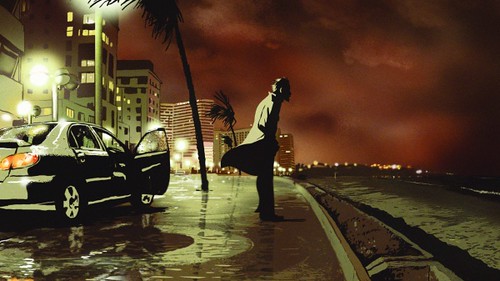
Waltz with Bashir

Watching Waltz with Bashir: A very good start to the year, and the second great animated movie I have seen this year.

I was drawn to seeing this movie by the poster above: it felt like a scene from Marine Drive in Mumbai. It is a documentary but, being an animation, it has no need for reconstructions of events which nobody filmed. Too much sepia, but the visuals are wonderful, the figures move stiffly but still do a great job of conveying emotion through body language, and the movie has a glorious soundtrack, and a very droll sense of humour.

I bombed Beirut, I bombed Sidon:


and Enola Gay


How distributed decision making typical of bureaucracies can help create atrocities by dispersing responsibility, how religions are only occasionally about what people believe, and how movies really are a multimedia art form.

Every single trailer in the theater felt like an advertisement for a computer game. The invention of photography forced painting to discover virtues other than realism, and the spread of the movies may have compelled novelists to discover qualities other than plot and scene. What will this new art do to old ones? We will have more movies which are made to go right into a computer game, but will we also see more works like Waltz with Bashir?

Sunday, December 21, 2008

Merry Christmas

A broadcast by the BBC of the Choir of Christ College, Cambridge, celebrating Christmas during the blackout of 1939.

There is something about fire

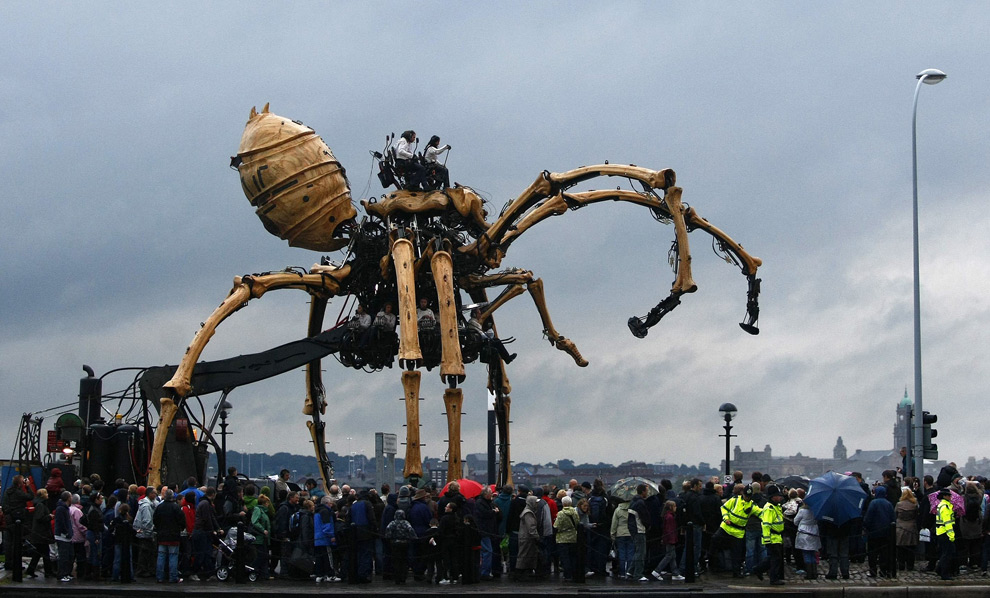
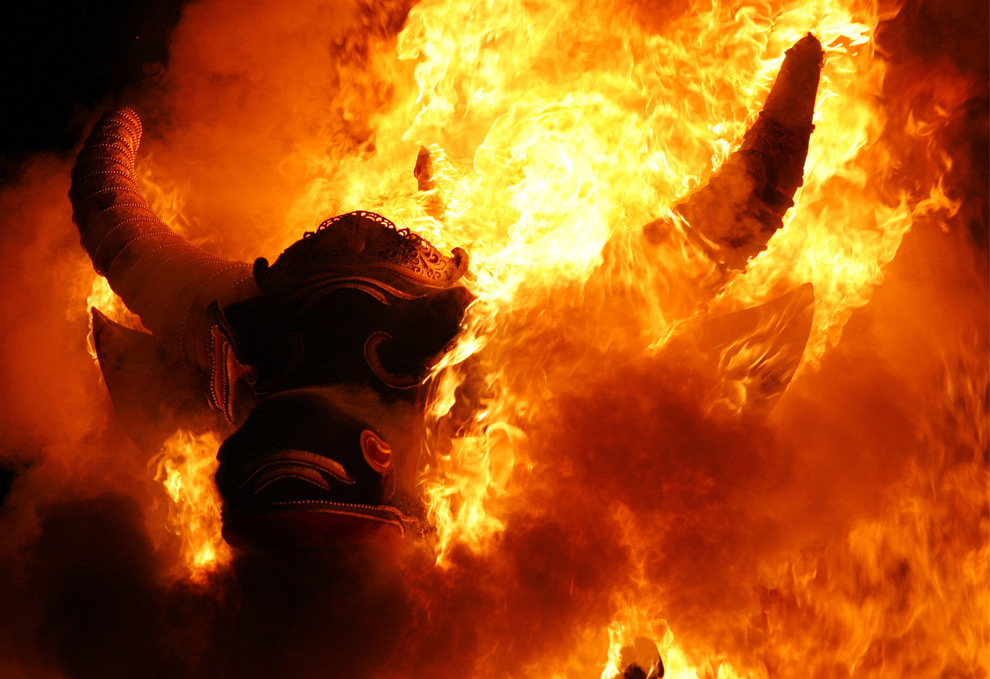
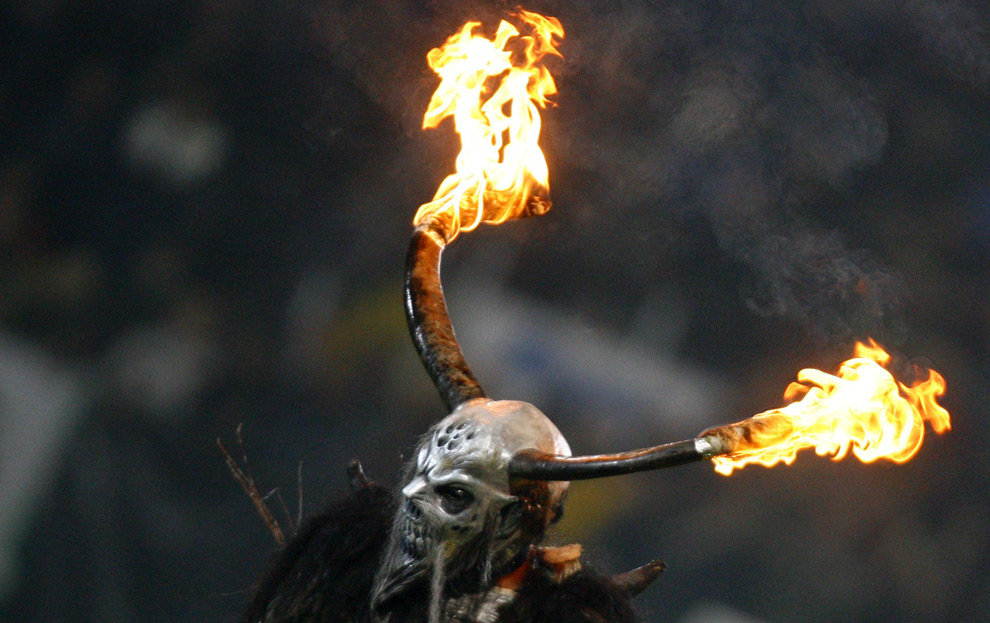
My favourites from among the "images of the year", published by the Boston Globe. (Text taken directly from the article.)

HT: Paul Kedrosky.

A giant mechanical spider, part of a piece of free theater by French company La Machine entitled "Les Mecaniques Servants", walks along the waterfront in Liverpool, England.


A bull sarcophagus in which a member of the Ubud royal family was cremated burns during the funeral ceremony in Ubud, Bali, Indonesia


A man in a traditional "Perchten" costume performs during an Austrian league soccer match in Ried, Austria


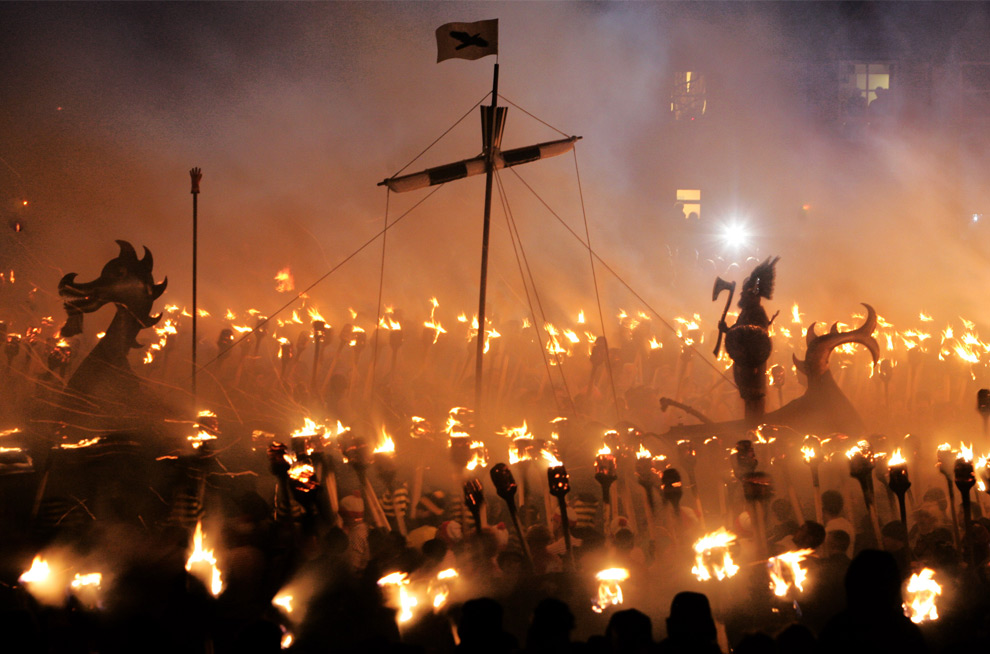
The Guizer Jarl is silhouetted as members of his Viking Squad walk around a long boat with burning torches during the annual Up Helly Aa Festival


Lightning bolts appear above and around the Chaiten volcano, as it began its first eruption in thousands of years


The moon and stars light up Mount Everest, also known as Qomolangma, as seen from near Everest Base Camp in the Tibet Autonomous Region


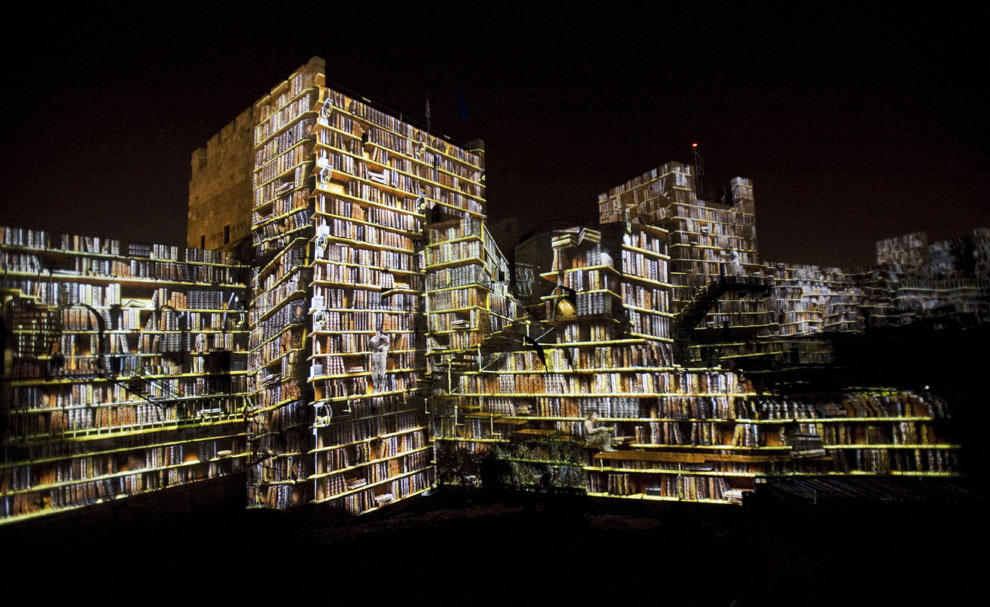
Images of books on shelves are seen projected on the walls of the Tower of David in Jerusalem's Old City

North Face


One of the most harrowing movie experiences of my life.

Sunday, December 07, 2008

Peter Sellers

Richard III: its been a hard day's night.

HT: Alex Ross


Thursday, November 27, 2008

Mumbai

Listening to the nauseating effluvia of Arundhati Roy on BBC Radio 4;  how much better Emily Dickinson is at a time like this.
After great pain, a formal feeling comes
The Nerves sit ceremonious, like Tombs
The stiff Heart questions was it He, that bore,
And Yesterday, or Centuries before?

The Feet, mechanical, go round
Of Ground, or Air, or Ought
A Wooden way
Regardless grown,
A Quartz contentment, like a stone

This is the Hour of Lead
Remembered, if outlived,
As Freezing persons recollect the Snow
First-Chill-then Stupor-then the letting go

Monday, November 24, 2008

Question

Heard on this show on BBC Radio 4:
You keep reading about dead people who are identified using their dental records. If we don't know who they are, how do we know who their dentist is?

Phrase of the day

Paraprosdokian
I want to die like my father, quietly, in his sleep—not screaming and terrified like his passengers
- Bob Monkhouse

A neat step

The Thai army knows what to do with prima donna generals
A MAVERICK Thai general who has threatened to bomb anti-government protesters and drop snakes on them from helicopters has been reassigned as an aerobics teacher, the Bangkok Post said on Friday.
HT: Paul Kedrosky

Tom Peters

Some management gurus are more modest than their followers. Tom Peters has lunch with the FT.

On whether management is getting harder
On the whole, Peters thinks not. We exaggerate the extent of change, he feels. It is the arrogance of modernity to believe that we face unique and unprecedented challenges. What people say now about the internet they used to say about the railways, the telegraph, the radio
On his book
It was not hard science. But what in management is? “It’s mostly luck, for God’s sakes!” Peters says. He feels the same way about this mega blockbuster that made his name: “A decent book with perfect timing” is his verdict. “There’s not an ounce of false humility in that.”
On his success
“Look,” Peters confesses, “I was born in 1942, in the US. I was protestant. I had relatively intelligent parents and I was white – that’s the first 99.9 per cent of it. Hard work may have done the rest.”
On his neighbour's success
“I had a neighbour who won a Nobel prize for his work on kidneys – he carried out the first effective transplant. I once asked him how he’d done it. ‘We did the most operations,’ he told me. At any point in time there are 10 people up there – one of them does the most.”
Malcolm Gladwell says says something similar about excellence in craftwork in his new book
Anything that is cognitively complex seems like it requires at least 10,000 hours… It’s deliberate practice, so it’s focused, determined, in environments where there’s feedback, where there’s a chance to really learn from mistakes. What’s fascinating about this notion that expertise arises only after 10,000 hours of deliberate practice is that it seems to apply incredibly broadly to an astonishing array of different professions - from playing chess to writing classical music to being a brain surgeon to playing hockey…
HT: Stefan Stern

Sunday, November 23, 2008

Returning

The New York Times on the reverse brain drain.
We learned new expressions: “He is on tour” (Means: He is traveling. Doesn’t mean: He has joined U2.); “What is your native place?” (Means: Where did your ancestors live? Doesn’t mean: What hospital delivered you?); “Two minutes” (Means: An hour. Doesn’t mean: Two minutes.)


I needed a nice car and a new television!

Felix Salmon

Sunday, November 16, 2008

Analogy

Chicago builds itself up, knocks itself down again, scrapes away the rubble, and starts over. European cities destroyed in the war were painstakingly restored. Chicago does not restore; it makes something wildly different. To count on stability here is madness. A Parisian can always see the Paris that was, as it has been for centuries. A Venetian, as long as Venice is not swallowed up in mud, has before him the things his ancestors saw. But a Chicagoan as he wanders about the city feels like a man who has lost many teeth. His tongue explores the gaps - let us see now: Here the Fifty-fifth street car turned into Harper avenue at the end of the trolley line; then the conductor hurried through the car, reversing the cane seats.
- Saul Bellow from "Chicago: the city that was, the city that is"

Thursday, November 13, 2008

Getting Better


Paul Kedrosky

Lawyers and Economists

This post from the Economist's Free Exchange Blog is excellent. They quote a very cross Willem Buiter
Except for a depressingly small minority among them, lawyers know nothing. They are incapable of logic. They don't know the difference between necessary and sufficient conditions or between type I and type II errors. Indeed, any concept of probability is alien to them. They don't understand the concepts of opportunity cost and trade off. They cannot distinguish between normative and positive statements. They are so focused on winning an argument through technicalities, that they no longer would recognise the truth if it bit them in the butt. If you are very lucky, a lawyer will give you nothing but the truth. You will never get the truth, let alone the whole truth. Things have degenerated to the point that lawyers and the legal profession not only routinely undermine justice, but even the law.
It reminded me of this old post by Brad De Long
we had found that it was possible to make intellectual and policy progress in discussions with economists because we had all been trained to think analytically: to break the issue down into background assumptions about the world, beliefs about the principal causal mechanisms, and claims about the likely effects of different policies on those chains of cause-and-effect. When we disagreed--as we often did--we could quickly ascertain where and why, and then agree on how to go hunting for pieces of information that would help resolve the disagreement. This was in striking contrast with our collective experience with lawyers or media types, who would be vague about cause and effect, or shift premises in the middle of a meeting when they saw that making different background claims about the world would provide a smoother road to their desired conclusion.

Obamalatory


HT: Don Bodreaux

Sunday, November 09, 2008

Tuesday, November 04, 2008

Otto

I really need to stop eating Octopuses
Once we saw him juggling the hermit crabs in his tank, another time he threw stones against the glass damaging it. And from time to time he completely re-arranges his tank to make it suit his own taste better - much to the distress of his fellow tank inhabitants
HT: Geekpress

A new dawn of American leadership is at hand

HT: Greg Mankiw
This is one of the most extraordinary people ever, but I just wish the people of the United States would accept that what is truly extraordinary is their country, and that no politician is going to get them where they wish to go. I hope they are not disappointed in Obama- too many people are treating this like the Second Coming.

Camelot Redux

I was listening to BBC Radio 4 when they broadcast an interview with a lady in the United States. She said she was voting for Barack Obama because her neighbourhood was run down, and the parks needed fixing and crime was soaring in her area.

Writing in the FT, Clive James puts it well
Great presidents inspire but they also deliver. The plain fact is, Mr Obama cannot deliver what he has promised. The problems he will confront are too difficult. The parallel with Tony Blair is impossible for a Briton to ignore. Enthusiasm among Mr Obama’s supporters is not just naive, it borders on the deranged, much like the enthusiasm in Britain in 1997 for Mr Blair. Remember how everything was possible, finally? “Things can only get better.” Look how that worked out
Postscript: It was even better when they spoke to a man in Kenya who hoped Obama would win because his village does not have water, power, or decent roads. He used exactly the same phrase the other woman used: "Obama will make a difference"

Moon fact of the day

The surface area of the Moon is roughly equal to that of Africa.

Monday, November 03, 2008

Napoleon complex

John Kay on the Great Man theory of History. A choice quote from Alasdair MacIntyre
One key reason why the presidents of large corporations do not, as some radical critics believe, control the US is that they do not even succeed controlling their own corporations.
More More from John Kay on the same theme.
Postscript: Thanks to Gaddeswarup for the correction.

Today's miscellany

The FT continues to be the Romantic's Wall Street Journal. Stefan Stern eulogizes Studs Terkel in the FT's management blog.
Work is about a daily search for meaning as well as daily bread, for recognition as well as cash, for astonishment rather than torpor, in short for a sort of life, rather than a Monday-to-Friday sort of dying
The Economist's Free Exchange Blog on the American elections.
You'll have to excuse us if we're a little edgy today. It's kind of like Christmas Eve, if Christmas only came once every four years, and if sometimes instead of presents you received a beating.

And a nice cartoon from Greg Mankiw

Sunday, November 02, 2008

The mother of all demos

Jeff Atwood (of Stack Overflow) blogs about a product demo in 1968
On December 9, 1968, Douglas C. Engelbart and the group of 17 researchers working with him in the Augmentation Research Center at Stanford Research Institute in Menlo Park, CA, presented a 90-minute live public demonstration of the online system, NLS, they had been working on since 1962. The public presentation was a session in the Fall Joint Computer Conference held at the Convention Center in San Francisco, and it was attended by about 1,000 computer professionals. This was the public debut of the computer mouse. But the mouse was only one of many innovations demonstrated that day, including hypertext, object addressing and dynamic file linking, as well as shared-screen collaboration involving two persons at different sites communicating over a network with audio and video interface

Saturday, November 01, 2008

Learning from Nature

Physics ArXiv blog On (traffic) jams and ants.