
HT: Geekpress
Night light in neighborhoods populated primarily by embattled Sunni residents declined dramatically just before the February 2007 surge and never returned, suggesting that ethnic cleansing by rival Shiites may have been largely responsible for the decrease in violence for which the U.S. military has claimed creditAnd
The effectiveness of the February 2007 deployment of 30,000 additional U.S. troops has been a subject of debate. In a report to Congress in September of that year, Gen. David Petraeus claimed "the military objectives of the surge are, in large measure, being met." However, a report the same month by an independent military commission headed by retired U.S. Gen. James Jones attributed the decrease in violence to areas being overrun by either Shiites or Sunnis.Looks like Iraq's problems are getting worse

is what a map of the states would look like if each state were a country with the same sized economyand may also help explain why Americans have this trouble.

Greg Mankiw reports that both the Republicans and Democrats are after Ben Bernanke.
"Why does one person have the right to grant $85 billion in a bailout without the scrutiny and transparency the American people deserve," asked House Speaker Nancy Pelosi (D., Calif) a reference to the loan the Fed gave AIG with the Treasury's blessing.I wonder what else she thinks he could have done. Maybe he could have invited her to make a speech. Or they could repeal the law of supply and demand and make US markets more like Pakistan's
Will WIlkinson on the legitimacy of technocrats in a democracy.
“Today the actions of American policy makers illustrate the need for economic patriotism,” said Bernard Carayon, a lawmaker of President Nicolas Sarkozy’s center-right governing party, UMP. “I congratulate them."I don't know if this has been badly translated, but the phrase "economic patriotism" is loathsome in its harumphing smugness.
On the other hand, Chris Dillow has an article in the Times, showing that the left can produce thoughtful economic analysis
What we're seeing, then, is the cost of separating ownership and control. In private firms, or partnerships - even limited liability ones - the two are closely aligned. In stock market-quoted firms, they are not.Carayon belongs to a right-of-centre party, and Dillow is a Marxist. Who says Marxists don't appreciate the virtues of markets and private ownership?
The one Investment Bank which still looks good (so far) is Goldman, and Wikipedia(!) tells us that they
decided to offer only a small portion of the company to the public, with some 48% still held by the partnership pool.[7] 22% of the company is held by non-partner employees, and 18% is held by retired Goldman partners and two longtime investors, Sumitomo Bank Ltd. and Hawaii's Kamehameha Activities Assn (the investing arm of Kamehameha Schools). This leaves approximately 12% of the company as being held by the public.
Well...quote, "on their own"...we have to - we cannot have the taxpayers bail out AIG or anybody else...this is something we're gonna have to work through -- there's too much corruption, there's too much access, we can fix it, I believe in America - we can have a 9/11 commission such as we had after 9/11, 'cause this is a huge crisis and we can come up with fixes and we can make sure that every American has a safer future and that is to make them know that their bank deposits are safe and insured.Marginal Revolution
We randomly assigned subjects to either feel relatively poor or relatively rich by having them complete demographic questions that included an item on annual income. The group made to feel poor was asked to provide its income on a scale that began at "less than $100,000" and went up from there, ensuring that most respondents would be in the lowest income tier. The group made to feel subjectively wealthier was asked to report income on a scale that began with "less than $10,000" and increased in $10,000 increments, leading most respondents to be in a middle tier. The group made to feel poor purchased twice as many lottery tickets (an average of 1.27) than those made to feel relatively wealthier (0.67 tickets, on average).HT: Free Exchange
In the second experiment, we indirectly reminded participants that, while different income groups face unequal prospects when it comes to education, employment and housing, everyone has an equal chance to win the lottery. This reminder that the lottery is a kind of “social equalizer” also increased lottery tickets purchases. The group given this reminder purchased 1.31 tickets, on average, as compared with 0.54 for those not given such a reminder.
TOWARDS the end of his 27 years in jail, Nelson Mandela began to yearn for a hotplate. He was being well fed by this point, not least because he was the world’s most famous political prisoner. But his jailers gave him too much food for lunch and not enough for supper. He had taken to saving some of his mid-day meal until the evening, by which time it was cold, and he wanted something to heat it up.and
The problem was that the officer in charge of Pollsmoor prison’s maximum-security “C” wing was prickly, insecure, uncomfortable talking in English and virtually allergic to black political prisoners. To get around him, Mr Mandela started reading about rugby, a sport he had never liked but which his jailer, like most Afrikaner men, adored. Then, when they met in a corridor, Mr Mandela immediately launched into a detailed discussion, in Afrikaans, about prop forwards, scrum halves and recent games. His jailer was so charmed that before he knew it he was barking at an underling to “go and get Mandela a hotplate!”
Elections are all very well, but the moment when black South Africans started cheering for a mostly-white rugby team, when white fans in the stadium tried gamely to sing a Zulu miners’ anthem and when Mr Mandela donned the green jersey of the Springboks—“It was the moment I realised that there really was a chance this country could work,” gushes a teary-eyed rugby official.Chris Dillow asked why a Nerd could never become president. I think this is one half of the answer.
The world is all that is the case. That last line was so pretentious. Anyway, the point stands.
Alesina and his coauthor show that geographic segmentation of ethnic groups is bad for the quality of government even after controlling for a nation’s overall fragmentation. Since poor government is responsible for the worst extremes of the human condition, regional segregation is a serious problem...They conjecture that segmentation bolsters destructive ethnic politics by making ethnic-specific policies easier to apply and ethnic voting blocs easier to organise.and one counter-intuitive result
Funny enough, religion doesn’t enter the mix. Religious segregation seemed to have no independent impact on government’s qualityThis is obviously the case not only for poor countries but also for wealthy ones, which is one reason why Singapore is paranoid about ethnic politics.
Apply the Copernican principle to India. Assume that it is not just this moment in time which is not special, but also this place, and the people who live here. Is there any reason to think these are a passing phase of India's history, or are we that different from Yugoslavia?
Russian oil companies are not producing more so their earnings are dependent on a rising oil priceGiven how they have been treating investors, we can hardly expect foreign firms to rush to provide new technology. On the other hand, command and control should be quite good at a straighforward task such as getting more oil out of the ground.
Further:The Economist's Free Exchange blogs on the same.
Russia can still abandon its great power aspirations, gracefully shrink its borders, and become Norway but I don't think they will.Postscript: Yup. Merrill has agreed to be bought by Bank of America. Seems the agreed line is that Fuld is to blame for Lehman's fate.
If Remedial Reading is required, some of the most clear-eyed writing on business has been from Britain: an FT columnist, and a Marxist blogger. I thought I would compile some of the pieces I most liked.
John Kay on what a CEO does:You need a chief executive, or a monarch, because choices between good alternatives need to be made and given legitimacy. This legitimacy can be acquired just as well from traditional authority as from meritocratic selection. Difficulties arise if chief executives - and monarchs - convince themselves that with their status comes unique insight and superior wisdomJohn Kay on the Great Man approach to business:
“It was not Napoleon,” Tolstoy claims, “who directed the course of the battle, for none of his orders were executed and during the battle he did not know what was going on .....(He) fulfilled his office as representative of authority as well as, and even better than, at other battles. He did nothing harmful to the progress of the battle, as he inclined to the most reasonable opinions, made no confusion, did not contradict himself, did not get frightened or run away from the field of battle, but with great tact and military experience carried out his role of appearing to command calmly and with dignity.”John Kay on transformational leadership:
Rows of suits are less photogenic than Carly Fiorina but they are what really makes modern business workChris Dillow on why the basics matter:
Which, I guess, shows just how low management has fallen. Rather than apply basic organizational principles, BA managers prefer to live in a purely imaginary world of visions.Chris Dillow on exactly when leadership adds value.
Afterthought: Deciding on the boundaries of an organization is the very model of "big-think" management decision, but the first post from Chris Dillow suggests that managers seems unable to handle even that, and prefer to wriggle deeper into a world of dreams and visions.
Further: None of the above is to say that Management is useless. That would be ridiculous. What these say is merely the obvious: that no organization of any size succeeds merely because of its leader. That no individual or group of individuals can know all that is happening which could be relevant to the future of that organization. That good leadership is about recognizing the relevant constraints and putting in place mechanisms which respect them. That results like the Coase theorem are both constraints and guides to action. That none of these can guarantee success or even survival.Some leaders see their job as just coming up with big and vague ideas, and treat engaging in conversation about the details of those ideas or the details of implementation as mere management work that is "beneath" them, as things for "the little people to do." Moreover, this distinction also seems to be used a reason for leaders to avoid the hard work of learning about the technologies their companies use and the people that they lead and to make decisions without considering the roadblocks and constraints that affect the cost and time line, and even if it is possible to implement their grand decisions and big ideas.And God knows this happens
I've had some conversations with project managers who have been assigned tasks by naive and overconfident leaders -- things like implementing IT systems and building software. And when they couldn't succeed because of absurd deadlines, tiny staffs, small budgets, and in some cases, because it simply wasn't technically possible to do what the leaders wanted, they were blamed.Postscipt: Who would have guessed that
the four volume Encyclopedia of Leadership..is 2120 pages long, weighs about 15 pounds, and costs a whopping $640 on Amazon

A photograph taken on the day of the attack by an astronaut on board the Internal Space Station
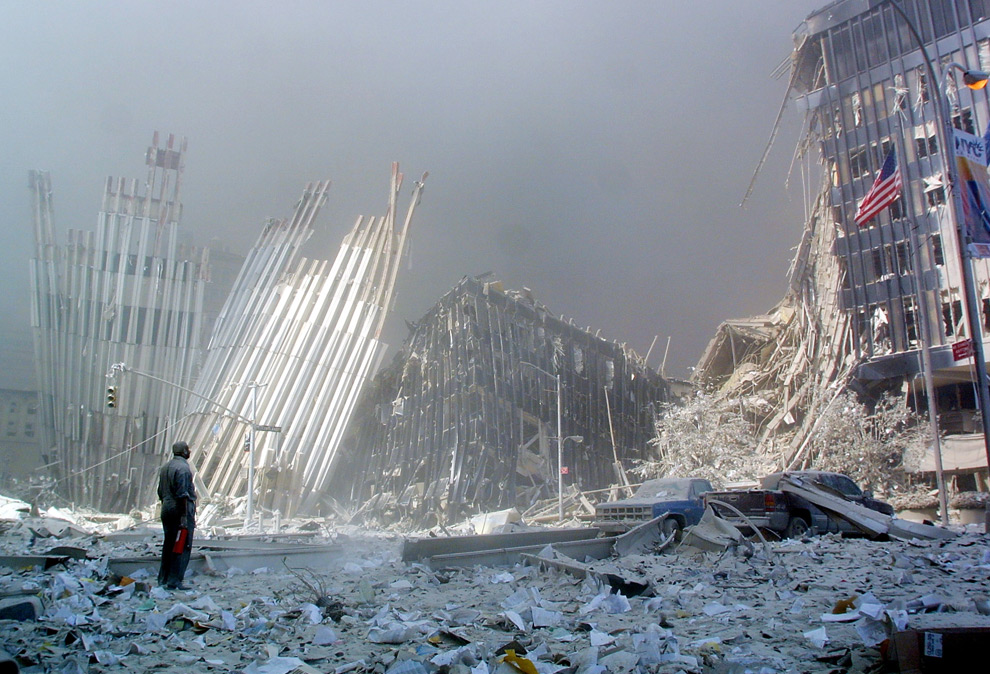
A man stands in the rubble, and calls out asking if anyone needs help
"The idea behind it is to encourage as many local people as possible to shop locally," said mayor Michael Chartier, launching the new currency at the Town Hall.
Why would a local currency cause local consumers to buy more local produce? Anyway, the logical next step would be for each household to launch its own currency.
Alex Ross endorses an independent candidate for President of the United States.
And has the LHC done the earth in yet? A complete letdown..


