three men who shared a vivid interest in making money by beating financial markets, though each expressed it in a slightly different way. They are Claude Shannon, the engineer who founded modern information theory at Bell Laboratories; Edward Thorp, a mathematician who collaborated with Shannon when they overlapped for a time at the Massachusetts Institute of Technology, before setting out on a long career as an investor; and John Kelly Jr., a Bell Labs physicist who came up with a controversial formula for betting (or investing, if you prefer) that since has become known as the Kelly criterion.
The book is populated with colorful incidental characters, as well: horse-race tout sheet pioneers John Payne and Moe Annenberg; mobsters Longy Zwillman and Ben "Bugsy" Siegel; G-man J. Edgar Hoover and US attorney Rudolph Giuliani; economists Paul Samuelson and Robert Merton; science fiction authors L. Ron Hubbard and Arthur C. Clarke; conglomerateurs Emmanuel Kimmell and Steve Ross (they built Time-Warner); filmmakers Robert Evans and Mario Puzo; and hedge fund operators Ivan Boesky and John Meriweather (of Long Term Capital Management). All mix and mingle in his pages.
Monday, September 11, 2006
Claude Shannon, Speculator


Thursday, August 31, 2006
Monty Hall again
Well, it is a remarkably simple strategy.The extraordinary feature of the two-box problem is that there is a strategy that seems better than always switching or always sticking, one that beats random choice even in a situation of almost total ignorance.
Nicely done
Tuesday, August 29, 2006
Monism?
The origins of loop quantum gravity can be traced back to the 1980s, when Abhay Ashtekar, now at Pennsylvania State University in University Park, rewrote Einstein's equations of general relativity in a quantum framework. Smolin and Carlo Rovelli of the University of the Mediterranean in Marseille, France, later developed Ashtekar's ideas and discovered that in the new framework, space is not smooth and continuous but instead comprises indivisible chunks just 10-35 (Rajeev: 10 to the power of -35) metres in diameter. Loop quantum gravity then defines space-time as a network of abstract links that connect these volumes of space, rather like nodes linked on an airline route map.
From the start, physicists noticed that these links could wrap around one another to form braid-like structures. Curious as these braids were, however, no one understood their meaning. "We knew about braiding in 1987," says Smolin, "but we didn't know if it corresponded to anything physical."
Instead of thinking of preons as particles that join together like Lego bricks, he concentrated on how they interact. After all, what we call a particle's properties are really nothing more than shorthand for the way it interacts with everything around it. Perhaps, he thought, he could work out how preons interact, and from that work out what they are.
To do this, Bilson-Thompson abandoned the idea that preons are point-like particles and theorised that they in fact possess length and width, like ribbons that could somehow interact by wrapping around each other. He supposed that these ribbons could cross over and under each other to form a braid when three preons come together to make a particle. Individual ribbons can also twist clockwise or anticlockwise along their length. Each twist, he imagined, would endow the preon with a charge equivalent to one-third of the charge on an electron, and the sign of the charge depends on the direction of the twist.
The simplest braid possible in Bilson-Thompson's model looks like a deformed pretzel and corresponds to an electron neutrino (see Graphic). Flip it over in a mirror and you have its antimatter counterpart, the electron anti-neutrino. Add three clockwise twists and you have something that behaves just like an electron; three
anticlockwise twists and you have a positron. Bilson-Thompson's model also produces photons and the W and Z bosons, the particles that carry the electromagnetic and weak forces. In fact, these braided ribbons seem to map out the
entire zoo of particles in the standard model.
In Markopoulou and Kribs's version of loop quantum gravity, they considered the universe as a giant quantum computer, where each quantum of space is replaced by a bit of quantum information. Their calculations showed that the qubits' resilience would preserve the quantum braids in space-time, explaining how particles could be so long-lived amid the quantum turbulence.
Smolin, Markopoulou and Bilson-Thompson have now confirmed that the braiding of this quantum space-time can produce the lightest particles in the standard model - the electron, the "up" and "down" quarks, the electron neutrino and their antimatter partners
Meanwhile, Markopoulou's vision of the universe as a giant quantum computer might be more than a useful analogy: it might be true, according to some theorists. If so, there is one startling consequence: space itself might not exist. By replacing loop quantum gravity's chunks of space with qubits, what used to be a frame of reference - space itself - becomes just a web of information. If the notion of space ceases to have meaning at the smallest scale, Markopoulou says, some of the consequences of that could have been magnified by the expansion that followed the big bang. "My guess is that the non-existence of space has effects that are measurable, if you can only see it right." Because it's pretty hard to wrap your mind around what it means for there to be no space, she adds.
Intelligent leaders
It might interest you to know that not a single serious study has ever been able to demonstrate a link between “emotional intelligence” and leadership effectiveness. The most robust and consistent single predictor of leadership effectiveness is, simply, intelligence. Emotional intelligence sells well, but scientific evidence supporting it is almost as solid as that supporting the effectiveness of homeopathy.
Expressed loosely, being smart makes women patient and makes men take more risks
Monday, August 28, 2006
On Terrorism
1. Taleb is wrong when he says
"you may believe, say, that financial markets will probably go up, while you behave, sensibly, as if they will go down. The reason? Because you think it very likely that they will go up a little, but, in the unlikely event that they go down, you think they will go down a great deal."
2. "successful suicide bombings became even slightly more common, can we really be confident that other fundamentalists would not copy that behaviour". This is quite correct- we should be preventing these attacks, but we also need to realize that there are other serious problems. If its really our intention to save lives, rather than simply political PR, we should see where our efforts can actually save most lives. By all means, prevent these attacks, but prioritize.
3. People are tough. I have seen half-dozen attacks on Mumbai. The latest was the train atrocity. People are back on the trains now. I can't imagine the terrorists believe they are any closer to their objectives because of their crimes. That must be pretty frustrating for them, and that should help prevent this: "Potential offenders catch the idea of offending from each other. And just like a disease that starts with only a few people and becomes an epidemic, once it reaches a tipping point the amount of criminal behaviour explodes". The American and British
responses are far more encouraging to them. Why give them the satisfaction of letting them think we consider them a huge issue? They are not.
I think this article in the Financial Times is also in favor of a more low-key approach to the "War on Terror". I also think Chris Dillow makes good sense here.
Friday, August 25, 2006
May I bring to your attention my paper
Perelman, by casually posting a proof on the Internet of one of the most famous problems in mathematics, was not just flouting academic convention but taking a considerable risk. If the proof was flawed, he would be publicly humiliated, and there would be no way to prevent another mathematician from fixing any errors and claiming victory. But Perelman said he was not particularly concerned. “My reasoning was: if I made an error and someone used my work to construct a correct proof I would be pleased,” he said. “I never set out to be the sole solver of the Poincaré.”
Paying the price
Tuesday, August 22, 2006
Monty Hall is back
This problem is real. Anyone who has changed jobs, bought a house or planned a merger has encountered a version of the two-box game; keep what you know, or go for an uncertain alternative. But familiar problems are not necessarily easy to model.
Sunday, August 20, 2006
Two on India
The second is subscription only, and is about the World Bank's India Development Policy Review.
Look at the detail, however, and you may despair at the depth and complexity of the problems India faces. For all its achievements, poverty remains entrenched. Some 260m people survive on less than one dollar a day. Nearly half of the country's children below the age of six are undernourished. More than half of its women are illiterate. Half its homes have no electricity, and in one state, Chhattisgarh, 82% are not even connected by road. Nor is there a huge pot of money to throw at these shortages. The government's average budget deficit, from 2000 to 2004, was exceeded only by that of Turkey. Even when it does spend money, the pipeline between government coffers and the intended beneficiaries is corroded by corruption, and cash seeps out.
India, for example, has a government committed to providing all its people with health care. But there are only five countries in the world where a lower proportion of spending on health comes from the government—just 21% (compared with, for example, 45% in America). So even the poor are paying for private health care. A survey has also found that health care absorbs a bigger share (27%) of low-level “retail” bribery than any other government function...Another found that between 1999 and 2003 the percentage of children fully immunised against childhood diseases had fallen from 52% to 45%.
Although India has, compared with other countries, a relatively equal distribution of income, it is a deeply unequal society, partly because of its legacy of social stratification and exclusion. The caste system is proving resilient, and there is evidence that, in some respects, the prejudice against girl children is worsening. In rich areas, sex-selective abortion is leading to highly skewed sex ratios at birth. Nor is the bias any less among the poor. A girl born in the early 1990s was 40% more likely than a boy to die between her first and fifth birthdays
The article in the new issue is about the Maoists in India. Not suprisingly, the epicenter is in the very parts, including Chattisgarh, which are falling further behind the rest of the country. These, though, are no defenders of the poor
Several hundred had mounted a co-ordinated attack on a police station, a paramilitary base and a relief camp for displaced people. They killed more than 30 of the camp's residents, mostly by hacking them to death with axes. The scholarly Mr Ueike did boast that his army relied on “low-tech weapons”.
This was the latest battle in a year-long civil war in Dantewada district, in which more than 350 people have been killed, and nearly 50,000 moved into camps such as the one at Errabore.
In nearly 1,600 violent incidents involving Naxalites last year, 669 people died. There have been spectacular attacks across a big area: a train hold-up last month involving 250 armed fighters, a jailbreak freeing 350 prisoners, a near-miss assassination attempt in 2004 against a leading politician. “Naxalism” now affects some 170 of India's 602 districts—a “red corridor” down a swathe of central India from the border with Nepal in the north to Karnataka in the south and covering more than a quarter of India's land mass.
In one there is a hand-pump installed by the local government, but the well is dry. There are no roads, waterpipes, electricity or telephone lines. In another village a teacher does come, but, in the absence of a school, holds classes outdoors. Policemen, health workers and officials are never seen. The vacuum is filled by Naxalite committees, running village affairs and providing logistic support to the fighters camping in the forest.
This is a dirty little war in which truth was long ago a casualty. Salwa Judum itself is also responsible for displacing people—a “scorched village” policy intended to starve the Maoists of local support. This recognises that the Naxalites' real strength lies not in their guerrillas in the jungle, with their peaked caps and “country-made” rifles, but in their civilian networks in the villages themselves....Even Mr Gill, who has seen more brutality than most, thinks the Maoists stand out in this respect: “Their ideology is that the manner of killing should frighten more than the killing itself.”
Salwa Judum, too, is accused of intimidation, extortion, rape and murder. Its thugs have been manning roadblocks, supposedly to hunt for Maoists, but also to demand money. Some SPOs—like some Naxalites—may be local hoodlums, who have signed up for the money on offer, and the shiny new bicycles and motorbikes still wrapped in plastic at the Dornapal police station. Some families refusing to join Salwa Judum on its “combing” operations—rampages of arson, thuggery and pillage—have been “fined” or beaten. A report on Salwa Judum produced in April by a number of civil-liberties groups concluded that its formation had “escalated violence on all sides...Salwa Judum and the paramilitary operate with complete impunity. The rule of law has completely broken down.”
He (Ajai Sahni of the Institute of Conflict Management, a Delhi think-tank) also says that the Naxalites have been among the most principled of terrorist groups in selecting their targets. Their attacks are not random; though, because they so often use crude landmines, they may kill the wrong people. Their leaders are thinking far into the future, taking a 20- to 25-year view of their struggle. “Liberated” areas, such as their part of Dantewada, would be expanded until they pose a threat even to India's cities.
Nepal's Maoists, with whom the Indian party has “fraternal” links, are a model of how such a strategy can work. Having managed to exclude the state from virtually all the countryside, and waged war for a decade, the Maoists in Nepal are now negotiating, from a position of some strength, their share in government—a decision their Indian comrades quietly deplore, despite a pretence of solidarity.
No deal
In recent years the United States has accounted for about 21 percent of the world's greenhouse gas emissions. China comes in second at about 15 percent. While many countries have stabilized their greenhouse gas levels, emissions from both nations, but especially China, are growing rapidly. Current projections suggest that by 2025 total emissions from the United States will increase by about one-third. By that year, China's emissions are expected roughly to double.... It follows that if an international agreement requires reductions, China and the United States will have to bear the brunt of the expense.
the biggest losers from greenhouse gas pollution are likely to be India and Africa. Some of the most detailed, careful and influential projections have been made by Yale University's William Nordhaus and Joseph Boyer. Nordhaus and Boyer show that in terms of human health and agricultural loss, India and Africa are by far the most vulnerable regions on Earth. Because of an anticipated increase in malaria, Africa will probably be hit especially hard, and India is expected to suffer a large increase in premature deaths as well.
The two nations now most responsible for the problem have comparatively little incentive to do anything about it.
Thursday, August 17, 2006
Beauty bare
And Scientific American has an article on Alain Connes and his hopes that non-commutative geometry could explain the structure of space-time.
As an example, Connes refers to the way particle physics has grown: The concept of spacetime was derived from electrodynamics, but electrodynamics is only a small part of the Standard Model. New particles were added when required, and confirmation came when these predicted particles emerged in accelerators.
But the spacetime used in general relativity, also based on electrodynamics, was left unchanged. Connes proposed something quite different: "Instead of having new particles, we have a geometry that is more subtle, and the refinements of this geometry generate these new particles." In fact, he succeeded in creating a noncommutative space that contains all the abstract algebras (known as symmetry groups) that describe the properties of elementary particles in the Standard Model.
I don't understand any of the details of the latter, and only the most basic concepts of the first, but it feels nice that creatures of flesh and blood can actually think such thoughts.
Monday, August 14, 2006
Retailing and Software
Some commentators have expressed concern that wage inflation in India is blunting the country's competitive edge in software services. These fears are overstated. It isn't particularly worrisome from India's perspective that the country's software engineers are now only a sixth as cheap as their U.S. counterparts. In 1998, that wage difference was about twice as large. The skills gap between its computer programmers and those from developed countries is shrinking even faster.
That doesn't mean that such jobs are open to everyone. "Only those individuals have been able to gain entry into this industry whose parents are both quite highly educated,'' says Anirudh Krishna, a professor of public policy at Duke University in Durham, North Carolina.
Krishna's research on three Bangalore-based software companies shows that undereducated parents, unaware of the potential in the software industry, fail to prepare their children for the available opportunities. Parental ignorance constrains the size of the talent pool.
term that International Monetary Fund Chief Economist Raghuram Rajan uses for the challenge India will face as rising software wages make engineers so expensive that other sectors of the economy, especially labor-intensive manufacturing, can't afford them.
Wednesday, August 09, 2006
Truth Serum
have each salesperson choose a personal balance of fixed and variable compensation. For example, the salesperson can choose a high commission percentage with no fixed salary or, at the other extreme, a modest fixed salary and no commission--or some combination in between. Each choice implicitly reveals how much the salesperson plans to sell, much as an insurance subscriber's choice of deductible and premium reveals how sick she is. Based on a truth-telling mechanism from game theory, this design works on paper.
Monday, August 07, 2006
On inequality
Its important to realize that these statistics are for all of India- a huge place. There is a lot of variation within the country.
However, it is broadly true that your well-being, and the social status that you enjoy, is largely determined by the family that you are born in into.
In the long run, this could cause India to go the way of Latin America. While the US followed a policy of homesteading (read this article by Hernando De Soto on the squatters who built America), land in Latin America was distributed by the government. Naturally, the wealthy and powerful grew even more wealthy and powerful. This could be one reason why wealth in Latin America has been tainted, and society has bene torn apart by the conflict between ultra-conservative reactionaries and redistributionist radicals.
This is related to one reason why I am against restictions on immigration into the large cities. In a country that fails to provide basic health-care and education to its rural poor, the alternative to internal migration is revolution.
Wednesday, August 02, 2006
On the workings of the Indian Economy
The New Economist links to a World Bank working paper by by Franklin Allen, Rajesh Chakrabarti, Sankar De, Jun Qian and Meijun Qianon on "Financing Firms in India. "
Our evidence, including results based on a survey of small- and medium-scale private firms, shows that alternative financing channels provide the most important source of funds. We also find that informal governance mechanisms, such as those based on reputation, trust and relationships, are more important than formal mechanisms (e.g., courts) in resolving disputes, overcoming corruption and supporting growth.
Now, how do businesses survive the corruption?
Perhaps one of the most effective solutions for corruption for firms in this sector is the common goal of sharing high prospective profits. This common goal can align interests of the investors and government officials with entrepreneurs and managers to overcome numerous obstacles.
Another potential effective solution for corruption is competition among local governments/ bureaucrats from different regions within the same country. Entrepreneurs can move from region to region to find the most supportive government officials for their private firms, which in turn motivates officials to lend "helping hands" rather than "grabbing hands," or else there will be an outflow of profitable private businesses from the region. This remedy should be typically available in a big country with multiple regions like India.
Tuesday, August 01, 2006
What price peace?
It's probably fair to say that the economics of national security had its beginnings in an essay by William D. Nordhaus of Yale University that appeared in December 2002, first in a non-technical essay in The New York Review of Books, then as a publication of the American Academy of Arts and Sciences…
It might seem faint-hearted to take seriously beforehand the task of estimating war's potential cost, wrote Nordhaus, slyly anticipating his critics, "a sign of insufficient resolve at best and appeasement at worst," but in fact it was simply realistic. "...[M]ost people recognize that the costs in dollars, and especially in blood, are acceptable only as long as they are low. If the casualty estimates mount to the thousands, if oil prices skyrocket, if a war pushes the economy into recession or requires a large tax increase, and if the United States becomes a pariah in the world because of callous attacks on civilian populations, then decision-makers in the White House and the Congress might not post so expeditiously to battle."…
And after disentangling direct military spending from various follow-on costs -- occupation and peacekeeping, reconstruction and nation-building, humanitarian assistance, the impact on oil markets and macroeconomic impact, Nordhaus produced a pair of estimates of the war's likely cost over a the course of a decade, low and high --$99 billion after a short and favorably resolved battle, compared to $1,934 billion, or almost $2 trillion dollars, nearly 20 percent of GDP, in the event of a protracted war with an unfavorable outcome.
As it happened, a trio of University of Chicago economists also produced in 2003 an estimate of the costs of the war, which came to very different conclusions -- partly by taking the analysis a step further and asking, compared to what?...
Assuming that Saddam had the same kind of staying power as repressive regimes in North Korea and Cuba, the Chicago economists concluded that the invasion would be a bargain, for Americans and Iraqis alike. The cost of continuing to contain Saddam at the same level as the precious decade -- 30,000 troops, 30 ships and 200 aircraft and their crews -- would add up to $380 billion going forward. "This dwarfs any reasonable estimate of US war costs," they wrote -- even before the possibility of increased terrorism was over the next twenty years was added in.
What about the Iraqis? What about the cost of war to them? Since Saddam came to power in 1979, their economy had stagnated, the Chicagoans noted; income per person had fallen by as much as 75 percent. They toted up the loss of lives as well -- the war with Iran, the repression of the Shiites, the Kurds and the Marsh Arabs, something like half a million premature deaths over a quarter-century, and projected the record into the future (with a suitable discount rate of 2 percent, and a 3 percent probability of spontaneous regime-change) and concluded another 200,000 to 600,000 Iraqis could be expected to die under a policy of continued containment were Saddam and his henchmen to continue to rule for another 33 years.
In contrast, after a forcible regime change, the Iraqi economy begins growing again. The war itself costs no more than a half a year's GDP. Oil revenues swell, income per person grows enough to make up for the quarter-century decline. "At first, it may seem surprising that war can lead to a huge improvement in human welfare. But, in fact, this conclusion is hard to escape so long as regime change even partly undoes the collapse in living standards under Saddam" -- at least it does as long as the killing stops.
And what if doesn't? Last week the Chicagoans were back, with a revised and considerably expanded rewrite of their 2003 paper, presented by Davis to the NBER's Summer Institute. Gone were some of the slam-bang certainties of the earlier version ("...[T]he costs of containment dramatically outweigh the costs of war according to our analysis"). Added were a number of cost-of-capital subtleties in calculating the cost of various contingencies, and a broader view of the possibilities themselves. Unchanged was the insistence that any judgment of the cost and efficacy of the invasion of Iraq would have meaning only when compared to the cost of /not/ invading -- that is, to maintaining a policy of containment.
What was striking, however, was that somehow the Chicagoans' numbers had changed.
In his role as discussant, Yale's Nordhaus underscored the disparity. In 2003, he noted, on the eve of the war itself, the Chicagoans had rated the cost of containment as $630 billion, compared to a projected $125 billion cost of war -- a virtual no-brainer. In the 2006 version, with the advantage of "partial hindsight" creeping in despite their determination to write as though they were still looking forward from early 2003, their (backward-looking) forward-looking cost of containment had become $297 billion, against a best guess of the cost of the war of $414 billion -- a very dramatic swing.
The words with which Nordhaus closed his 2002 discussion of the economic consequences of a war with Iraq suggest just how imaginative a before-the-fact analysis must be in the future if it is to be persuasive:
"The cost of a war may turn out to be low, but the cost of a successful peace looks very steep. If American taxpayers decline to pay the bills for ensuring the long-term health of Iraq, America would leave behind mountains of rubble and mobs of angry people. As the world learned from the Carthaginian peace that settled World War I, the cost of a botched peace may be even higher than the price of a bloody war"
Monday, July 31, 2006
Lazy philanthropy
A politicized free-for-all transfers money from projects that have been shown to work to those that are merely plausible.
And thenThe book, called Empowerment and Poverty Reduction: A Sourcebook, was meant to be a catalogue of the most effective strategies for poverty reduction, brought together to give potential donors a sense of the current best practice. It contains a very long list of recommended initiatives, including computer kiosks for villages; cell phones for rural areas; scholarships for girls attending secondary school; school-voucher programs for poor children; joint forest-management programs; water-users groups; citizen report cards for public services; participatory poverty assessments; Internet access for tiny firms; land titling; legal reform; micro-credit based on group lending; and many others. While many of these are surely good ideas, the authors of the book do not tell us how they know that they work.
Indeed, there is reason to suspect that the authors of the sourcebook were not even looking at their own evidence. My favorite example is the description of the Gyandoot program in Madhya Pradesh, India, which provided computer kiosks in rural areas. The sourcebook acknowledged that this project was hit hard by lack of electricity and poor connectivity and that “currently only a few of the Kiosks have proved to be commercially viable.” It then goes on to say, without apparent irony, “Following the success of the initiative . . .”
Tyler Cowen points to responses by Angus Deaton, Nicholas Stern, and Jagdish Bhagwati.Primary education, and particularly the question of how to get more children to attend primary school, provides a fine test case because a number of the standard strategies have been subject to randomized evaluations. The cheapest strategy for getting children to spend more time in school, by some distance, turns out to be giving them deworming medicine so that they are sick less often. The cost, by this method, of getting one more child to attend primary school for a year is $3.25. The most expensive strategy among those that are frequently recommended (for example by the World Bank, which also recommends deworming) is a conditional cash-transfer program, such as Progresa in Mexico, where the mother gets extra welfare payments if her children go to school. This costs about $6,000 per additional child per year, mainly because most of the mothers who benefit from it would have sent their children to school even if there were no such incentive. This is a difference of more than 1,800 times.
Saturday, July 29, 2006
Are women underpaid?
Nature or Nurture?
The big surprise is among the poorest families. Contrary to what you might expect, for those children, the I.Q.s of identical twins vary just as much as the I.Q.s of fraternal twins.... [H]ome life is the critical factor for youngsters at the bottom of the economic barrel
An analysis of the reading ability of middle-aged twins showed that even half a century after childhood, family background still has a big effect -- but only for children who grew up poor.
A later study of French youngsters adopted between the ages of 4 and 6 shows the continuing interplay of nature and nurture. Those children had little going for them. Their I.Q.s averaged 77, putting them near retardation. Most were abused or neglected as infants.... Nine years later, they retook the I.Q. tests.... The amount they improved was directly related to the adopting family's status. Children adopted by farmers and laborers had average I.Q. scores of 85.5; those placed with middle-class families had average scores of 92. The average I.Q. scores of youngsters placed in well-to-do homes climbed more than 20 points, to 98.... Taken together, these studies show that the issue has changed: it is no longer a matter of whether the environment matters but when and how it matters
Wednesday, July 26, 2006
An eye for an eye
In virtually every human society, “He hit me first” provides an acceptable rationale for doing that which is otherwise forbidden. Both civil and religious law provide long lists of behaviors that are illegal or immoral — unless they are responses in kind, in which case they are perfectly fine.
Every action has a cause and a consequence: something that led to it and something that followed from it. But research shows that while people think of their own actions as the consequences of what came before, they think of other people’s actions as the causes of what came later.
Also,In a study conducted by William Swann and colleagues at the University of Texas, pairs of volunteers played the roles of world leaders who were trying to decide whether to initiate a nuclear strike. The first volunteer was asked to make an opening statement, the second volunteer was asked to respond, the first volunteer was asked to respond to the second, and so on. At the end of the conversation, the volunteers were shown several of the statements that had been made and were asked to recall what had been said just before and just after each of them.
The results revealed an intriguing asymmetry: When volunteers were shown one of their own statements, they naturally remembered what had led them to say it. But when they were shown one of their conversation partner’s statements, they naturally remembered how they had responded to it. In other words, volunteers remembered the causes of their own statements and the consequences of their partner’s statements.
What seems like a grossly self-serving pattern of remembering is actually the product of two innocent facts. First, because our senses point outward, we can observe other people’s actions but not our own. Second, because mental life is a private affair, we can observe our own thoughts but not the thoughts of others. Together, these facts suggest that our reasons for punching will always be more salient to us than the punches themselves — but that the opposite will be true of other people’s reasons and other people’s punches.
If the first principle of legitimate punching is that punches must be even-numbered, the second principle is that an even-numbered punch may be no more forceful than the odd-numbered punch that preceded it.
I think thepoint is that its really, really hard for people to put themselves in other's shoes. That explains why disasters like these occur:In a study conducted by Sukhwinder Shergill and colleagues at University College London, pairs of volunteers were hooked up to a mechanical device that allowed each of them to exert pressure on the other volunteer’s fingers.
The researcher began the game by exerting a fixed amount of pressure on the first volunteer’s finger. The first volunteer was then asked to exert precisely the same amount of pressure on the second volunteer’s finger. The second volunteer was then asked to exert the same amount of pressure on the first volunteer’s finger. And so on. The two volunteers took turns applying equal amounts of pressure to each other’s fingers while the researchers measured the actual amount of pressure they applied.
The results were striking. Although volunteers tried to respond to each other’s touches with equal force, they typically responded with about 40 percent more force than they had just experienced. Each time a volunteer was touched, he touched back harder, which led the other volunteer to touch back even harder. What began as a game of soft touches quickly became a game of moderate pokes and then hard prods, even though both volunteers were doing their level best to respond in kind.
Each volunteer was convinced that he was responding with equal force and that for some reason the other volunteer was escalating. Neither realized that the escalation was the natural byproduct of a neurological quirk that causes the pain we receive to seem more painful than the pain we produce, so we usually give more pain than we have received.
We consistently overestimate our own abilities and resolution, and underestimate those of our opponents.A week ago, Israeli officials said their military had knocked out up to half of Hezbollah’s rocket launchers and suggested that another week or two would finish the job of incapacitating the Lebanese militia. That talk has largely stopped.
No. We are not back.
Thursday, July 20, 2006
We are back
Perhaps its just that some ISPs have started sub-domain filtering. Its not quite freedom, as long as some faceless bureaucrat can deny acces even to specific sites without due process, but aleast there is no wholesale blocking.
I think this fiasco is one more argument for checks and balances, and a free press.
For now, Hooray!
Monday, July 17, 2006
The Oceans are deep, and HQ is far away
enterprising ships’ captains engaged in private trading of their own, abusing company resources for personal gain. Now, researchers at Columbia University have shown that it was this illicit trading, rather than officially sanctioned activity, that was directly responsible for the creation of the first global market and the success of the East India Company.
However, I am not sure about this claimIn a paper in this month’s American Journal of Sociology, they describe how many rogue captains ignored orders to trade in established markets and then return directly to England, choosing instead to explore new locations and trade between local Asian ports for their own personal profit. Although they were breaking the law by appropriating supplies and ship crews for this private trading, in doing so they ultimately benefited the East India Company by building a larger market and gaining a unique knowledge of local market fluctuations.
Surely the captains of the Dutch and French companies were equally enterprising? I don't know.She and co-author Peter Bearman argue that not only did these entrepreneurial individuals enable the East India Company to completely dominate East Asian trade by 1760
A good example of the advantages of delegation when knowledge is diffuse and communications is slow? A key insight of The Modern Firm by John Roberts is that when these conditions prevail, the way to go is to delegate power, while ensuring that the local guy has the right incentives. When these conditions do not apply, however, centralization could lead to lower costs.
Saturday, July 15, 2006
Healthy, wealthy, and wise?
Perhaps this is an example of diminishing returns? Really poor public health can trap you in poverty, but as people's health improves, and life expectancy goes up (beyond 40 or so, when your kids are "grown up" and working?), improvements may cease to have dramatic effects. After all, diminishing returns from capital is old hat.
I am (almost) speechless
Good for them.
HT: Lynne Kiesling at Knowledge Problem
Friday, July 14, 2006
All over the place
Guess this frenzy of Blogging will have to end as well.
In the meantime, it appears we have been too quick to jump to conclusions- these particular devils may have been innocent this time, after all. (Whats the matter with these people, though? Is this some kind of fetish, that its not enough to kill bystanders, but they must be killed with a particular explosive?)
I have been reading Nitin's blog regularly. That will have to stop, as the Office proxy blocks his site. I respect the guy's knowledge of the world, but I suspect the problem is far more complicated than we imagine. (Isn't that easy to say?) Anyway, shall try to keep up.
Why I am an optimist
People respond to incentives. When the cost of doing something goes up (perhaps the price of petrol goes up) they cut down on that activity (they switch to small cars, they drive less, they car-pool, they turn off the A/C when they don't need it). At the same time, alternatives become more attractive- alternative energy attracts more investment.
This may not apply to Global Warming, because the atmosphere is a commons- dumping CO2 into the air is effectively costless for each individual, so there is no incentive to do less.
However, a couple of stories in the Economist's Technology Quarterly make me hopeful.
One is about wave energy.The potential is huge
a report published earlier this year by the Carbon Trust, an organisation set up by the British government to help meet its targets for reducing greenhouse-gas emissions, concluded that 20% of Britain's electricity could be provided by wave and tidal power. This is four times more than previous estimates, and means that marine energy alone could enable Britain to reach its emissions-reduction targets. America, meanwhile, the Department of Energy's National Renewable Energy Laboratory has estimated that the use of wave power on the east coast could provide 10-25 times more electricity than the total wind potential of the Great Plains
Most produce electricity at a cost of between 10-20 pence (18-36 cents) per kilowatt hour (kWh), whereas electricity produced from natural gas costs around 4p/kWh.
Near Póvoa de Varzim, off the northern coast of Portugal, three 150-metre-long articulated snake-like pontoons, called Pelamis Wave Energy Converters, are in the final stages of being hooked up to the country's national grid...Each one has three power-converter modules distributed along its length, which transform the flexing motion at the snake's joints into electricity as the snakes are buffeted by the waves. The three snakes are the first stage of a planned 24-megawatt wave-power farm, which will be capable of providing 15,000 households with power. The Pelamis's design avoids the trade-off between resilience and efficiency by switching to a higher-efficiency mode in calm seas.
But the new device, called the Snapper, increases efficiency still further. Electrical generators tend to work most efficiently when a small force is applied at high speed—which is just the opposite of what wave power provides, says Ed Spooner, a consultant engineer based near Durham, in England, who invented the Snapper. His invention works much like a typical linear generator, in which a magnet is moved up and down inside coils of wire, inducing electrical currents in the process. But there is a crucial difference: alongside the coils are a second set of magnets of alternating polarity. These prevent the central magnet from moving up and down smoothly. Instead, magnetic forces repeatedly halt its motion, so that it moves up and down in a jerky fashion. The resulting series of short, rapid movements is more suitable for generating electricity than a slow, smooth movement. Early tests suggest that it could be as much as ten times more efficient than existing wave generators.
The other story is about hybrid cars like the Prius. These combine an Internal Combustion engine with a battery that never needs to be plugged in to the mains, because it draws its power from the engine. The Prius
achieves over 40 miles per gallon, perhaps 20% more than it would without hybridisation
One of them (Greg Hanssen of EnergyCS) has
replaced the original nickel-metal hydride (NiMH) battery with a higher-capacity lithium-ion battery, and has hacked the control software to prevent the petrol engine kicking in until the car is moving at high speed. As a result, his modified Prius can travel over 30 miles in all-electric mode, compared with a mile or so for a standard Prius.
studies by California's Air Resources Board confirm that generating the electricity to power cars in pure-electric mode produces only about half of the greenhouse gases of typical petrol vehicles. This assumes the power grid is half coal-fired, as America's is today. As the grid “decarbonises” over time, such emissions will fall.
Even when the petrol engine kicks in (as the master computer requires on all Prius cars at higher speeds), electric power is still blended in to improve fuel economy and provides up to 75% of the total power at 55mph.
All this efficiency need not be at the expense of power. Another pioneer is Andrew Frank, an engineering professor at the University of California at Davis.
Visitors to his lab today find a plug-in Ford Explorer sports-utility vehicle (SUV) equipped with a giant 16 kilowatt-hour (kWh) battery designed for long range—a conventional Prius battery has a capacity of 1.3kWh. He has replaced the original 3.5-litre internal-combustion engine with a frugal 1.9-litre version, thus boosting fuel economy, but the added kick from the electric motor means this SUV can still accelerate to 60mph faster than an ordinary Explorer. He has made similar modifications to a Mercury saloon, so it can travel 40 miles in all-electric mode and achieve an astounding 200mpg.
Bottomline: If we feel that CO2 is a major problem, raise the cost of throwing Co2 into the air- raise carbon taxes. Then, leave it up to the Engineers and Scientists. They have come through before.
Thursday, July 13, 2006
Some more on our neighbour
and do their best to prevent any development that could threaten their positionThe civilian elite, including a select group of English-speaking landowners and industrialists, whinge about this (Rajeev:the Army's power), but few seriously object. Living enchanted tax-free lives (Rajeev: the magazine states elsewhere that there are just 2 million tax-payers), under tight security, the rich have been courted by successive military and civilian rulers; landowners are especially prized for their ability to deliver the rural vote. Some 7% of the landowners hold over 40% of Sindh's land. Most invest little and squeeze their peasant share-croppers cruelly. A landowner in Sindh's interior told your correspondent that he would not provide his villagers with gas for cooking—though it could be had free from a local pumping-station—because he enjoyed a char-grillled meal on occasional visits to his lands.
and fail to provide even the basics of civilization, so that even the cities are no refuge for the desperateNor do all of Mr Musharraf's political allies actually want their compatriots to be educated. One minister, a rising star, was recently overheard vowing to stop any school being built on his land in Punjab; he feared that bookish serfs might demand a decent wage.
and the common people then turn to Islamist extermists who wage war on the elite.In the cities, and especially in Karachi, there is not much in the way of law and order. The rich can shield themselves from bother, by buying private security or favours from policemen, but their workers cannot.
Some of the differences with (parts of) India are of degree, not kind, but what a degree!The second explanation for General Musharraf's half-measures is that he is afraid of the extremist groups. There may be only a few thousand active militants, but their potential support is much greater. The biggest jihadi newspapers, including several banned under different names, have print-runs of up to 100,000. Islamic extremists are the only political force in Pakistan easily able to rally a crowd. On February 14th, after JUD's Mr Saeed denounced cartoons of the Prophet published in a Danish newspaper, a mob rampaged through Lahore, burning hundreds of cars and foreign businesses as well as the Punjab provincial assembly.
On Pakistan
While it may be true thatAS THE gunsmoke cleared after an attack by local Islamist guerrillas, called the Pakistan Taliban, soldiers at a wild outpost in North Waziristan found the corpses of 45 militants and four of their comrades. One of the soldiers had been decapitated alive. His missing head was later found in a captured militant's satchel.
The army is fighting a small war in North Waziristan, one of seven tribal agencies along the border with Afghanistan where it has deployed 80,000 troops. Neighbouring South Waziristan had been equally violent until, in late 2004, the army bribed local Taliban leaders to stop attacking it. These extremists have since set up an administration of sorts, having first murdered 150 of the tribal elders through whom the government used to rule.
Until 2002 the army had never entered the agencies, which are home to 6m xenophobic Pushtuns. They are run along quasi-colonial lines by a powerful civil servant, known as the political agent, whose duty is to keep the tribes quiet. Working through state-sponsored local elders, he has a pot of cash to reward good behaviour, arbitrary powers to punish transgressors—and little need to account for his actions. His main power is to exact collective punishment. When a crime is committed, the political agent can demolish houses and jail people—including children—at random until the tribe concerned delivers the alleged culprit.
A heavy majority of Pakistanis, certainly outside North-West Frontier Province, are politically secular. The Islamic parties have never won more than 11% of the vote—and that was with considerable help from General Musharraf.its also the case that
This has been helped along by the failures of the StatePakistan is a bigoted place, and becoming more so. That may be true of all countries with a Muslim majority, yet few have hurtled towards the Islamist edge as fast as Pakistan. Its leaders are at least partly to blame. Almost all of them, civilian and military, have pandered to the mullahs. In 1977 whisky-swigging Zulfikar Ali Bhutto banned alcohol. Under General Zia, the only sincerely pious leader, Pakistan introduced draconian sharia punishments, made blasphemy a capital offence and ruled that unless rape victims could produce at least four male Muslim eye-witnesses they would be held guilty of fornication, a serious crime. Ms Bhutto did not seriously attempt to repeal these laws. Nawaz Sharif tried to introduce full sharia law. And General Musharraf helped the mullahs to unprecedented power.
And Pakistan's liberal's are looking EastwardsAt the time of its creation, Pakistan had a couple of hundred Islamic schools, or madrassas. Now, having failed to build a decent education system, it has accumulated between 10,000 and 40,000 madrassas—up to 20% of which, according to a World Bank study, teach fighting skills. The national curriculum for regular schools is infected with religious and sectarian bigotry; until recently, ten-year-olds had to learn to “make speeches on jihad and shahadat (martyrdom)”.
Pakistan's impoverished public universities are largely controlled by the youth wing of the biggest Islamic party, Jamaat-e-Islaami. At the University of Punjab, in Lahore, these ambitious religionists have banned Coca-Cola, which they call “Jews' drink”. Last year, they broke the legs of a student accused of flirting with one of his female class-mates. In Islamabad, Quaid-i-Azam University has three mosques but no bookshop. One of Pakistan's handful of serious academics spoke yearningly of the liberal scholarly atmosphere he had recently enjoyed at a conference in Tehran.
Pakistan's beleaguered liberals are hoping for a cultural return from the Middle East, where General Zia dragged them. According to Khaled Ahmed, a Pakistani columnist: “If we lost our culture through Talibanisation in the west [of the country], we can get it back from India, where our culture is still alive.”
Online marketing
The guy also has a knack for horrible similies. Apparently Segmentation is not much better than traditional advertisingRishad Tobaccowala, the “chief innovation officer” of Publicis, one of the world's biggest advertising groups, and boss of Denuo, a Chicago-based unit within Publicis with the job of probing the limits of new advertising models, likens traditional Wanamaker-era advertising to “an atom bomb dropped on a big city.”
Instead of atom bombs on cities, says Mr Tobaccowala, segmentation is at best “dropping conventional bombs on villages”.As for Online advertising,
Instead of bombs, says Mr Tobaccowala, advertisers now “make lots of spearheads and then get people to impale themselves.”
Companies such as Massive and Double Fusion are already placing two-dimensional brand advertisements into games. A player moving through the streets of New York to kill something or other might see a DHL truck or a billboard. “But the future is intelligent three-dimensional ads” and “ads with behaviour,” says Jonathan Epstein, Double Fusion's boss. For instance, his technology will soon allow Coca-Cola to place a Coke can into a game, where it fizzes when a player walks by and might give him certain powers if he picks it up. If a character uses a mobile phone inside a game, the technology can swap the brand and model of the phone depending on which country the player is in. But the most important aspect of the technology, says Mr Epstein, is that it will track exactly how long the player uses the phone, thus leaving no doubt about whether an “impression” had indeed been made.
Wednesday, July 12, 2006
What is a just war?
Fact remains, that one man's terrorist is another man's hero. Who is to say who is right?
Of all the cliches I have heard in my life, this one probably irritates me the most. A terrorist is a man who knowingly kills innocent people. Innocent, unsuspecting people going about their lives peacefully.Such a man can not be thought of as a hero in any civilised society. Which is why even in Pakistan, they try their best to pretend that the attacks had nothing to do with them. They claim that the terror attacks have been carried out by someone else. In Pakistan, they consider soldiers who fought in wars as heroes. They think of the guys who attacked Kargil as heroes.
About Time
What I did read was "A hole at the heart of Physics" by George Musser.The article is behind the pay-wall, but google has a cache here. Its on how Philosophers may be able to help Physicists decipher Time.
There is some stuff about General Covariance, which is supposedly fundamental to Relativity, but which I could make neither head nor tail of, and so obviously cannot be important.
However, the bit about the Arrow of Time was quite nice. I have come across this stuff before, and Wikipedia explains it here.The basic question is why cups can break, and glass shatter, but broken cups never re-assemble themselves. This is a mystery because the basic laws of Physics seem time-invariant. They work whether time moves forward or backward (we could run a movie of two ball-bearings colliding backwards or forwards, and would not know which is which). One explanation is that this is a result of the Second Law of Thermodynamics, and this where the article points out something that I should have noticed long ago- its so simple.
The basic idea is that there are more ways for a system to be disordered than to be ordered. If the system is fairly ordered now, it will probably be more disordered a moment from now. This reasoning, however, is symmetric in time. The system was probably more disordered a moment ago, too. As Boltzmann recognized, the only way to ensure that entropy will increase into the future is if it starts off with a low value in the past. Thus, the second law is not so much a fundamental truth as historical happenstance, perhaps related to events early in the big bang. (Italics added)
Well, I thought that was pretty neat.Other theories for the arrow of time are similarly incomplete. Philosopher Huw Price of the University of Sydney argues that almost every attempt to explain time asymmetry suffers from circular reasoning, such as some hidden presumption of time asymmetry.
That settles it
Liking this blog, on average, is a sign that you have broad interests and thus are ill-suited for graduate study in economics.Broad interests- thats a good thing, isn't it?
"Privatization"
He points out thatIn the year ended March 2005, 73 unprofitable companies controlled by the federal government incurred total losses of about $2 billion, of which two-thirds was accounted for by just 10 companies, including two from the fertilizer industry and two from coal, one telephone-equipment manufacturer, one drugmaker and one railway operator.
WhileThe Common Minimum Program of May 2004, the agenda agreed on by the government and its allies, states that, ``generally, profit-making companies will not be privatized.''
Obviously``Chronically loss-making companies will either be sold off or closed after all workers have got their legitimate dues and compensation,'' says the Common Minimum Program, giving the government latitude that it has just not used effectively.
More good stuff. Whats the world coming to, when a Bloomberg correspondent writes like a political analyst?The trick lies in separating distressed companies from surplus labor, with generous compensation and retraining benefits for the latter. This strategy would serve the twin goals of increasing the value of distressed assets and reducing the opposition of labor to outright sales.
The eastern Indian state of West Bengal, ruled by Marxists, has implemented just such a strategy, even roping in the U.K. Department for International Development to foot the cost of worker payouts.
Some light relief
Finally, I have realized that our quest for appropriate sizing must involve physical activity. Running produces a six-pound weight loss, as I cough out a lung immediately afterward. Walking also works, and driving while yelling, which is aerobic.
Tuesday, July 11, 2006
Monday, July 10, 2006
Heels on Fire
The dimensions of morality
He then makes this (not terribly original) point:If you are a nation of billiard balls, you want a morality that protects individuals from harm, but otherwise leaves them as free as possible. You want to build only on the first two foundations, which gives you the standard American/Enlightenment morality that focuses on harm/suffering/victimization and on fairness/rights/justice.
But if your society is a hive, you won’t be quite so concerned that every individual is getting his or her fair share; you’d be more concerned about the integrity of the hive itself, and the last three foundations are all about that: being very aware of who your “team” is and treating its members better than others; knowing and respecting the hierarchical divisions of labor that let your hive function efficiently and compete with other hives; and guarding your own personal purity—denying yourself the carnal and self-indulgent pleasures, and instead striving to live in a pure and holy way, ready to communicate with the God that your hive is oriented around.
Whichever side you are on, you probably think the other one is motivated by hidden, devious, and ugly motives. I guarantee you: You are exaggerating. Everyone is morally motivated, even though those moral motives sometimes cause people to do terrible things. Just read Osama bin Laden or Adolf Hitler; you’ll find hypermoralism. By all means, work to make the world a better place, but understand first that much of the evil in our world comes from people pursuing differing notions of virtue.
This is his Edge home page, and this is his contribution to the Edge 2005 "World question center".
For what its worth, I agree with him- a lot of the heat in public debate comes from genuine anger, and a conviction that anyone who "won't see that" must be evil. And of course, I am a complete billiard ball.
HT: Aldaily Scitechdaily.
Sunday, July 09, 2006
More Pankaj Mishra
the country's $728 per capita gross domestic product is just slightly higher than that of sub-Saharan Africa.
as the 2005 United Nations Human Development Report puts it, even if it sustains its current high growth rates, India will not catch up with high-income countries until 2106.
Nor is India rising very fast on the report's Human Development index, where it ranks 127, just two rungs above Myanmar and more than 70 below Cuba and Mexico.
nearly 380 million Indians still live on less than a dollar a day.
Malnutrition affects half of all children in India, and there is little sign that they are being helped by the country's market reforms, which have focused on creating private wealth rather than expanding access to health care and education.
communist insurgencies (unrelated to India's parliamentary communist parties)have erupted in some of the most populous and poorest parts of north and central India.
At the same time, I feel Nitin is far, far too optimistic. "The 21st century will be India’s"? That is far from being the only possible outcome. For example, we are far poorer than Argentina (per capita GDP: $13,600) . Who says we can't do what they did: grow strongly for a few decades (or years), then fall prey to political populism and economic stagnation? God knows our politicians would not mind. And I would call that an optimistic scenario: at least Indian children won't be starving en masse.
In fact, I am willing to concede everything that Pankaj Mishra says about the state of India today. And the role of Cassandra is hugely valuable
Many serious problems confront India. They are unlikely to be solved as long as the wealthy, both inside and outside the country, choose to believe their own complacent myths.
This is BS
Saturday, July 08, 2006
More about genetic engineering
They have a long way to go.
But this is cool:In living organisms, biological machinery composed of enzymes such as polymerase is able to manufacture and repair DNA molecules at speeds of up to 500 bases a second, with error rates of about one base in a billion. That represents a trillionfold performance improvement in yield throughput output divided by error rate) over the best DNA synthesis machines, which add a base every 300 seconds.
AndWhat we mean by that term is well illustrated by Elowitz and Leibler’s ring oscillator, which they began as an attempt to build a synthetic biological clock, hoping that it would provide insight into the clocks that exist naturally in biological systems.Their basic circuit consisted of a DNA ring called a plasmid containing three genes: tetR, lacI and λ cI, which encode the proteins TetR, LacI and λ cI, respectively. For any gene to be translated into a protein, the enzyme polymerase must first bind to a region of the DNA strand called a promoter that lies upstream of the gene. Polymerase then transcribes the gene into messenger RNA, which in turn is translated into a protein. If polymerase cannot bind the promoter, the gene is not translated and the protein is not made. Elowitz and Leibler arranged for the protein products of the three genes in their circuit to selectively bind to one an-other’s promoter regions. Thus, the LacI protein would bind the tetR promoter, whereas the λ cI protein would bind the lacI gene’s promoter, and TetR would bind the promoter of the λ cI gene. These interrelations enable the protein product of one gene to block polymerase from binding to the promoter of another gene. Manufacture of the three proteins consequently happens in an oscillatory cycle: an abundance of LacI protein represses tetR gene activity; the absence of TetR protein then allows the λ cI gene to be turned on, which has the effect of repressing LacI production, and so on. When one of the protein products in this cycle is also linked to a gene for making a green fluorescent protein and the entire circuit is inserted into bacteria, the oscillation of this device can be observed as the bacteria blink on and off like holiday lights.
Inspired by these early examples, one of us (Endy), along with Knight and our M.I.T. colleague Randy Rettberg, is developing a library of biological components similar to the libraries available to chip designers. This Registry of Standard Biological Parts should facilitate a wide range of biological building projects, and our hope is that others will contribute new entries. So far the registry contains more than 1,000 individual BioBricks, as we call them, including many parts analogous to electronics, such as inverters, switches, counters, amplifiers, and components that can receive input or output a display. We have also defined a standard signal carrier—polymerase per second, or PoPS—akin to the current in a wire connecting two electronic components, so that bio fab engineers can more easily combine and reuse genetic devices.
Friday, July 07, 2006
The decisive moment
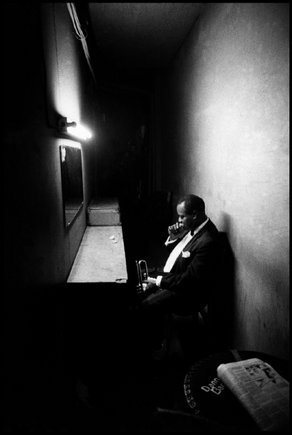
Slate has some lovely pictures on this theme- the title comes from Cartier-Bresson's photograph. Check them out.
I particularly liked this one of Armstrong, but there is lots more.
Thursday, July 06, 2006
I don't believe it!
Now what do I do? Act normal, I guess. :-)
Thiruvananthapuram
Buahahahaha
Tuesday, July 04, 2006
Yap Yap Yap
CONTRARY to popular belief, mobile phones do not pose a safety threat to airliners. On an average transatlantic flight, several phones are usually left switched on by accident, and the avionics systems on modern aircraft are hardened against radio interference. No, the use of phones on planes is banned because they disrupt mobile networks on the ground. An airliner with 500 phones on board, whizzing across a city, can befuddle a mobile network as the phones busily hop from one base-station to the next.
They also point out that even this problem is more or less solved.
Scientific American disagrees.