Tuesday, August 26, 2008

But..pointy headed bosses?

Joel Spolsky learns why Middle Management exists.
And frankly, people here seem to be happier with a little bit of middle management. Not middle management that's going to overrule the decisions they make on their own. Not symbolic middle management that only makes people feel important. But middle management that creates useful channels of communication. If my job is getting obstacles out of the way so my employees can get their work done, these managers exist so that, when an employee has a local problem, there's someone there, in the office next door, whom they can talk to.
This is, of course, just one reason to have layers of middle management.

I was very surprised that someone as obviously bright as Joel would need to discover this for himself. Surely he would not have thought of running Microsoft the way he runs Fog Creek, and it is not unknown for software systems to have layers of abstraction to allow enable developers to manage its complexity, but I guess it is a question of knowing just when to add a layer of management.

The world’s most efficient, cutest and tastiest cows

The Times
For between £200 and £2,000, people can buy a cow that stands no taller than a large German shepherd dog, gives 16 pints of milk a day that can be drunk unpasteurised, keeps the grass “mown” and will be a family pet for years before ending up in the freezer
I wonder what this will do for vegetarianism, when suburban children realize that they just ate Cupcake's sister for dinner. Yum!

HT: Aldaily

E=MC2

William Tucker at the Freakonomics blog argues for the green credentials of Nuclear Power

A 1,000-megawatt coal plant is fed by a 110-car coal train arriving every day. A nuclear reactor is replenished by a single tractor-trailer bringing new fuel rods once every 18 months. Over the course of a year, the coal plant will release 400,000 tons of sulfur and fly ash. Some of this ends up in landfills, but most escapes into the atmosphere where it kills 30,000 people annually, according to the E.P.A. Then there’s the carbon dioxide — seven millions tons annually from each plant — which is the principle cause of global warming.

By comparison, the “wastes” of nuclear power can once again be contained in a single truck. I recently watched one of these spent fuel assemblies being lifted into the receiving room at France’s nuclear reprocessing center in La Hague. It is an eerie sight — the most radioactive object in the solar system emitting double what you would have received standing at ground zero in Hiroshima. Yet a three-foot wall separated us, and the emissions didn’t even register on our badges. More than 95 percent of the spent fuel rod can be recycled. That is why France is able to store all its “waste” (from 30 years of producing 75 percent of its electricity) beneath the floor of a single room.

The most radioactive object in the Solar System??

Anyway, the death toll from Chernobyl appears to have been far less than was originally anticipated, and it appears that Nature thrives where humans dare not live.

Less than a mile from what is left of Chernobyl's ill-fated fourth reactor, a pair of elks is grazing nonchalantly on land irradiated by the world's worst nuclear accident. In nearby Pripyat, an eerie husk of a town where 50,000 people used to live before they were forced to flee on a terrifying afternoon in 1986, a Soviet urban landscape is rapidly giving way to wild European woodland.

Radiation levels remain far too high for human habitation but the abandoned town is filled with birdsong and the gurgling of streams forged by melting snow. Nobody thought it possible at the time but 20 years after the reactor exploded on 26 April 1986, during an ill-conceived "routine" Soviet experiment, Chernobyl's radiation-soaked "dead zone" is not looking so dead after all.

The next obstacle: the cost of building and operating a Nuclear Power plant. Then, public opinion.

Marketing myopia

John Kay takes Theodore Levitt on

Penn Central could have taken to the skies, and the buggy whip manufacturers might have made air filters, but there is no reason to think that they would have been any good at these activities: no reason to think that they would have performed better than any other firm which saw airlines or automobile components as a new market opportunity.

Postscript: The implicit assumption behind Levitt's theory is that firms should at all times try to grow or at least survive. At the same time, I think he would argue that firms should try and maximize shareholder value. I think John's thesis is based on the contradiction between the two.

Monday, August 25, 2008

Signs of approaching winter in London

The Sun rises at 6 pm am.

The Dawn Chorus consists of one crow.

Postscript: Thanks to John for catching the error.

Sunday, August 24, 2008

What is Mathematics?

VI Arnold has a unique viewpoint
Mathematics is a part of physics. Physics is an experimental science, a part of natural science. Mathematics is the part of physics where experiments are cheap.

Animals!

An article in the New York Times about bikers in New York who have formed a group to care for abused animals.

Vegetarian Hell's Angels- what is the world coming to?

Saturday, August 23, 2008

Information Visualization

Paul Kedrosky generates tag clouds for Ben Bernanke's Jackson Hole speech this year

and last year

and concludes

Anyone else get the feeling that Ben's more worried about the entire financial system than about mere mortgages? Me too.
HT: Brad DeLong

Blown to bits

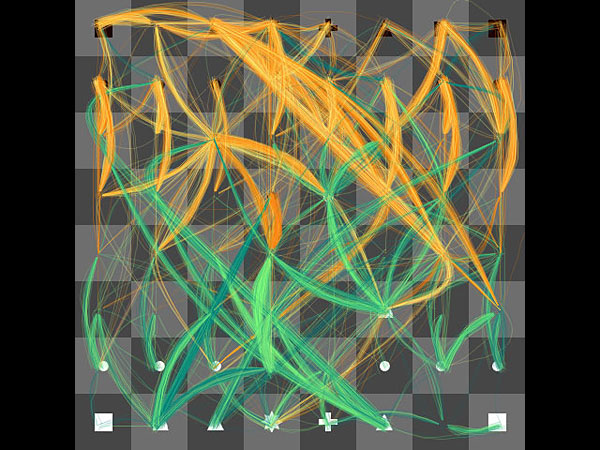
Slideshow in Slate about Information Visualization.

The points in the image below represent every possible nine-letter combination of the DNA letters A, T, C, and G. The arcs represent sequences in the fruit fly, mouse, and human.

The chessboard represents a chess program actually working out its next move. I tried the original program and it is amazing to view.

And this masterpiece of abstract art represents US population data by county in the years 1790-2000

HT: Andrew

Surreal

Pervez Musharraf on the Daily Show with Jon Stewart.

Who told him to go on? How does Jon Stewart get these people?

Basics

The Built on Facts blog asks a question in Physics which anyone can understand, and could have been asked at any time after Maxwell's work 150 odd years ago.
Short version: an accelerating charge radiates. So if you let an electron fall in a gravitational field, it should radiate. But a person (or detector) falling along beside it does not perceive the electron as accelerating and so the electron shouldn't radiate in their frame. How to reconcile the perspectives?
Commenter Alex Besogonov says that the answer may be the Unruh effect.

Are there mice on Mars?

Dr Boli says there are.

Annals of Outsourcing 2

Biologists are getting regular folks to help with protein folding problems.

HT: Low Dimensional Topology (!) Blog

On writing

Tyler Cowen quotes Walter Benjamin.

Friday, August 22, 2008

Nice Doggie

On the BBC

Mahmoud Darwish

A poem from the obituary in the Economist
He said: Will you bargain with me now?
I said: For what would you bargain
In this grave?
He said: Over my share and your share of this common grave
I said: Of what use is that?
Time has passed us by,
Our fate is an exception to the rule
Here lie a killer and the killed, asleep in one hole
And it remains for another poet to write the end of the script.
I read the comments, and the poem made great sense.

Thursday, August 21, 2008

In the Bradman class

GH Hardy knew what he was talking about. In the Freakonomics blog, Justine Wolfers plots a histogram of the career averages among the top 100 batsmen (among those who have played at least 20 innings).


He was inspired by this chart in the New York Times, showing Usain Bolt's new 200-meter record, relative to the 250 greatest 200-meter sprints ever. Bolt is the extreme outlier to the left.

Tuesday, August 19, 2008

It may be time to pay up

I may need to take out a subscription to the FT, just so I can read more articles like this blog post by Martin Wolf.

He starts with the question:
What is the goal of the limited liability, joint-stock company, the core institution of the contemporary capitalist economy?
Back in school, I learnt that the goal is to maximize shareholder value. I remain convinced that this goal makes sense, but this piece has made me think. The mechanism which supposedly compels managers to maximize shareholder value is the market for corporate control, but what is the effect of such a market on behavior within a firm?

First, there may be some sense in which "firms" wish to maximize shareholder value, but people work for other reasons
Committed workers in successful companies do not work in order to maximize shareholder value or even to earn the largest possible living. Indeed, it is impossible to direct most companies solely by the goal of profit-maximization
If people are not willing to give their all for the shareholder, how can a firm get its employees to perform?
The salient characteristic of the contracts inside the firm (that is between the company, its employees and, quite often, its suppliers and even distributors) is that they are relational. That is to say, they cannot be written down in any precise form. Companies are hierarchies in which people engage voluntarily. They necessarily work on the basis of trust in what is often a very long-term relationship: I work extra hard to meet a deadline now, in return for consideration when I need to look after my elderly mother later on. For many companies, trustworthiness is an essential ingredient in their long-term success.
Knowing what an employee is capable of takes time - an employee who moves from job to job or firm to firm remains an unknown quantity - and performance usually requires you to work in a team. Simply increasing incentives may have perverse effects.

So what is the effect of an active market for corporate control on the "implicit contracts" within an organization?
if companies can be freely bought and sold, relational contracts, which depend on continuing interaction among specific people inside the business, are hardly worth the paper they are (not) written on. Rational employees will act opportunistically, because they will always expect their company to do the same. The longer and more reliable relationships are expected to be, the less likely such opportunistic behaviour is to emerge
Hence
capital-market arrangements (and associated views of the firm) that enforce shareholder value maximization may (I stress “may”) make companies work less efficiently than otherwise, in terms of their primary role, by precluding (or at least making far more difficult) a range of potentially valuable relational contracts inside the firm.
I wonder if there is something about the location of London- stuck between the US and Europe- which makes it less inclined to dogmatism than either.

Postscript: This is exactly why this, while fascinating, seems so Marxist. It hearkens back to a time when productivity was easy to measure because what was produced was tangible. and there were no long lead times between effort and output. Today, productivity is a much vaguer concept. If your designer or software developer is staring into space, he could be planning his next vacation or could be about to generate a breakthrough idea for you. Marx was a product of his time of "dark, satanic mills".

Today, Martin Wolf can argue that there is a perspective from which shareholders are not genuine owners because they do not bear the greatest part of the risks of running a business
They contribute nothing of value to the competitive strengths of the firm, enjoy the benefits of limited liability and are well able to diversify the risks they run. They are merely an (ever-shifting) group of people with a claim to the residual incomes. Those with the biggest (undiversifiable) investment in the firm -- and thus the greatest exposure to firm-specific risks -- are not shareholders, but core workers. The interests of the latter are, therefore, paramount
while Chris Dillow argues beautifully that employee-ownership is appropriate because employees control the one truly scarce resource. For bonus points, he also points out the conditions where co-ops may not make sense, and these include
physical capital-intensive firms where worker effort can be monitored. Here, the key to success is getting machinery to run well, rather than getting workers to do well. Car plants, for example, are better run by capitalists, not workers
An example of the benefits of knowing economics theory. Nuance comes easily.

Pretty awesome

I love this phrase
That means if you have Osama bin Laden standing in the middle of the Pakistan Cute Children and Puppies Convention, he can't be hit with a missile without causing innocent lives to be lost. But if you have a C-130 with a chemical laser in the nose, you can turn him into charcoal in a flash of light, without any damage other than some shocked and awed little kids.
from this new Physics blog: Built on Facts

HT: Tyler Cowen

Monday, August 18, 2008

Annals of Outsourcing

A wealth of information creates a poverty of attention- Herbert Simon

Stage one was SETI@Home: use spare processing capacity on the desktops of the aam junta to process raw data.

In June, the Economist reported that astronomers have started to make their data freely available to amateurs, who can try to scoop the professionals.

Now, Geekpress reports that historians have implemented a clever technique to augment the technology used to scan old documents- use CAPTCHAs to get users of websites to arbitrate on words which the machines don't recognize.

Afterthought: Dash it. isn't this what Google has been doing all along? They have outsourced the job of organizing the internet and creating nice connections between content to human-bots (also known as bloggers)

Apply fresh gilt to the bars of their prison

A sparkling turn of phrase from this post on the FT's management blog. The subject is this book, which sounds more and more interesting.
I once heard a church sermon in which the priest said that you could tell most of what you needed to know about a person from looking at their bank and credit card statements. How they prioritise their spending will tell you how they prioritise their life. So it was with companies. You looked through the numbers for very human traits such as character, resilience, or imagination.
Another point of the post, though, seems to be that few people who do an MBA actually get a chance to change their industry. Surprise, surprise: almost anyone can get into a consulting organization or a bank, but other industries seem to expect their recruits to actually know something about their business.
there is one sparkling example of career reinvention in the shape of a woman who ditched her investment bank to take a lower-paid job with a fashion house

Saturday, August 16, 2008

The Royal Road

A nice article by John Allen Paulos. Freud may have been right about dreams and the unconscious.

A Treasure House

That is what this Internet thingamajig is. A whole course on Quantum Mechanics, taught by Leonard Susskind.

Plus ça change

Amit Verma wishes
it would somehow become cool for people to read books
Since the article he links to refers to Orwell, I thought I would quote Orwell's essay on the topic.
But if my estimate is anywhere near right, it is not a proud record for a country which is nearly 100 per cent literate and where the ordinary man spends more on cigarettes than an Indian peasant has for his whole livelihood. And if our book consumption remains as low as it has been, at least let us admit that it is because reading is a less exciting pastime than going to the dogs, the pictures or the pub, and not because books, whether bought or borrowed, are too expensive.
Postcript: Amit, congratulations.

Expat life

An HSBC survey.
Hong Kong and India based expats have the highest salaries in the world; with close to half earning more than £100,000 p.a.
HT: The FT management blog

Marx in the Fields

A magnificent article by Tim Harford in the Financial Times (emphases added).
Bandiera and her colleagues proposed a different way of adjusting the piece rate – one that workers could not influence with a collective go-slow – and measured the result. By the time the experiment was over, Farmer Smith’s initial scepticism had long evaporated: the new pay scheme increased productivity (kilograms of fruit per worker per hour) by about 50 per cent.
And
The researchers responded by linking managers’ pay to the daily harvest. The result was that managers started favouring the best workers, rather than their own friends, and productivity rose by another 20 per cent.
And
They proposed a “tournament” scheme in which workers were allowed to sort themselves into teams. Initially, friends tended to group themselves together, but as the economists began to publish league tables, and then hand out prizes to the most productive teams, that changed. Again, workers prioritised money over social ties, abandoning groups of friends to ally themselves with the most productive co-workers who would accept them. In practice that meant that the fastest workers clustered together, and again, productivity soared – by yet another 20 per cent.
Without taking sides, the article has a powerful Marxist tinge to it. On the one hand, the relentless increases in output. As the manifesto puts it:
The bourgeoisie..has been the first to show what man’s activity can bring about. It has accomplished wonders far surpassing Egyptian pyramids, Roman aqueducts, and Gothic cathedrals..The bourgeoisie, during its rule of scarce one hundred years, has created more massive and more colossal productive forces than have all preceding generations together.
and on the other hand, the atomization of society. Again, the manifesto:
All fixed, fast-frozen relations, with their train of ancient and venerable prejudices and opinions, are swept away, all new-formed ones become antiquated before they can ossify. All that is solid melts into air, all that is holy is profaned, and man is at last compelled to face with sober senses his real conditions of life, and his relations with his kind.
Alienation

Postscript: As a rootless cosmopolitan, I tend to be on the side of the bourgeoisie; I just like to think I am honest about the trade-offs.

Friday, August 15, 2008

Continuous improvement

Know when to measure. An SLA really makes sense only when problems are common enough for the statistics to make sense

The proverbial "six nines" availability (99.9999% uptime) means no more than 30 seconds downtime per year. That's really kind of ridiculous...Think of it this way: If your six nines system goes down mysteriously just once and it takes you an hour to figure out the cause and fix it, well, you've just blown your downtime budget for the next century.

Know what to do when simple measurements won't help

After some internal discussion we all agreed that rather than imposing a statistically meaningless measurement and hoping that the mere measurement of something meaningless would cause it to get better, what we really needed was a process of continuous improvement. Instead of setting up a SLA for our customers, we set up a blog where we would document every outage in real time, provide complete post-mortems, ask the five whys, get to the root cause, and tell our customers what we're doing to prevent that problem in the future. In this case, the change is that our internal documentation will include detailed checklists for all operational procedures in the live environment.

Our customers can look at the blog to see what caused the problems and what we're doing to make things better, and, hopefully, they can see evidence of steadily improving quality.

From Joel on software.

Thursday, August 14, 2008

Music is like Math, Literature is like Statistics

This post by Andrew Gelman on a talk by De Veaux on why there are no six year old novelists and why the title of this post is true.

Another from his blog
I pretty much think that any idea in programming can also apply to statistics
implies that Statistics is like Programming. (Hence, Programming is like Literature. QED!)

I can certainly see the point of this comment
John's strategy of debugging by deleting code is a good heuristic within almost any paradigm. I apply it to almost all my writing, actually - if a sentence reads awkwardly, I try cutting it. If the paragraph still makes sense, I probably didn't need it that much
And this passage from The Structure and Interpretation of Computer Programs also brings out the relationship between being able to write and being able to code (emphasis added)
Our design of this introductory computer-science subject reflects two major concerns. First, we want to establish the idea that a computer language is not just a way of getting a computer to perform operations but rather that it is a novel formal medium for expressing ideas about methodology. Thus, programs must be written for people to read, and only incidentally for machines to execute. Second, we believe that the essential material to be addressed by a subject at this level is not the syntax of particular programming-language constructs, nor clever algorithms for computing particular functions efficiently, nor even the mathematical analysis of algorithms and the foundations of computing, but rather the techniques used to control the intellectual complexity of large software systems.

Our goal is that students who complete this subject should have a good feel for the elements of style and the aesthetics of programming. They should have command of the major techniques for controlling complexity in a large system. They should be capable of reading a 50-page-long program, if it is written in an exemplary style. They should know what not to read, and what they need not understand at any moment. They should feel secure about modifying a program, retaining the spirit and style of the original author.

Wednesday, August 13, 2008

Joel on software

A lovely article by Joel Spolsky on why the basics still matter in well-engineered code and what this joke has to do with strcat:
Shlemiel gets a job as a street painter, painting the dotted lines down the middle of the road. On the first day he takes a can of paint out to the road and finishes 300 yards of the road. "That's pretty good!" says his boss, "you're a fast worker!" and pays him a kopeck.

The next day Shlemiel only gets 150 yards done. "Well, that's not nearly as good as yesterday, but you're still a fast worker. 150 yards is respectable," and pays him a kopeck.

The next day Shlemiel paints 30 yards of the road. "Only 30!" shouts his boss. "That's unacceptable! On the first day you did ten times that much work! What's going on?"

"I can't help it," says Shlemiel. "Every day I get farther and farther away from the paint can!"
Postscript: A nice (non-technical) article on the 80/20 rule and why software "bloat" is no big thing.

Random thoughts 2

Continuing from here.

Chris introduced me to Oakeshott and his essay On being conservative

To be conservative... a propensity to use and to enjoy what is available rather than to wish for or to look for something else; to delight in what is present rather than what was or what may be. Reflection may bring to light an appropriate gratefulness for what is available, and consequently the acknowledgment of a gift or an inheritance from the past; but there is no mere idolizing of what is past and gone. What is esteemed is the present; and it is esteemed not on account of its connections with a remote antiquity, nor because it is recognized to be more admirable than any possible alternative, but on account of its familiarity: not, Verweile doch, du bist so schon, but Stay with me because I am attached to you.

and

it asserts itself characteristically when there is much to be enjoyed, and it will be strongest when this is combined with evident risk of loss. In short, it is a disposition appropriate to a man who is acutely aware of having something to lose which he has learned to care for; a man in some degree rich in opportunities for enjoyment, but not so rich that he can afford to be indifferent to loss. It will appear more naturally in the old than in the young, not because the old are more sensitive to loss but because they are apt to be more fully aware of the resources of their world and therefore less likely to find them inadequate

This is what I struck me very strongly when I watched Man on Wire and when I read about the Harvard Business School: is this conservative disposition, and happiness itself, impossible for achievers? Does excellence require a willingness to take others for granted?

And what disturbs me about the attitude urged on us by Lucy is the possibility that we lose sight of what the Venerable Bede knew
"The present life of man, O king, seems to me, in comparison with that time which is unknown to us, like to the swift flight of a sparow through the room wherein you sit at supper in winter amid your officers and ministers, with a good fire in the midst whilst the storms of rain and snow prevail abroad; the sparrow, I say, flying in at one door and immediately another, whilst he is within is safe from the wintry but after a short space of fair weather he immediately vanishes out of your sight into the dark winter from which he has emerged. So this life of man appears for a short space but of what went before or what is to follow we are ignorant."

Some random thoughts

Incursions upon freedom are very often motivated by egoism - the egotistical belief of our rulers that they can improve things by restricting our liberty. My support for freedom is founded upon a denial of this.
In this context, we should distinguish two different defences of freedom. Very crudely speaking, we might call them the Smith/Mill defence and the Hayek/Oakeshott defence.
The first says people should be left alone because when individuals pursue their own egotistical drives, society benefits.
The second says they should be left alone because no-one can foresee the consequences of intervention, and so no-one has the intellectual resources to justify restricting liberty.

and

The cult of personality that surrounded Mao was an even greater - and therefore more mistaken - assertion of individual ego than the cult that surrounded Jack Welch

Lucy Kellaway in the FT

My suspicion is that death or the prospect of death, real or imagined, has very little to tell us about the office at all. We all have to work. We all have to die. Thinking about the second does not change the reality of the first.

and

I had a friend who died not long ago of cancer. He went on working until two weeks before he died, not because he was expressing a deathbed view on work/life balance, but because work was part of his life. For as long as he was physically capable, he wanted to go on leading his life in just the same way as he had before he was ill. He had discovered something about life: the best way of living it is not to think of death at all.

I agree with her first point, and disagree with her second.

Wise words

From an article by John Kay.

Sir Josiah Stamp, a founder of economic statistics, observed that “the government are very keen on amassing statistics – they collect them, add them, raise them to the nth power, take the cube root and prepare wonderful diagrams. But what you must never forget is that every one of these figures comes in the first instance from the village watchman, who just puts down what he damn well pleases.”

No Sh*t Sherlock!

ScienceDaily usually publishes really interesting news, but this is ridiculous

Caregivers Of Spouses With Dementia Enjoy Life Less

End of post.

Sunday, August 10, 2008

I do set my bow in the cloud

London 8 pm

The spirit is willing

From a report on an Edge "master class" on Behavioral Economics.

Sendhil Mullainathan
showed a bunch of data on itinerant fruit vendors (all women) in India. 69% of them are constantly in debt to money lenders who charge 5% per day interest. The fruit ladies make 10% per day profit, so half their income goes to the money lender. They also typically buy a couple cups of tea per day. Sendhil shows that 1 cup of tea per day less would let them be debt free in 30 days, doubling their income. 31% of these women have figured that out, so it is not impossible. Why don't the rest get there?
There are different kinds of poverty
very busy people are exactly like these poor fruit vendors. If you have very little time, it is scarce and you are as time-poor as the fruit ladies are cash-poor. So, you act like there is a high discount—and you commit to future events—like agreeing to travel and give a talk. Then as the time approaches, you tend to regret it and ask "why did I agree to this?"

Man on Wire


Sublime. Everything which Tyler said it is, and even more. For the first time, I feel I understand what the surrealists were trying to do, and this man is a great surrealist artist. The movie is also the story of a tragedy, and one which appears inevitable after the fact.
The mob, when they are gazing at a dancer on the slack rope, naturally writhe and twist and balance their own bodies, as they see him do, and as they feel that they themselves must do if in his situation.
Adam Smith TOMS

Postscript
: I was amazed to see that the movie was part produced by the BBC and was funded by the UK Film Council.

Middle America meets New York


I came across this image in the New York Times. The photograph is of a man in New York who is an expert on Japanese clothes.

What is really cool is the lady tourist in the background- the one with the icecream.

Saturday, August 09, 2008

The Office

Where do they get these actors? The Onion urges young people to participate in political life.

Friday, August 08, 2008

For Sanity's Sake


The FT recently wrote about the folks at Despair Inc.
It now appears that they recently mocked the government, which led to the outburst described here and to the lovely "demotivator" which is this picture.

A factory for Unhappy People

He opted for more time with his family, rather than follow in the footsteps of the “Goldman Sachs executive who came to talk about leadership and values…I just remember this look of total defeat on his face when he said how he had four ex-wives.”

Tuesday, August 05, 2008

Bring your sweaters

Black holes are much, much colder than their surroundings in space. That means heat flows from the surrounding space into the black hole. If we wait for a long, long time, the universe will expand, it'll cool, and eventually empty space will become colder than the black holes. When that happens, they will start to evaporate. But don't hold your breath.

Of making many books there is no end; and much study is a weariness of the flesh

The FT reports on the new, new model of motivation in the HBR

this summer’s bumper edition of the Harvard Business Review contains an article promising to reveal “a powerful new model” for employee motivation. Drawing on the latest research into how the brain works, the article’s authors (Nitin Nohria, Boris Groysberg and Linda-Eling Lee) argue that employee motivation depends on four key elements, or “drivers”: the drive to acquire (rewards and experiences), the drive to bond (building a sense of belonging), the drive to comprehend (work must be meaningful) and the drive to defend (fair play for all).

Managers cannot afford to slip up on any one of these four drivers, the article says. The authors’ research into different organisations showed “if employees detected that a manager was substantially worse than her peers in fulfilling even just one drive, they rated that manager poorly”.

The FT points out the significant *ahem* overlap with previous models of motivation

The authors’ four drivers seem plausible enough at first sight. But how much do they add to what we already knew about motivation? How much do they differ, for example, from the motivational needs theory of David McClelland – not mentioned in the article – which date back to his 1961 book The Achieving Society?

McClelland, a psychologist, argued that people at work experience three basic needs in varying degrees: the need for achievement, the need for authority and power, and the need for affiliation. If you want to have motivated staff, take the trouble to find out what is important to them and, crucially, don’t put them in jobs that do not suit them.

Achievement-oriented colleagues need regular feedback, and a sense that progress is being made. But those who seek affiliation are the vital team players who can help bind groups of people together.

And then there is Herzberg's model

In fact, there was probably no need for HBR to publish the new article on motivation at all, considering that they could simply have reproduced what is still one of the most widely read HBR articles ever – “One more time: how do you motivate employees?”, by another American psychologist, Frederick Herzberg, which was first published in 1968.

Herzberg argued that motivation really has to come from within. It cannot be willed by managers – although thoughtless acts can certainly help destroy people’s motivation.

There are the so-called “hygiene factors” at work – the office environment, or pay levels – but these do not truly motivate.

What really motivates people are their sense of achievement, recognition for their work, the work itself, responsibility, advancement and personal growth. Herzberg called for “job enrichment”: trying to make sure that people had interesting work to do.

The FT quotes the "one Herzbergian paragraph which tells you all you need to remember about employee motivation"

If I kick my dog (from the front or the back), he will move. And when I want him to move again what must I do? I must kick him again. Similarly, I can change a person’s battery, and then recharge it, and recharge it again. But it is only when one has a generator of one’s own that we can talk about motivation. One then needs no outside stimulation. One wants to do it

Given how difficult achieving this is, I think the wisest advice is from a previous passage of the FT article

This data would not surprise EL Kersten, co-founder of the subversive US company Despair, Inc. In his slippery and ironic book, The Art of Demotivation, Kersten argues that all corporate attempts to boost employee motivation are not merely doomed to fail, but are in fact counter-productive.

Since all that expenditure – on consultants, culture-change programmes, away days and longer off-site trips – seems to produce no positive effects, indeed serves mainly to further demotivate staff, Kersten says, why not save your money and set out deliberately to demotivate your employees in the first place? Make them feel small, but at a fraction of the cost.

Monday, August 04, 2008

Career path

what we have done so far is only count the kind of experience that men also have. What we need to be able to do is count all human experience. So I would like to count the secretarial positions as good training places to take over the jobs of the bosses

From the FT's interview with Gloria Steinem

“Men don’t raise children as much as women do,” she says. “This is the understatement of all time. That will change, eventually. Corporations frequently punish men who even leave early or leave on time, you know, to go to their kid’s soccer match.”

Bryan Caplan on why men do less housework.

Sunday, August 03, 2008

Pizza plants!

Undiluted schmaltz: Wall-e.

There was a point in the middle where I almost wept from irritation, as they unleashed every sentimental cliche you could imagine, but then came a wonderful pastiche of "2001: a space odyssey", and everything was forgiven.
Once you accept that this is meant to be irony, its very, very funny.

Addendum: there are many wonderful passages: the opening sequence, where we see what appear to be trees, and then gigantic termite mounds, but are neither, the bit where Wall-e rocks himself to sleep, but the very best part of the whole evening was a short which they showed before the movie: Presto.

Sublime!

Saturday, August 02, 2008

Friday, August 01, 2008

Saint Gore

From an article in the Economist

IN 1993, Bill Clinton was pondering whether to authorise what is now called an “extraordinary rendition”, when American agents snatch a suspected terrorist abroad and deliver him to interrogators in a third country. The White House counsel warned that this would be illegal. President Clinton was in two minds until Al Gore walked in, laughed and said: “That’s a no-brainer. Of course it’s a violation of international law, that’s why it’s a covert action. The guy is a terrorist. Go grab his ass.”

Being Reckless

Cure better than prevention

Thursday, July 31, 2008

Wednesday, July 30, 2008

Markets in Everything

Sorry, Tyler, but I can't see how I can call this anything else! This is the ancillary industry edition
I also use verification companies, which assist escorts in verification of clients. These companies do the verification of the client and put them in a database so that when the client wants to meet with a girl for the first time, he doesn’t have to go through the verification process again. For a fee, I can call in and they will tell me if the client has a history of giving the girls problems, where he works, and his full name.
From the Freakonomics blog.

I got to the above from a link on a piece by Sudhir Venkatesh on the same blog.

Postscript: Oh, this is just ridiculous
Lawyers have one common fantasy, according to high-end sex workers: they want their lady-friend to play the role of “opposing counsel,” by visiting them in the hotel room to strike a plea bargain. I’ll leave the rest to the imagination.
From a follow on post by Sudhir Venkatesh.

And I am sure this is true
If you want to stay in the game, you better keep a police man happy. You always give a freebie now and then, because most women get caught now and then, especially if you’re on the streets. And you always want to tell him he’s the biggest man you’ve ever seen. Men ain’t that hard to figure out.

Tuesday, July 29, 2008

On Revenge

From an article in the New York Times- gives you some idea of why it took so long for our species to civilize itself.

In Sicily there is an oral tradition describing various methods of revenge: tying a man’s feet to his neck so that when he moves, he strangles himself; handcuffing a victim to a bonfire of olive wood; throwing him into a sty with hungry pigs.

Some results from a study by Naci H. Mocan, looking at data on 89,000 people from 53 countries.

Mr. Mocan collected data compiled by a United Nations Interregional Crime and Justice Research Institute survey from the 1990s and 2000. People were asked what would be an appropriate sentence for a 20-year-old man found guilty of stealing a color television if it was his second offense. The punishments ranged from alternatives to prison through two to six months in jail, all the way to a life sentence. Mr. Mocan tried to take account of the different values of a television in different countries, the effectiveness of the legal system and the going rate, if you will, for other crimes.

The results

Within a given country, people who have been victims of the same kind of crime (here, a burglary) tend to be more vengeful, but not if they have been victims of a different crime, like mugging

and

vengeful feelings are stronger in countries with low levels of income and education, a weak rule of law and those who recently experienced a war or are ethnically or linguistically fragmented

and that

women turned out to be more vengeful than men. If a woman had been a victim of burglary, she was 10 percent more likely to impose a prison sentence; for men the figure was 5 percent.

Monday, July 28, 2008

Your masters command it

An AGM, as described by the Financial Times.

Sir Gerry Robinson, chairman of Allied Domecq, was awarded a knighthood at the end of 2003.

One month later, at the distiller's annual meeting, he resembled a nobleman petitioned by starving vassals.

Three times Sir Gerry was asked by shareholders why Allied only provided coffee and chocolate biscuits before and after the event.

To applause, the first petitioner demanded sandwiches. "We aren't asking for the world," pleaded the second, "we think you might reward us for coming here and listening to you."

A piece of cake would do, he added.

And

No. It turned into yet another rambling lunch question. "I'm not going to answer the lunch question again," Sir Gerry ruled.

But he did not say anything about carrier bags.

"How about a small carrier bag to take away containing a small sample of products?" demanded the next speaker, who, in keeping with his desire for miniature freebies, described himself as a "small, private shareholder".

Realising he was mired in a bog of triviality, Sir Gerry burst out laughing. Others might have wept.

Things could be worse- you could have the Riddler at your AGM:

In 1997, to quote just one example, the late Lord Hambro's final one as chairman of the merchant bank that bore his name was hijacked by a riddling, Latin-spouting octogenarian who demanded that the finance director stand up and click his heels. He obliged.

Sunday, July 27, 2008

Delegate

From the blog of the Futurepundit, Randall Parker: it appears that Nature does what engineers are taught to do- hide complexity.
Decisions flow from the properties of the materials our bodies are made of and their interactions with the environment. When we pick up an object, we are able to hold it not primarily because of what our brain says but because our soft hands mold themselves around the object automatically, increasing surface contact and therefore frictional adhesion. When a cockroach encounters an irregular surface, it does not appeal to its brain to tell it what to do next; instead, its musculoskeletal system is designed so that local impacts drive its legs to the right position to take the next step.
And
The biologist who discovered this last fact, Joseph Spagna, currently at the University of Illinois, teamed up with engineers at the University of California at Berkeley to build a robot inspired by nature. The result, named RHex (for its six legs), is a robot that can traverse varied terrain without any central processing at all. At first it had a lot of trouble moving across wire mesh with large, gaping holes. Spagna’s team made some simple, biologically inspired changes to the legs of the robot. Without altering the control algorithms, they simply added some spines and changed the orientation of the robot’s feet, both of which increased physical contact between the robot and the mesh. That was all it took to generate the intelligence required for the device to move ahead. In a related project, Iida and his MIT group are now building legs that operate with as few controlled joints and motors as possible, an engineering technique they call underactuation.
I am impressed just that it can walk across such a mesh.

Another post from the same blogs describes how nature employs the "need to know" principle. The eye is fooled by optical illusions, but the Hand is not
Ben-Gurion University of the Negev Psychologist Tzvi Ganel and his colleagues presented research participants with the “Ponzo” illusion, an image common in psychological research that makes two objects that are similar in length appear drastically different. They then hooked participants’ index finger and thumb to computerized position tracking equipment and asked them to grasp the objects with their fingers.

Even thought the object appeared to be larger (or smaller) than it really was, the size of their grasp reflected the object’s real rather than apparent size. For good measure, the researchers arranged the illusion so that the object that appeared to be the smaller of the two was actually the larger of the two.
More evidence for the existence of the two visual pathways which I first read of in VS Ramachandran's book
According to this view, put forward more than a decade ago by Mel Goodale and David Milner, one system, -- vision-for-perception -- gives us our conscious visual experience of the world, allowing us to see objects in the rich context of the scenes in which they are embedded. It’s also the one that is fooled by optical illusions.

The other system, vision-for-action, provides the visual control we need to move about and interact with objects. This system does not have to be conscious, but does have to be quick, goal-directed, and accurate - and as a consequence, is much less likely to be fooled by illusions such as the one used by Ganel and his colleagues.

Saturday, July 26, 2008

The Arrow of Economics

Google suggested that I would be interested in this blog, and I did find this interesting post on some questions which Kenneth Arrow finds difficult.

Family Guy

My mother


My grandmother


From my mother's blog

Friday, July 25, 2008

London

Dirigibles glide again through the skies over London.


Another view- this time, almost right outside my Office window, but the picture does not bring that out.


I saw this advertisement for the Tate in Holborn tube station. Again, the image is shot from an odd angle. Need to try again!

A new gameshow

Elberry proposes one I would watch.
HT: Harry Hutton of Chase Me Ladies

Elitist snob? Moi?

Its all done with mirrors

Randall Parker blogs on illusions. Its appears that illusions are not merely central to understanding how perception works- perception is an illusion, since the brain is constantly struggling to anticipate the world, not merely to see it as it is.

In an experiment originated by Dr. Nijhawan, people watch an object pass a flashbulb. The timing is exact: the bulb flashes precisely as the object passes. But people perceive that the object has moved past the bulb before it flashes. Scientists argue that the brain has evolved to see a split second into the future when it perceives motion. Because it takes the brain at least a tenth of a second to model visual information, it is working with old information. By modeling the future during movement, it is “seeing” the present.

And we also fool ourselves, except when we are depressed:

Individual subjects were placed in front of a panel with a green light, a yellow light and a spring loaded button, and were instructed to make the green light flash as often as possible. In one segment, they would win money every time the green light went on. In another, they would lose money when it didn't. A screen in the room showed their score. Afterward, subjects were asked how much control they had. … Among the "normal," non-depressed subjects, it depended on whether they were losing or making money. When they were winning money, they thought they had considerable control. … When they were losing money, they thought they had virtually no control. In other words, these subjects took credit for good scores and dished off blame when scores were poor. … The depressed subjects saw things differently. Whether they were winning or losing money, they tended to believe they had no control. And they were correct: the "game" was a fiction.

Thursday, July 24, 2008

Dosas in Dupont Circle


This lecture by Tyler is just what the Internet is for!

A talk which ranges from the anguish caused by the arrival of McDonalds in India, the joy of eating Dosas in Washington, how the development of Reggae was catalyzed by the increasing range of American Radio Stations, why Paul Simon was being provincial when he championed South African music, and how Doo-wop music shaped the music of Madagascar.

The wonderful music! Listen for the delightful version- wonderful violin, drums, voice- of "Be my baby" from Madagascar, the references to James Bond and Oceans Eleven in a 1960's song by Desmond Decker, that Tuvan throat singing version of Led Zeppelin's "When the levee breaks", and the story of how Bob Marley gave up music for a while and became an illegal immigrant and worked on the General Motors assembly line.

Addendum: not too much analysis. Only two references to the role of market size on the success of various traditions of music, and the only discussion of cost structures, etc is a very interesting answer to a question. The lecture is a wonderful series of illustrations.

Tuesday, July 22, 2008

Monday, July 21, 2008

The more loving one


Tyler Cowen offers up a challenge to Auden.

Sunday, July 20, 2008

Talk to the Invisible Hand

Greg Mankiw shows us why the Daily Show is still the best place for news. Awesome!

Friday, July 18, 2008

Natural foods

A letter to the Economist


Your article on the regulation of pesticides should have pointed out that slightly exceeding the “maximum residue levels” in some food, as occasionally happens, is a risk perhaps equivalent to the likelihood of being hit on the head by a meteorite (“A balance of risk”, July 5th). Of greater risk to humans is the exposure to thousands of pesticides made naturally by plants (to kill herbivorous insects) and found in all fruits and vegetables. The average daily diet contains a quarter teaspoon of natural nerve toxins, endocrine disrupters, carcinogens and chemicals that damage chromosomes, skin, blood and the thyroid.

Humans are not adapted to these natural chemicals, in which the margin of safety is about tenfold compared with traces in synthetic pesticides (some 10,000-fold higher). Yet unqualified environmental groups and European bureaucrats are obsessed with agricultural pesticide safety, basing their assumptions on unjustified fear and anxiety. Neither makes for good policy.

Anthony Trewavas
Professor of plant biochemistry
Institute of Molecular Plant Sciences
Edinburgh


Postscript: The above reminded me of this post on the impact of environmental impact of growing food locally.

Sweet

From the Economist's Free Exchange blog

investors are rioting and some are demanding the government freeze share prices to protect against future losses

This is a really surreal idea. What sort of market would this be? Is this so somebody can avoid booking paper losses?

Thursday, July 17, 2008

Time and causality

From a New York Times interview with Dennis Overbye.

Causality is one of those topics that is going to get me in trouble if I pretend to know too much about it. It's an issue in physics because of quantum mechanics, which ascribes an irreducible randomness to nature on the smallest, subatomic scales. (See my first answer in this series.) If you don't know when an atom is going to decay or what direction a photon (the discrete carriers of light in quantum theory) is going to go when an atom loses energy, then you can't say "why" it went one way or another or one time or another. Some part of causality has been lost.

and

There is another issue with cause and effect, it seems naively to me, when you fold in time. The basic laws of physics are supposed to work equally well whether time is going forward or backward. You can't tell, watching a movie of a pair of billiard balls or a pair of electrons colliding, whether the film is running forward or backward. If the universe really works this way, then you can't have cause and effect uniquely defined. One time the red ball causes the blue one to go flying; the other (reversed) time the blue one causes the red one to fly off.

Economists on economizing

Which is very different from maximizing wealth. Alex Tabarrok tells us to spend more today

Over confidence and in particular the idea that we are special and will live a long life suggests the error is saving too much. Note that we also tend to think that our partner will be alive as well. My wife once asked me whether we were saving enough for "our" retirement. "Sure," I said, "don't forget one of us will probably die before the other and I'm not saving for your future husband." "Why," she replied with a sigh, "can't economists be more human?"


Availability bias probably also suggests we save too much - we see people who saved too little in the street but the ones who saved too much are dead and gone.

And

Kotlikoff's finding is that a large fraction of Americans, some 40%, are saving too much. Kotlikoff's program takes into account that we may need less wealth when we are old and retired (e.g. less transportation for work related reasons) but not that the marginal utility of wealth may be lower when we are old. (e.g. Money's not so valuable if you don't need it to or can't use it to attract a mate.) Thus over-saving may be even more common than Kotlikoff suggests.

Wednesday, July 16, 2008

A Hard World

Arnold Kling links to a nice piece by Summers on the Fannie Mae/Freddie Mac fiasco.

What went wrong? The illusion that the companies were doing virtuous work made it impossible to build a political case for serious regulation. When there were social failures the companies always blamed their need to perform for the shareholders. When there were business failures it was always the result of their social obligations. Government budget discipline was not appropriate because it was always emphasized that they were "private companies.” But market discipline was nearly nonexistent given the general perception -- now validated -- that their debt was government backed. Little wonder with gains privatized and losses socialized that the enterprises have gambled their way into financial catastrophe.

The bottomline is clear

It is hard in this world to do well. It is hard to do good. When I hear a claim that an institution is going to do both, I reach for my wallet. You should too.

Addendum: Tyler adds

He always had a talent for the bottom line...Larry Summers was my professor for Macro II and every lecture was a joy. "Lecture" isn't even the right word, it was more like turning on a faucet.

Tuesday, July 15, 2008

Devilish clever

Moments into the keynote talk, the teachers and I found ourselves blinded by darkness. As our eyes adjusted, we were told to cover one eye with our hands before the lights were raised again. A little wait for our open eyes to become light-adjusted and then the lights re-dimmed. What would happen to our vision this time? The answer depends on whether adaptation to light levels occurs centrally, in the brain, or locally in each eye. The audience tested this, looking through each eye one at a time and discovering the strange experience of having one eye adapted to the light and one to the dark, thus showing that light adaptation occurs locally. Both eyes open led to a strange, grey, grainy, effect.

but

A huge video of a waterfall filled the screen. After a minute staring at the cascading water, the video was stopped and the audience experienced the well-known illusion of the water appearing to flow upwards. But what if the flowing water was watched with just one eye (with the other covered), with the paused video then observed through the previously covered eye? The illusion was still experienced, thus showing that in this case, adaptation to motion had occurred centrally, in the brain.

And about expectations

Led Zeppelin's Stairway to Heaven began to fill the lecture room. Then a verse was played backwards (courtesy of Jeff Milner). Could we hear any words in the backward version? None. But then Stafford told us the hidden lyrics: “Oh here's to my Sweet Satan...”. The backward track was played again, and there the words were, bold, impossible to ignore.....Once the expectations for what to hear are in place, they can't be undone. You can't unhear the devilish lyrics once you know about them. This is a powerful demonstration of how our perceptual experiences are based not just on what is served up by our senses, but also on what our brains bring to the table.

A long way to go


Monday, July 14, 2008

Vilhelm Hammershøi


Last weekend, spent two hours at the Royal Academy, browsing their exhibition on Vilhelm Hammershøi. It made me as happy as their previous show of Art from Russia. I found his painting of his sister ("Portrait of a young woman") extremely moving, and I loved how you could tell that the light on the walls in "Sunbeams or Sunshine" is actually light which has been reflected from the floor. The image in "Street in London" is just how the road outside the British Museum looks today, but with loads of traffic and huge crowds added.

A very quiet, peaceful evening, and the tea and crumpets afterwards were lovely!

Friday, July 11, 2008

It too hot, lets ban thermometers


The title of this post paraphrases Russ Roberts. His post is about how Airlines are mailing their customers complaining about speculative activity in the oil market. The airlines seem to be arguing that the high cost of fuel today is due to speculation.


Twenty years ago, 21 percent of oil contracts were purchased by speculators who trade oil on paper with no intention of ever taking delivery. Today, oil speculators purchase 66 percent of all oil futures contracts, and that reflects just the transactions that are known. Speculators buy up large amounts of oil and then sell it to each other again and again. A barrel of oil may trade 20-plus times before it is delivered and used; the price goes up with each trade and consumers pick up the final tab.Some market experts estimate that current prices reflect as much as $30 to $60 per barrel in unnecessary speculative costs


Exactly why speculators play this game of buying from one another, and why prices go up with each transaction is unclear. Why would speculator 1 sell to speculator 2 when he knows that speculator 2 can sell it on in a few days at a higher price? Why not hold on for a few days and pocket that profit himself?


The piece reminded me of this other article, also about how the Airlines industry seems to want the government to step in and regulate them. They are honest in some places


For passengers, Crandall's plan means fewer flights and higher fares. And for employees, it means less flexibility to fight for fair wages and benefits


and you can always read between lines such as these


Fares would undoubtedly go up, but they'd be more consistent. And regulation would provide the industry with some much-needed financial stability....Collectively, airlines have lost over $13 billion since deregulation, and that's even after you throw all the profitable years into the mix.


And this post by the Undercover Economist is about the impact of banning futures trading on the volatility of commodity prices.They quote a recent paper


The fundamental result of this paper is that futures markets are systematically associated with lower levels of commodity price volatility. The means for arriving at this result is a series of quasi-experiments with futures markets provided by history, namely their establishment as well as prohibition through time.


Alex Tabarrok at Marginal Revolution has a post on the same topic


Back in 1958, onion growers convinced themselves that futures traders (and not the new farms sprouting up in Wisconsin) were responsible for falling onion prices, so they lobbied an up-and-coming Michigan Congressman named Gerald Ford to push through a law banning all futures trading in onions. The law still stands.

And yet even with no traders to blame, the volatility in onion prices makes the swings in oil and corn look tame, reinforcing academics' belief that futures trading diminishes extreme price swings.

Wednesday, July 09, 2008

Let us praise city people!

On the 4th of July, an interesting article by Ed Glaeser on the relationship between cities and democracy.

As we celebrate our freedom at spacious suburban barbecues, we should remember that the road to freedom started on far more crowded city streets...

In the fight for freedom between dictatorship and democracy, dictatorship starts with a big edge.

Dictatorships have a small number of insiders who have strong incentives to fight for their regime. Because the benefits of democracy are so widely shared, no one has particularly strong incentives to fight to create or preserve representative government.

Democracies have a massive free-rider problem where all of us have a natural tendency to let someone else die for our liberty. Solving this free rider problem requires coordination and this is what urban density has done for millennia. Urban density connects citizens and enables them to meet and plan and talk. With enough talking, groups like the Sons of Liberty may even convince themselves that it is worth dying for a common cause. Monarchies flourished in our agricultural past, because effective democratic opposition was far more difficult to organize in a dispersed rural setting.


And some history I did not know

the true birthplace of modern democracy was the wool-trading towns of the Low Countries. In Bruges's market square, there is a statue of a butcher and a weaver, who are far more important in the history of freedom than their contemporary, the rural warlord William Wallace. In 1302, more than 450 years before our Tea Party, these two urban artisans coordinated their fellow guild members' surreptitious destruction of the French king's army occupying their town. Two months later, they led the urban militias from Bruges and Ghent that destroyed the elegantly armored French cavalry in the Battle of the Golden Spurs.

The Bruges revolt of 1302 was only one of a string of urban uprisings that bedeviled the autocratic overlords who tried to control the wealthy but troublesome cities of the Low Countries. In 1566, a great revolt began 40 miles from Bruges. For 80 years, urban rebels fought against their Hapsburg overlords, and eventually turned Europe's most urbanized area into the independent republic of the Netherlands. In 1581, the Dutch enacted an Act of Abjuration declaring that the King of Spain was unfit to lead them. It is the most direct ancestor of our own Declaration of Independence.

First, boot up your black hole


Don't ask me why, but I just remembered this article about the work of Leonard Susskind. Decided to blog it in case I wish to locate it again.
The last line is pretty zany:


So the idea of a black hole computer remains controversial


but the rest of the article is simply fascinating.


Stephen Hawking of the University of Cambridge showed theoretically that black holes are not truly black, but emit radiation. In fact they evaporate very slowly, disappearing over many billions of years. This "Hawking radiation" comes from quantum phenomena taking place just outside the event horizon, the gravitational point of no return. But, Hawking asked, if a black hole eventually disappears, what happens to all the stuff inside? It can either leak back into the universe along with the radiation, which would seem to require travelling faster than light to escape the black hole's gravitational death grip, or it can simply blink out of existence.

Trouble is, the laws of physics don't allow either possibility. "We've been forced into a profound paradox that comes from the fact that every conceivable outcome we can imagine from black hole evaporation contradicts some important aspect of physics," says Steve Giddings, a theorist at the University of California, Santa Barbara.

Researchers call this the black hole information paradox. It comes about because losing information about the quantum state of an object falling into a black hole is prohibited, yet any scenario that allows information to escape also seems in violation. Physicists often talk about information rather than matter because information is thought to be more fundamental.

In quantum mechanics, the information that describes the state of a particle can't slip through the cracks of the equations. If it could, it would be a mathematical nightmare. The Schrödinger equation, which describes the evolution of a quantum system in time, would be meaningless because any semblance of continuity from past to future would be shattered and predictions rendered absurd. "All of physics as we know it is conditioned on the fact that information is conserved, even if it's badly scrambled," Susskind says.


Something about the power of abstract mathematical models


In 1997, Maldacena developed a type of string theory in a universe with five large dimensions of space and a contorted space-time geometry. He showed that this theory, which includes gravity, is equivalent to an ordinary quantum field theory, without gravity, living on the four-dimensional boundary of that universe. Everything happening on the boundary is equivalent to everything happening inside: ordinary particles interacting on the surface correspond precisely to strings interacting on the interior.

This is remarkable because the two worlds look so different, yet their information content is identical. The higher-dimensional strings can be thought of as a "holographic" projection of the quantum particles on the surface, similar to the way a laser creates a 3D hologram from the information contained on a 2D surface. Even though Maldacena's universe was very different from ours, the elegance of the theory suggested that our universe might be something of a grand illusion - an enormous cosmic hologram....

The holographic idea had been proposed previously by Susskind, one of the inventors of string theory, and by Gerard't Hooft of the University of Utrecht in the Netherlands. Each had used the fact that the entropy of a black hole, a measure of its information content, was proportional to its surface area rather than its volume. But Maldacena showed explicitly how a holographic universe could work and, crucially, why information could not be lost in a black hole.

According to his theory, a black hole, like everything else, has an alter ego living on the boundary of the universe. Black hole evaporation, it turns out, corresponds to quantum particles interacting on this boundary. Since no information loss can occur in a swarm of ordinary quantum particles, there can be no mysterious information loss in a black hole either. "The boundary theory respects the rules of quantum mechanics," says Maldacena. "It keeps track of all the information."


And what this means to a mahout and elephant who happen to fall into a black hole


Let's say Alice is watching a black hole from a safe distance, and she sees an elephant foolishly headed straight into gravity's grip. As she continues to watch, she will see it get closer and closer to the event horizon, slowing down because of the time-stretching effects of gravity in general relativity. However, she will never see it cross the horizon. Instead she sees it stop just short, where sadly Dumbo is thermalised by Hawking radiation and reduced to a pile of ashes streaming back out. From Alice's point of view, the elephant's information is contained in those ashes...

There is a twist to the story. Little did Alice realise that her friend Bob was riding on the elephant's back as it plunged toward the black hole. When Bob crosses the event horizon, though, he doesn't even notice, thanks to relativity. The horizon is not a brick wall in space. It is simply the point beyond which an observer outside the black hole can't see light escaping. To Bob, who is in free fall, it looks like any other place in the universe; even the pull of gravity won't be noticeable for perhaps millions of years. Eventually as he nears the singularity, where the curvature of space-time runs amok, gravity will overpower Bob, and he and his elephant will be torn apart. Until then, he too sees information conserved.


Susskind argues that both stories are right, which takes relativity to a new level


The elephant is both inside and outside the black hole; the answer depends on who you ask. "What we've discovered is that you cannot speak of what is behind the horizon and what is in front of the horizon," Susskind says. "Quantum mechanics always involves replacing 'and' with 'or'. Light is waves or light is particles, depending on the experiment you do. An electron has a position or it has a momentum, depending on what you measure. The same is happening with black holes. Either we describe the stuff that fell into the horizon in terms of things behind the horizon, or we describe it in terms of the Hawking radiation that comes out."

Wait a minute, you might think. Maybe there are two copies of the information. Maybe when the elephant hits the horizon, a copy is made, and one version comes out as radiation while the other travels into the black hole. However, a fundamental law called the no-cloning theorem precludes that possibility. If you could duplicate information, you could circumvent the uncertainty principle, something nature forbids. As Susskind puts it, "There cannot be a quantum Xerox machine." So the same elephant must be in two places at once: alive inside the horizon and dead in a heap of radiating ashes outside.

What's more, this new type of "non-locality" is not just for black holes. It occurs anywhere a boundary separates regions of the universe that can't communicate with each other. Such horizons are more common than you might think. Anything that accelerates - the Earth, the solar system, the Milky Way - creates a horizon. Even if you're out running, there are regions of space-time from which light would never reach you if you kept speeding up. Those inaccessible regions are beyond your horizon.

A Neat Idea

At least some people are thinking for themselves. If the purpose of public toilets is to help keep a city clean, why not pay people to use them?

Win-Win

Enjoy, and build up a nice stock of memories.